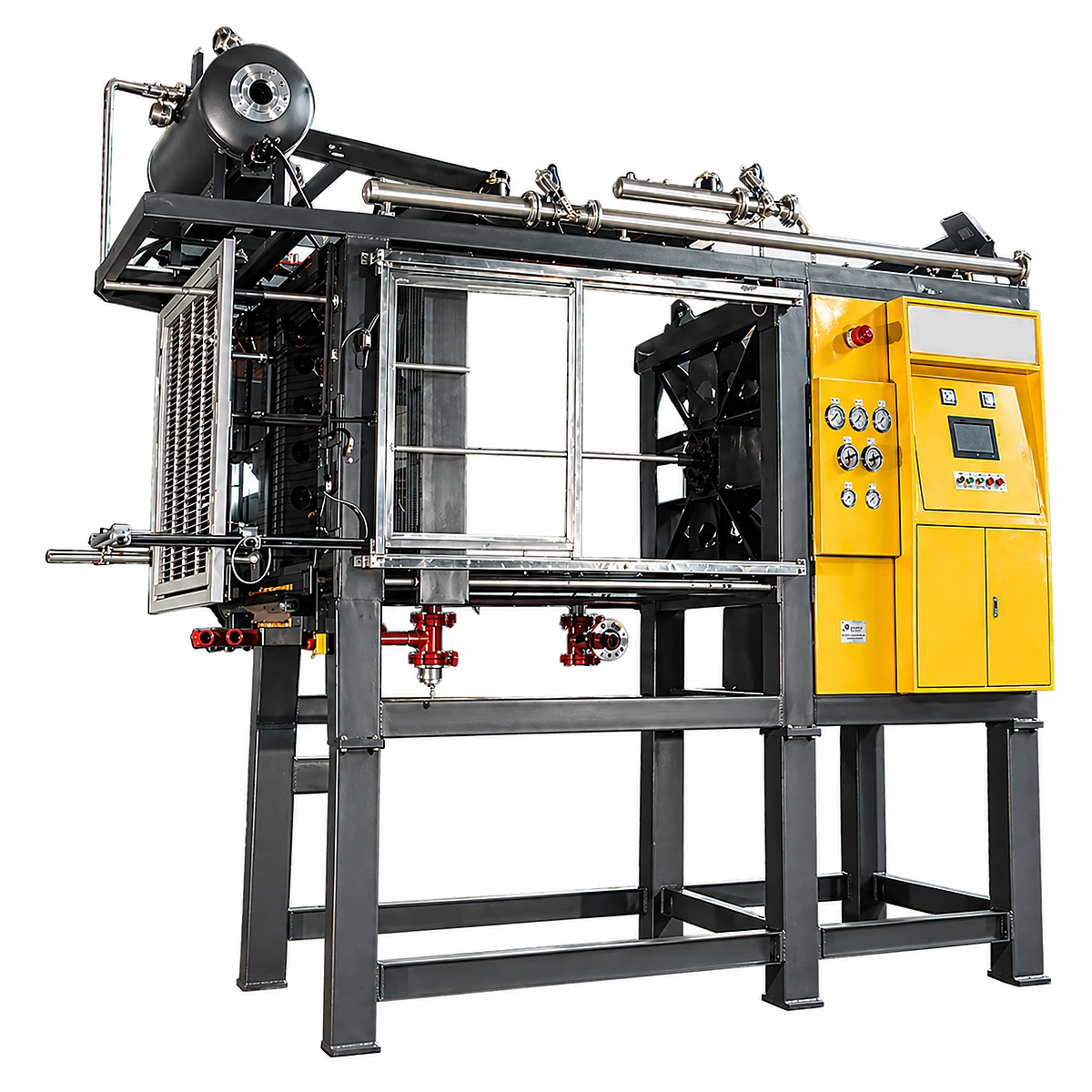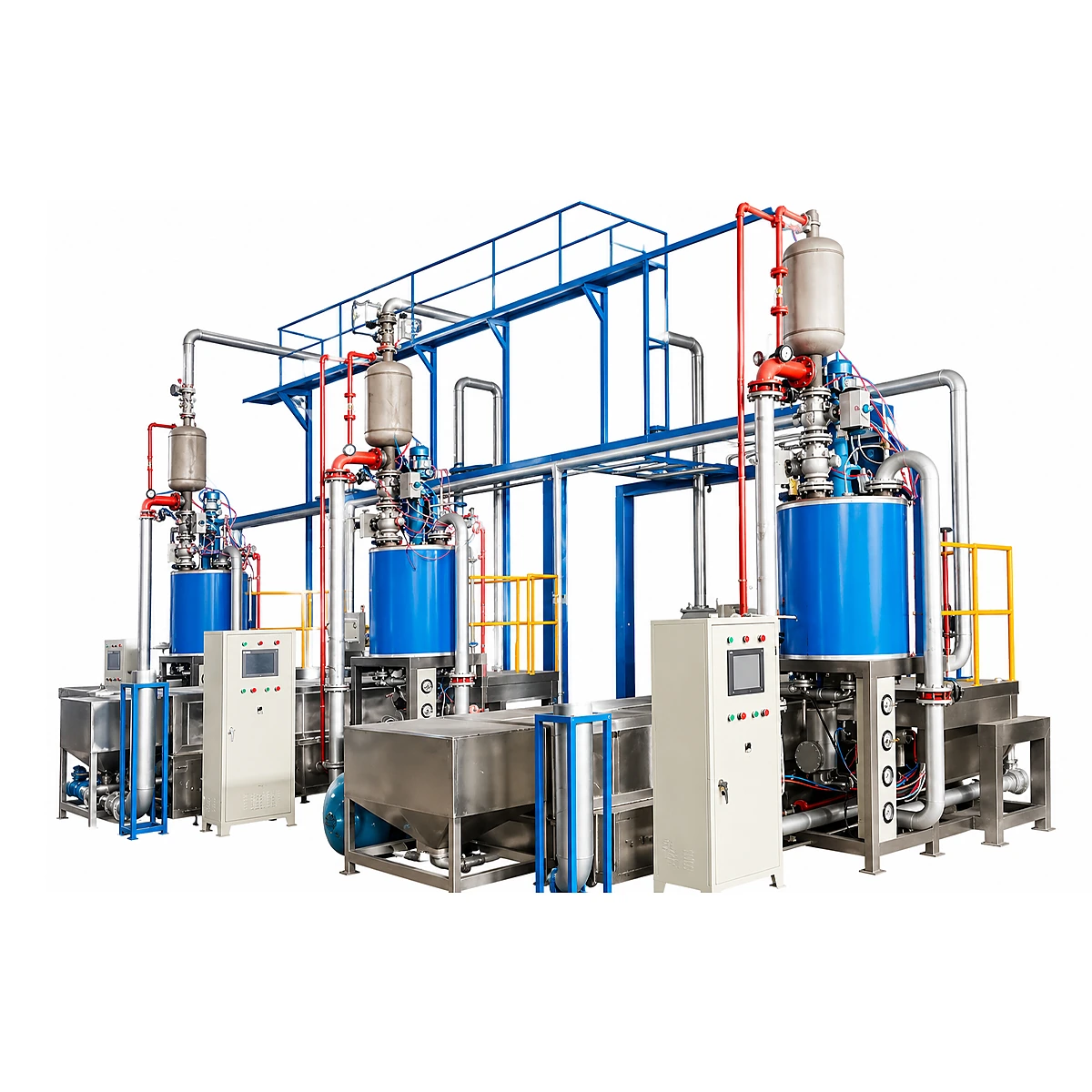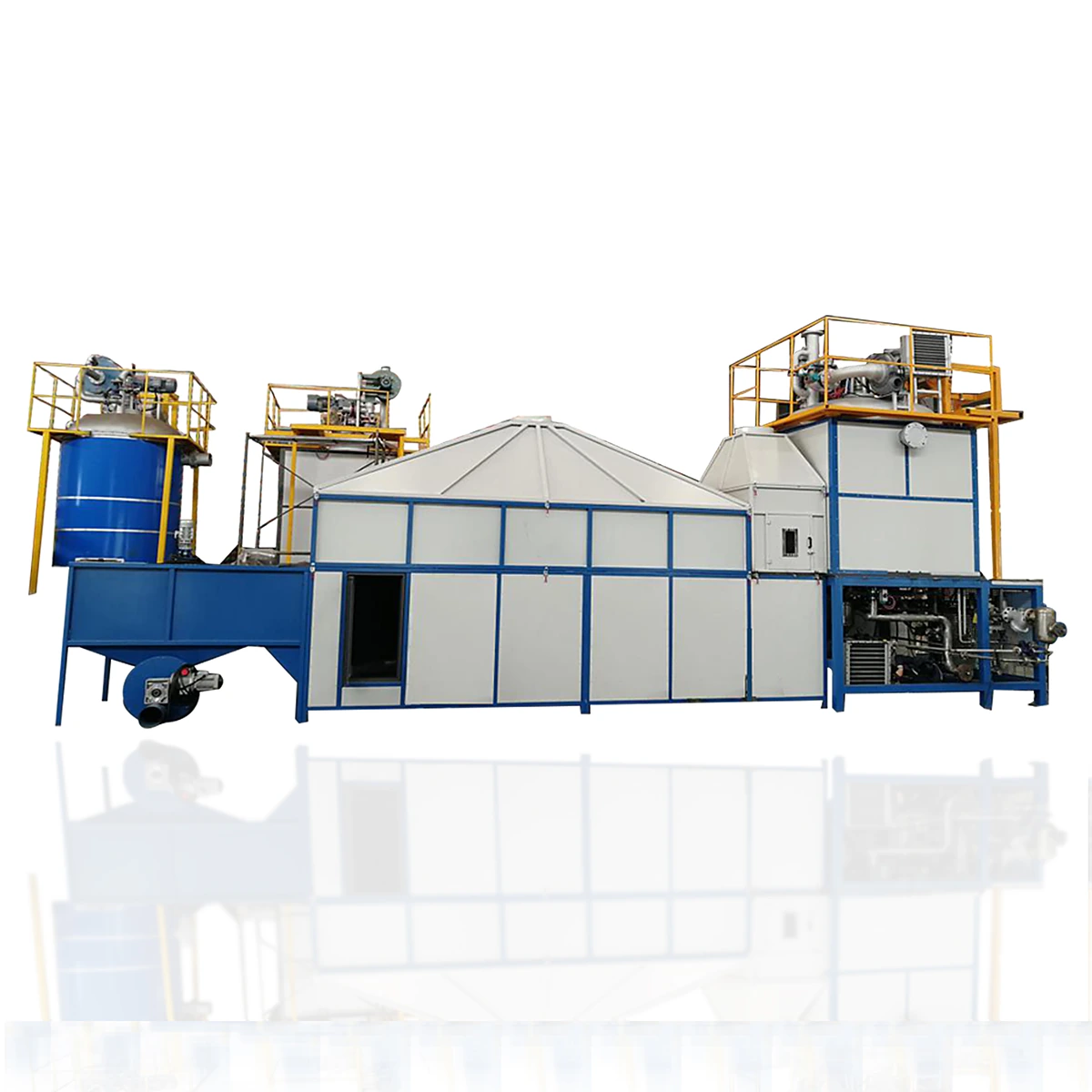

"Protective foam packaging machine" is not one machine. Four unrelated equipment families are quoted under the phrase: molded foam machines, foam-in-place dispensers, foam converting equipment, and foam sheet extrusion lines. They share no tooling, no utilities and no cost structure, so a quotation from each is not a comparison. Three inputs decide which family you are actually shopping for, and all three come from your product rather than from any machine catalogue: what you are protecting, how many units and how many SKUs you ship a year, and whether the packaging comes back to you. This guide works through the four families, then goes deep on the one where the word "protective" changes the machine specification most — molded foam — because that is where buyers most often order a commodity machine and then discover it cannot hold the density their customer's drop test requires.
1. "Protective" Is a Performance Word, Not a Material Word
The most expensive mistake on this search term is not choosing the wrong material. It is assuming that a machine which makes foam packaging automatically makes protective foam packaging.
Take molded foam as the example, because the two products come off machines that look identical on a showroom floor. A fish box and an electronics insert are both steam-molded expanded polystyrene. But a fish box is molded at 14–25 kg/m³ with thin walls, and a cushioning insert for an appliance or a piece of medical equipment is molded at 30–50 kg/m³ with walls of 10–50 mm. That density difference is what produces compression strength — roughly 100 kPa at 30 kg/m³ and roughly 200 kPa at 50 kg/m³ — and compression strength is what survives the drop test.
Fusing that much bead mass through that much wall thickness is a different duty cycle, and it shows up in the machine specification:
| Specification | Commodity molded foam (box, tray) | Protective molded foam (cushioning insert) |
|---|---|---|
| Molding density | 14–25 kg/m³ | 30–50 kg/m³ |
| Compression strength delivered | Not the design driver | ~100 kPa at 30 kg/m³, ~200 kPa at 50 kg/m³ |
| Wall section | Thin | 10–50 mm |
| Steam chest rating | 0.4–0.6 MPa standard | 0.7–0.9 MPa reinforced |
| Clamping duty | Standard | Heavy-duty for thick sections |
| Cooling after mold | Standard cycle | Extended 5–10 minutes before stacking |
| Bead aging before molding | Shorter | 24–48 h across 6–8 silos, lot-coded |
| In-process QC | Visual and dimensional | In-line compression test at >100 kPa at 10% strain |
A machine built to the left-hand column will physically produce a part from the right-hand column. It will just produce it inconsistently, and the inconsistency lands on the day your customer runs their incoming test. Read the steam chest rating on any quotation before the price.
2. The Three Inputs That Decide the Route
Before comparing machines, fix these three. They are the only inputs that change the answer, and none of them is a machine parameter.
Input one: what you are protecting. Not the weight alone — the weight together with how fragile it is. A 40 kg washing machine that tolerates a firm landing and a 4 kg optical instrument that does not are opposite problems. The fragile item needs a cushion that yields at a controlled rate; the heavy item needs one that does not bottom out. This is what sets your density target, and the density target is what rules machine families in and out.
Input two: annual volume and SKU count, in that order. Molded foam requires a mold per part. One mold serving high volume amortises well; twenty molds serving twenty low-volume SKUs usually does not. This single ratio is what separates buyers who should mold from buyers who should dispense or cut.
Input three: whether the pack comes back. Most buyers never ask this, and it is the input that most changes the machine. If packaging is one-way — it ships and it is discarded or recycled at destination — you are optimising cost per part. If packaging cycles in a closed loop between your plant and an assembly line, you are optimising cost per trip, and a material that survives one impact is the wrong material. Section 5 works this through.
| Your situation | Route that usually fits |
|---|---|
| Few SKUs, high annual volume, one-way packaging | Molded foam — EPS |
| Few SKUs, closed-loop returnable packaging | Molded foam — EPP |
| Many SKUs, low volume each, frequent design changes | Foam-in-place dispensing, or converting |
| Prototype or short-run, geometry still changing | Converting — no tooling to commit |
| Surface protection, void fill, light goods | Foam sheet or wrap |
| You already buy molded inserts and want to make them yourself | Molded foam — this is the common case behind this search |
3. The Four Machine Families
Each of these is legitimately called a protective foam packaging machine by the companies that sell it. They are not competitors in the ordinary sense — most buyers are only a real candidate for one.
| Molded foam | Foam-in-place | Converting | Sheet / wrap | |
|---|---|---|---|---|
| Material in | EPS or EPP beads | Two-component liquid chemistry | Foam sheet, bun or block | Resin pellets |
| Part out | Finished insert, moulded to shape | Foam cushion formed in the carton | Insert cut from stock foam | Roll or bag stock |
| Tooling | A mold per part | None | Cutting program, no hard tooling | Die per profile |
| Economics improve with | Volume per SKU | SKU variety | Short runs and design churn | Continuous throughput |
| Weakest at | Many low-volume SKUs | Cost per part at volume | Cost per part at volume | Shaped, load-bearing protection |
| Do we build it | Yes — core business | No | Partly — for EPS block, not for PE/PU stock | No |
Two notes on the honest boundaries of that last row, because they save you a wasted enquiry.
Foam-in-place dispenses two liquid components that react and expand inside the shipping carton around the product. There is no mold and no bead. It is a genuinely good answer for a plant shipping many different shapes in small numbers, and it is a chemical dispensing system rather than a steam molding machine. We do not build them, and if that is your profile you should be talking to a foam-in-place supplier rather than to us.
Converting means cutting an insert out of foam you already have, with no tooling to commit — the fastest route when geometry is still changing. Our involvement here is specifically EPS: we build the block molders that produce the block and the cutting lines, including CNC contour cutting, that shape it. Converting from polyethylene or polyurethane bun stock is a different equipment set that we do not supply. The block-plus-cutting route for packaging is covered in our EPS block molding for packaging guide, and the cutting equipment itself in the cutting machine guide.
4. Route One in Detail: What a Molded Protective Foam Machine Must Be Rated For
If sections 2 and 3 put you in molded foam, this is the specification to hold a quotation against. A protective line is a chain — pre-expander, aging silos, molder, molds, utilities — and the density set at the first stage is the one the drop test measures at the last.
The reference machine in our range for cushioning work is the SM-1200 shape molding machine:
| Parameter | SM-1200 |
|---|---|
| Mold platen (L x W) | 1,200 x 1,000 mm |
| Max product size | Up to 1,150 x 950 x 350 mm, mold-dependent |
| Density range | 15–50 kg/m³ |
| Steam supply pressure (tank) | 0.4–0.8 MPa, safety-relieved |
| Molding chamber pressure | 0.08–0.12 MPa, closed-loop PLC at the mold jets |
| Clamping force | 25 tons hydraulic |
| Steam consumption | 8–15 kg per cycle, by product mass |
| Cooling | Vacuum plus water spray, vacuum tank built in |
| Weight variance under closed-loop control | Within ±5 g |
| Mold change, quick-insert swap | About 45 minutes, same format |
| Mold change, full platen and piping | 4–6 hours, different format |
| Installed power | 25 kW, 380V / 50Hz |
| Certifications | CE, ISO 9001 |
Three lines in that table decide protective work specifically.
Density range is the qualifying spec. A machine capped below 30 kg/m³ cannot reach the compression strength band that cushioning uses, whatever else it does well. Confirm the top of the range in writing, not the middle.
Weight variance is a proxy for repeatability. Compression strength tracks density, and density tracks how much bead mass ends up in the cavity. A line holding part weight within ±5 g is holding density; a line run on operator feel makes parts that pass on Monday and fail on Friday. This is why the closed-loop pressure regulation matters more on protective parts than on boxes.
Cycle time is quoted against a stated condition, so read the condition. Two published figures apply here and they are not interchangeable: our cushioning line configuration runs a 60–100 second cycle at 30–50 kg/m³, while the SM-1200 specification quotes 120–150 seconds for complex thick-section parts in the same density band. The variable is section thickness and geometry, not marketing. Ask any supplier which condition their number refers to, and never accept the empty-machine figure — the SM-1200 runs 30–45 seconds with no product in it, and that number is a machine timing baseline that should never be used for capacity planning.
Around the molder, the parts of the line that a "complete line" quotation most often thins out: a pre-expander that can hold the high end of the density band, aging silos with enough separation to keep buyer recipes apart, and the cooling capacity for thick walls. The full 20-machine configuration, with output ranging from 3,000 to 15,000 inserts per day depending on how many molders you install, is laid out on the EPS packaging production line page. Silo sizing is worked through separately in our silo storage guide, and general machine selection in the shape molding machine buyer's guide.
5. EPS or EPP: Decided by Whether the Pack Comes Back
Within molded foam there is one more fork, and input three from section 2 settles it.
EPS is rigid and it protects by crushing. The cell walls fracture, absorb the energy, and stay crushed. For a one-way pack that is exactly right and it is the cheapest way to deliver the protection. For a pack that ships twice it is wrong, because the cushion that protected the first trip is already spent.
EPP is resilient. Its polypropylene cell walls flex instead of fracturing, so the part recovers its shape and protects again. Our published material comparison puts EPP recovery above 95% and useful life at 50–100+ cycles, with the cost-per-use crossover against EPS typically arriving somewhere around 15–20 trips — EPP parts cost several times more to produce, so below that crossover EPS wins on economics and above it EPP wins decisively. The full property-by-property comparison is in EPS vs EPP: differences and applications, and density selection in the EPP foam density guide.
The machine consequence is real, and it is the part buyers discover late: EPP is not a bead you load into an EPS line. It needs a secondary foaming stage, and that stage runs at higher steam pressure than anything on an EPS line.
| EPS route | EPP route | |
|---|---|---|
| Protection behaviour | Crushes once | Recovers, multi-impact |
| Packaging model it suits | One-way | Closed-loop returnable |
| Expansion equipment | SPJY-1400 pre-expander | SPEPP-2F secondary foaming machine |
| Steam pressure at that stage | 0.18–0.25 MPa | 0.5–0.8 MPa |
| Density range at that stage | 8–45 kg/m³ across the batch range | 15–90 kg/m³ |
| Batch cycle at that stage | Minutes, model-dependent | 6–10 minutes per batch |
| Typical protective end use | Appliance, electronics, medical, cold chain inserts | Automotive component dunnage, reusable transit crates, medical device and high-value electronics |
Read the steam pressure row twice if you are budgeting a line that might carry EPP later. Adding EPP to an EPS plant is not a bead change; it is a machine.
6. The Qualification Evidence Your Customer Will Ask For
Protective packaging is one of the few packaging categories where the buyer tests the product on arrival. Electronics, appliance, automotive and medical accounts run a sample against a drop-test protocol — ISTA 3A and ASTM D5276 are the designations you will see most often — and a single failed sample can reject a full shipment, with the cost landing on the packaging supplier rather than the brand.
That makes the test capability part of the machine decision, not a downstream afterthought. What a protective line needs to produce alongside the parts:
- Compression evidence per batch, not per year. An in-line compression tester verifying above 100 kPa at 10% strain during production is the practical implementation. The underlying method for rigid cellular plastics is ASTM D1621, which is the standard your customer's lab will cite when they disagree with your number.
- Material conformity. For expanded polystyrene the reference specification is ASTM C578. If your route is instead flexible polyethylene foam — section 3, route four — the applicable family is ASTM D3575, and the two are not interchangeable in a specification document.
- Lot traceability from bead to part. Bead lot coded into a silo, silo tied to a batch, batch tied to a shipment. When a part fails at a customer, this is the difference between quarantining one pallet and quarantining a quarter's production.
- Recipe control, not operator memory. A plant serving several industrial accounts runs a different density, cycle and steam time for each. A PLC recipe library holds them; paper does not. Recipes kept on paper are a leading source of scrapped batches.
- Dimensions measured after cooling, not at the mold. Walls of 10–50 mm keep moving for hours after demolding. Parts that measure correctly at the machine can fail the buyer's incoming check two days later, which is why extended cooling of 5–10 minutes before stacking is a specification and not a courtesy.
Defect diagnosis — fusion, shrinkage, surface — is covered separately in our EPS quality control and defects guide.
7. Utilities: The Line Item Most Often Thinned Out of a Quotation
High-density molding uses more steam per cycle than commodity molding, for the straightforward reason that there is more bead mass to fuse. On a three-molder cushioning line the demand works out at roughly 560–870 kg/h of steam once pipeline loss is counted, which points at a 1–1.5 T/h boiler; compressed air lands around 2.8–4.8 m³/min, driven mostly by heavy clamping.
Two things follow. First, confirm in writing whether boiler, steam piping and air compressor are inside or outside a quoted line price — this is the most common silent exclusion in a "turnkey" number, and it is not a small one. Second, steam is where the running cost of a foam plant concentrates for the life of the machine, which makes boiler efficiency and pipeline insulation an operating decision rather than a commissioning detail. The US Department of Energy's steam system resources are a reasonable external benchmark for what a well-specified plant should be losing, and we work the numbers through for foam specifically in our steam energy cost analysis.
8. What to Put in Your Enquiry
Most of the confusion on this term disappears if the first message answers these seven points. Without them, a supplier is guessing which of the four families you meant.
| State this | Why it changes the quotation |
|---|---|
| What you are protecting, with weight and a note on fragility | Sets the density target, which rules whole machine families in or out |
| Annual volume and number of SKUs | The ratio that decides molding against dispensing or converting |
| Whether packaging is one-way or returns to you | Decides EPS against EPP, and therefore which expansion machine belongs in the scope |
| The drop-test protocol your customer applies, if you know it | Determines whether compression testing and a test lab belong in the line |
| Whether you have steam, or none | Boiler and steam piping are the items most often silently excluded from a line price |
| Voltage and frequency | 380V / 50Hz is standard; other configurations are a build change, not a shipping change |
| Destination market and required conformity marking | Sets the safety and documentation package that travels with the machine |
One check worth running on whoever replies: ask which model or series their certificates name. Conformity marking and ISO 9001 certification are issued with a defined scope, and a certificate covering one machine series does not cover another. Read the PDF and match the model to your order — and apply that check to us as readily as to anyone else. Broader supplier vetting for machinery bought from China is in our 8-question buying guide.
9. Where ChinaEps Sits
Eps Industry Engineering Co., Ltd manufactures EPS and EPP processing equipment across sites in Jiangyin, Wenzhou and Dongguan totalling more than 10,000 m², with equipment exported to over 60 countries. Since this article is about telling four machine families apart, here is our own scope in the same terms:
- Molded foam is our core manufacturing. Pre-expanders, EPP secondary foaming, aging silos, shape molders, block molders, cutting lines including CNC contour cutting, material handling, recycling equipment and mold tooling.
- Converting we cover only on the EPS side — the block molders and cutting lines that produce and shape EPS block. Converting polyethylene or polyurethane bun stock is a different equipment set and we do not supply it.
- Foam-in-place dispensing and foam sheet extrusion we do not build at all. If section 2 put you in one of those, a quotation from us would waste your time.
- What we will say at enquiry stage: if you ship twenty low-volume SKUs whose geometry changes every season, molding is probably the wrong answer for you and we will say so rather than quote twenty molds. The mold count is where this decision goes wrong most often, and it goes wrong in the supplier's favour, which is exactly why it is worth asking about directly.
On safety: machine guarding and interlocks are not optional extras on steam equipment and belong in your acceptance criteria whoever supplies the machine. OSHA's machine guarding standards are a workable common reference even outside the United States, because they describe the hazard rather than one jurisdiction's paperwork.
Frequently Asked Questions
What is a protective foam packaging machine?
The phrase covers four unrelated equipment families: molded foam machines that steam-mold EPS or EPP beads into shaped inserts, foam-in-place systems that dispense two liquid components into the carton around the product, converting equipment that cuts inserts out of stock foam, and sheet or wrap extrusion lines. They share no tooling and no utilities. Establish which family is meant before comparing any quotations, because a quotation from each is not a comparison.
How is a protective foam machine different from an ordinary foam packaging machine?
In molded foam, the difference is the density band and everything that supports it. Commodity boxes mold at 14–25 kg/m³; cushioning inserts mold at 30–50 kg/m³ with 10–50 mm walls, which needs a reinforced steam chest at 0.7–0.9 MPa against a standard 0.4–0.6 MPa, heavy-duty clamping, extended cooling of 5–10 minutes and in-line compression verification. A commodity machine will make the part; it will not make it repeatably.
What density does protective foam packaging need?
Cushioning inserts are typically molded at 30–50 kg/m³, which delivers roughly 100 kPa compression at 30 kg/m³ and roughly 200 kPa at 50 kg/m³. The correct point inside that band comes from your product's weight and fragility, not from a catalogue. Whatever you choose, confirm the top of the supplier's stated density range in writing — a machine capped below 30 kg/m³ cannot reach the cushioning band at all.
Should I choose EPS or EPP for protective packaging?
Ask whether the packaging comes back. EPS protects by crushing and stays crushed, which is correct and cheapest for one-way packaging. EPP recovers its shape and protects repeatedly, with published recovery above 95% and useful life of 50–100+ cycles, so it suits closed-loop returnable systems; the cost-per-use crossover typically arrives somewhere around 15–20 trips. Note that EPP is a machine decision, not a bead swap — it requires a secondary foaming stage running at 0.5–0.8 MPa against 0.18–0.25 MPa on an EPS pre-expander.
When is molding the wrong answer?
When your SKU count is high and your volume per SKU is low, or when geometry is still changing. Molded foam needs a mold per part, so the economics depend on volume per SKU rather than total volume. A plant shipping many different shapes in small numbers is usually better served by foam-in-place dispensing or by converting, neither of which commits tooling.
Do I need a drop-test lab to supply protective packaging?
Not necessarily on day one, but you need evidence your parts hold their specification. The practical minimum is in-line compression verification above 100 kPa at 10% strain plus lot traceability from bead to shipment; the method behind the compression number is ASTM D1621. An on-site drop-test lab makes sense once you are supplying accounts that test every batch, because it moves the failure from after the container ships to before it loads.
What cycle time should I expect from a protective foam molding machine?
Read the condition attached to the number. Our cushioning line configuration runs 60–100 seconds at 30–50 kg/m³, while the SM-1200 specification quotes 120–150 seconds for complex thick-section parts in the same density band — section thickness and geometry are the variable. Never plan capacity on an empty-machine figure; the SM-1200 runs 30–45 seconds with no product in it, and that is a machine timing baseline only.
Is the boiler included when I buy a protective foam packaging line?
Often not, and it is the most common silent exclusion. A three-molder cushioning line needs roughly 560–870 kg/h of steam once pipeline loss is counted, pointing at a 1–1.5 T/h boiler, plus about 2.8–4.8 m³/min of compressed air. Ask explicitly whether boiler, steam piping and compressor are inside or outside the quoted price, and get the answer in the contract rather than in an email.
Can one machine make both fish boxes and protective inserts?
Within limits, yes — the SM-1200 covers 15–50 kg/m³, which spans both, and mold changeover is about 45 minutes for a same-format quick-insert swap or 4–6 hours when the platen and steam piping have to be reconfigured. The constraint is not the machine range but the changeover time against your production schedule. A plant switching daily between a 16 kg/m³ box and a 45 kg/m³ insert should model that changeover honestly before assuming one machine covers both.
What is the most common sourcing mistake on this search term?
Comparing quotations from two different machine families as though they were competing offers for the same thing. A foam-in-place system and a molding line answer different questions, and whichever is cheaper on paper is not therefore the better fit. Fix the three inputs first — what you protect, volume against SKU count, and whether the pack returns — then request quotations only from the family those inputs point to.
--- ## 评审说明(不发布,仅供人工审阅) ### 1. 规则 6 检查:为什么判定"值得新写"(与本簇 08-04 那份"不新写"结论不矛盾) 同一天我给 `eps packaging molding machine` 出的是**不新写**的补充建议稿。这次判**写**,两者的分界线只有一条:**买家在搜索词里有没有把材料定死**。 | | `eps packaging molding machine`(08-04,判不写) | `protective foam packaging machine`(本簇,判写) | |---|---|---| | 材料 | 买家已经选定 EPS | 只说 foam,材料未定 | | 落点 | `/en/solutions/industrial-cushioning-packaging-line/` 逐项对得上 | 该页**从第一句就预设 EPS**,材料未定的买家读不到自己的问题 | | 站内空地 | 无 —— 四个页把四种意图占满 | 有 —— 见下表 | 站内实查(grep 全 `src/`): | 可能覆盖本词的页 | 覆盖什么 | 为什么不算覆盖本词 | |---|---|---| | `/en/solutions/industrial-cushioning-packaging-line/` | EPS 高密度防护整线,标题里已含 "Protective Inserts" | **整页预设 EPS**。它回答"EPS 防护整线怎么配",不回答"我该不该用 molded foam" | | `/en/products/sm-1200-shape-molding-machine/` | 单机成交 | 机器级,不做工艺路线分诊 | | `/en/blog/eps-shape-molding-machine-buyers-guide/` | 成型机选型 pillar | 同样预设 EPS | | `/en/blog/eps-vs-epp-differences-applications/` | EPS/EPP 材料对比 | **材料**对比,不是**机器族**对比;且不含 foam-in-place / converting / sheet | | `/en/blog/epe-vs-eps-foam-sheet-guide/` | EPE/EPS 板材对比 | 同上 | **关键 grep 证据**:全站 `src/` 搜 `foam-in-place` / `foam in place` / `Instapak` / `foam-in-bag` / `die-cut` —— **命中 0**。整站唯一 "contour cutting" 出现在 `products.ts:149`(SPQ-CNC 切 EPS 块)。也就是说,四大机器族里我们**只讲了一族半**,另外两族半在站内是彻底空白。搜 "protective foam packaging machine" 的人有相当比例落在那两族半里,站内没有任何一页能接住他们、也没有任何一页能诚实地把他们送走。 **互抢风险评估**:本文**不争** `eps packaging production line` / `eps packaging molding machine` 两个词(它们仍归承接页),正文对这两个意图一律用出链把权重导向承接页与 SM-1200 产品页。本文认领的是**材料未定阶段**的上游词。GSC 实查佐证见下节。 ### 2. GSC 实测(本次自己拉的,`gsc_search_performance` chinaeps.net,2026-07-07 → 08-04,query 维度 limit=100) - 返回 100 行合计 **302 曝光 / 4 点击 / 均位 19.9** - **没有任何一条 query 含 "protective"** - 最接近的三条边缘信号:`cushioning system`(1 曝光 / 位 **99**)、`automated molded fiber cushioning line`(2 曝光 / 位 **47**)、`0.5t weight medium box filler`(8 曝光 / 位 3.9) **读法**:`automated molded fiber cushioning line` 这条特别有意思 —— molded fiber 是 molded foam 的**替代工艺**,Google 已经把本站放进"cushioning 品类"的候选集,但排在 47 位。说明品类相关性有了、**品类页缺位**。这正是本文要补的位置。 ⚠️ **口径提醒(沿用 08-04 那份稿子的更正)**:上面 302 曝光是 `limit=100` 返回行的合计,**不是全站真实总量**(GSC 隐藏长尾匿名 query)。不要拿它跟 page 维度的数字直接比。同时,`2026-08-03-eps-shape-molding-machine-manufacturer.md` 那份草稿声称 sm-1200 产品页近 28 天 227 曝光 —— 与本次 query 维度 302 的口径不同,两者不能互证也不能互驳,**那条待核项仍然挂着**。 ### 3. 全文数字出处(逐条可核,无一处编造) | 数字 / 说法 | 出处 | |---|---| | 防护件密度 30-50 kg/m³ / ~100 kPa@30 / ~200 kPa@50 / 壁厚 10-50 mm / 加强蒸汽室 0.7-0.9 MPa vs 常规 0.4-0.6 / 循环 60-100s / 熟化 24-48h 6-8 silo / 延长冷却 5-10 min / 在线压缩 >100 kPa@10% strain / 3,000-15,000 件每天 / 三机线蒸汽 560-870 kg/h / 锅炉 1-1.5 T/h / 压空 2.8-4.8 m³/min / 配方库 / lot 追溯 | `src/data/solutions-deep-dive.ts:1425-1600`(`industrial-cushioning-packaging-line` 的 answerCapsule / customerProblem / ourSolution / equipmentShowcase / productionFlow / utilityConsumption),逐项照抄 | | 商品级鱼箱密度 14-25 kg/m³ / 循环 60-90s | `sm-1200-shape-molding-machine.yaml:29` | | SM-1200 全部规格(平台 / 最大件 / 密度 15-50 / 罐压 0.4-0.8 / 腔压 0.08-0.12 / 合模 25t / 每循环蒸汽 8-15kg / 真空+水喷冷却 / ±5g / 换模 45min 与 4-6h / 25kW / 380V-50Hz / CE+ISO9001 / 空循环 30-45s / 厚件 120-150s) | `sm-1200-shape-molding-machine.yaml:24-46`,逐格照抄 | | SPEPP-2F EPP 二次发泡(蒸汽 0.5-0.8 MPa、密度 15-90 kg/m³、批次 6-10 min、明确对比 EPS 预发机 0.18-0.25 MPa)+ 可回收周转箱应用 | `spepp-2f-epp-secondary-foaming-machine.yaml:30-33 / 41 / 50` | | EPS 预发机密度 8-45 kg/m³(batch 全系)/ 蒸汽 0.18-0.25 MPa | `products-deep-dive.ts` spjy-1400 modelVariants(与 08-04 beads 稿同源) | | EPP 恢复率 >95% / 50-100+ 次循环 / 15-20 次成本交叉点 / EPP 生产成本 3-5× | `src/content/blog/eps-vs-epp-differences-applications.md:189 / 211 / 231 / 298`(**站内已上线**内容,本文以内链引用而非新造) | | 江阴 / 温州 / 东莞 3 地、10,000+ m² | `clients/chinaeps/CLAUDE.md` | | 出口 60+ 国 | `sm-1200-shape-molding-machine.yaml` 等多处站内既有表述 | **刻意没写的:** - ❌ **任何价格数字。** CLAUDE.md v10.4 决策表第 ① 类(钱 / 定价)必须运营人员拍板;且站内博客正文的价格已被有意撤过一轮。本文改用**可溯源的非价格量级**(密度 / 压力 / 循环 / 蒸汽量 / SKU-量比)表达经济性分岔,不需要价格也能把决策讲清楚。EPP 的 "3-5×" 是站内已上线的相对倍数,不是绝对价格。 - ❌ **任何客户案例 / 客户评价 / quote**(门禁 #19)。第 9 节只写自家范围与"我们会劝退你"的话,没有编任何客户故事。 - ❌ **任何 aggregateRating / testimonials 占位**(门禁 #19) - ❌ **foam-in-place 的任何设备参数**。站内零数据,写了就是编造。第 3 节只做**定性**描述 + 明确说"我们不造"。这同时守住 `feedback_chinaeps_eps_not_pu`(PU 主题归 machinepu)——本文没有出现任何 PU 机型、没有链 machinepu、没有把 PU 当卖点,只把它当**劝退分支**。 - ❌ **EPE 片材挤出线的任何参数**。同理,站内零数据。 - ❌ 排名 / 询盘预测(CLAUDE.md 禁无数据支撑的预测) - ❌ **全文无 emoji**(`feedback_no_emoji_on_websites`) - ❌ 没链 `/en/blog/how-to-choose-eps-pre-expander/` —— 该页正文重复内容且 GSC 判 `Crawled - currently not indexed`(08-03 草稿已记)。预发机链接一律指产品页。 ### 4. authorUrl 与任务指令冲突(按仓库现状执行,同 08-04 beads 稿) 任务要求 `authorUrl` 填 LinkedIn 个人页。**本仓库刻意不这么做**:`src/data/authors.ts:6-7` 注释写明 "No external LinkedIn — E-E-A-T is carried by named person + role + expertise + on-site bio + company affiliation",且 memory 有全局禁规 `feedback_no_linkedin_dependency`。 故本稿 `authorUrl: /en/about/`,作者 **Mae Xu(Mold Design & Application Engineer)**。门禁 #17 的实质要求(真名、非集体名、Person schema + jobTitle + knowsAbout)满足,LinkedIn 那一条按站内规则豁免。**要改这条全局规则属于"建立未来规则"级决策,需运营人员点头。** ⚠️ 顺带一条**已上线数据错误**(不属本簇,建议单开修):`eps-vs-epp-differences-applications.md:7-8` 与 `eps-shape-molding-machine-buyers-guide.md:7-8` 的 `authorTitle` 写的是公司名 `Eps Industry Engineering Co., Ltd.`、`authorBio` 写的是公司简介,**而不是 Mae Xu 本人的职务与简介**(authors.ts 里有正确版本)。这正是门禁 #17 要防的"集体名冒充真人"形态,只是藏在 authorTitle/authorBio 而非 author 字段里。`epe-vs-eps-foam-sheet-guide.md:8` 是写对的,可作修复参照。 ### 5. 权威外链 6 条,全部是仓库内已在用的 URL(门禁 #18 要求 ≥2) | URL | 用途 | 仓库内使用次数(grep 实测) | |---|---|---| | `astm.org/d1621-16.html` | ASTM D1621 硬质泡沫压缩性能 —— 撑 ">100 kPa @10% strain" | 4 | | `astm.org/c0578-22.html` | ASTM C578 硬质发泡聚苯乙烯标准 | 17 | | `astm.org/d3575-14.html` | ASTM D3575 柔性烯烃类泡沫 —— 撑路线四 PE/EPE 分支 | 4 | | `energy.gov/eere/amo/steam-systems` | 蒸汽系统能效基准 | 3 | | `osha.gov/machine-guarding` | 机械防护 | 5 | | `iso.org/iso-9001-quality-management.html` | 认证范围说明 | 10 | **没有凭印象贴新 URL。** 六条全部 grep 确认站内已在使用。 ⚠️ **ISTA 3A / ASTM D5276 本文只作为标准代号出现在正文里,没有做成超链接** —— 因为这两条 URL **在本仓库内不存在**(grep 确认),我不打算凭印象拼一个 astm.org/ista.org 的路径。承接页 `solutions-deep-dive.ts:1445 / 1463` 现在也是纯文字引用同样两个代号,本文与之一致。**若审核认为必须超链,请先人工 curl 验证真实 URL 再加**,别直接用 08-04 那份草稿里提议的两条(那两条是提案,未经验证)。 ### 6. 站内内链 12 条,全部指向真实存在的页(已逐条对 `src/content/blog/` 与 `src/content/products/` 核过文件名) `/en/solutions/industrial-cushioning-packaging-line/` · `/en/products/sm-1200-shape-molding-machine/` · `/en/products/spepp-2f-epp-secondary-foaming-machine/` · `/en/products/spjy-1400-pre-expander/` · `/en/blog/eps-shape-molding-machine-buyers-guide/` · `/en/blog/eps-block-molding-machine-packaging-guide/` · `/en/blog/eps-cutting-machine-complete-guide/` · `/en/blog/eps-vs-epp-differences-applications/` · `/en/blog/epp-foam-density-guide/` · `/en/blog/eps-quality-control-defects-guide/` · `/en/blog/eps-silo-storage-system-complete-guide/` · `/en/blog/steam-energy-cost-eps-production-optimization/` · `/en/blog/eps-machine-buying-guide-china/` **内链设计意图**:本文是**上游路由型**内容。四大机器族里属于我们的那一族半,全部用出链导向既有承接页 / 产品页;不属于我们的两族半,只做文字劝退、不给任何外部出链。净效果是给 `industrial-cushioning-packaging-line` 增加一条主题相关的入链,而不是跟它抢词。 ### 7. 一处站内数据打架(本文已按"两个条件都如实写出"处理,但建议单独收敛) - `solutions-deep-dive.ts:1439 / 1479`:防护整线循环 **60-100 秒**,密度 30-50 kg/m³ - `sm-1200-shape-molding-machine.yaml:30`:**120-150 秒**(complex / 厚件),密度 **同样是 30-50 kg/m³** 两处都带条件(前者按整线配置、后者按厚件复杂件),不算硬矛盾,但**同一密度带给出两个差 2 倍的循环时间**,买家会当成前后不一。本文第 4 节和 FAQ 里把两个数字**连同各自条件一起写出来**,并说明变量是断面厚度与几何 —— 这是目前唯一诚实的写法。**建议单开一条:定一个单一口径(例如按壁厚分档给循环时间表),两处同步。** ### 8. 发布前必做(本稿未做,属发布环节) 1. **封面图**:`/images/blog-covers/protective-foam-packaging-machine-density-window.webp` 是占位路径,**必须落真图**才能过门禁 #4。`public/images/blog-covers/` 现有 8 张,无此文件。建议拍"同机出的低密度鱼箱壁 vs 高密度厚壁内衬"同框对比图,正好是全文论点。禁库存图。 2. **6 语种正文**:frontmatter 已给 7 语种 titles/descriptions,但门禁 #4 要求各语种 body ≥ 500 字符,只有骨架不算。ru/ar 需母语校对。 3. **templateType 排期(门禁 #21)**:本稿取 `listicle`。选它有两个理由 —— 一是 08 月草稿批里 `pillar`(2) / `how-to`(4) / `X-vs-Y`(3) 都已撞,`listicle` 是 14 天窗口内唯一没用过的可用类型;二是本文骨架确实是枚举式(三输入 / 四机器族 / 七项询盘清单),不是硬套。**但要说清楚**:门禁 #21 防的是"同骨架连发",`listicle` 这个标签本身挡不住这件事 —— 本文与 08-04 beads 稿都带"一个词对应 N 台机器"的分诊成分,**两篇不要连着发**,中间至少隔一篇别的结构。本文与 beads 稿的实质差别在组织轴:beads 稿按**机器分类**展开,本文按**买家的三个输入**展开、机器族是输入的结果。 4. **节奏熔断(门禁 #22)**:单站 ≤ 3 篇/周、≤ 8 篇/月。`blog/drafts/` 里 08 月草稿存量已远超月上限,**发布顺序必须人工挑,不能全发**。若只能挑少数几篇,本篇的理由是它是**唯一一篇打材料未定阶段**的稿子,其余多数在互相分同一批 EPS 设备词。 5. `pre-deploy-quality-check.sh` 7 道门禁 + `pre-deploy-fingerprint-guard.sh`,rsync **必带 `-c`**(memory 硬规则 `feedback_rsync_must_checksum`),部署后跑 `每日代码同步审计.sh`。 6. 发布 +14 天跑一次 `gsc_cannibalisation`,重点看本文与 `industrial-cushioning-packaging-line` 有没有意外互争。 ### 9. 队列回填 `clients/chinaeps/软文计划/2026-08.md` L62(`protective foam packaging machine`)行尾已追加本草稿相对路径,`[ ]` **保持未勾**(勾 `[x]` = 已上线,由人来做)。本簇只有主词一个(辅助词与主词同名),无其他行需回填。 PLAN_OK clients/chinaeps/blog/drafts/2026-08-04-protective-foam-packaging-machine.md