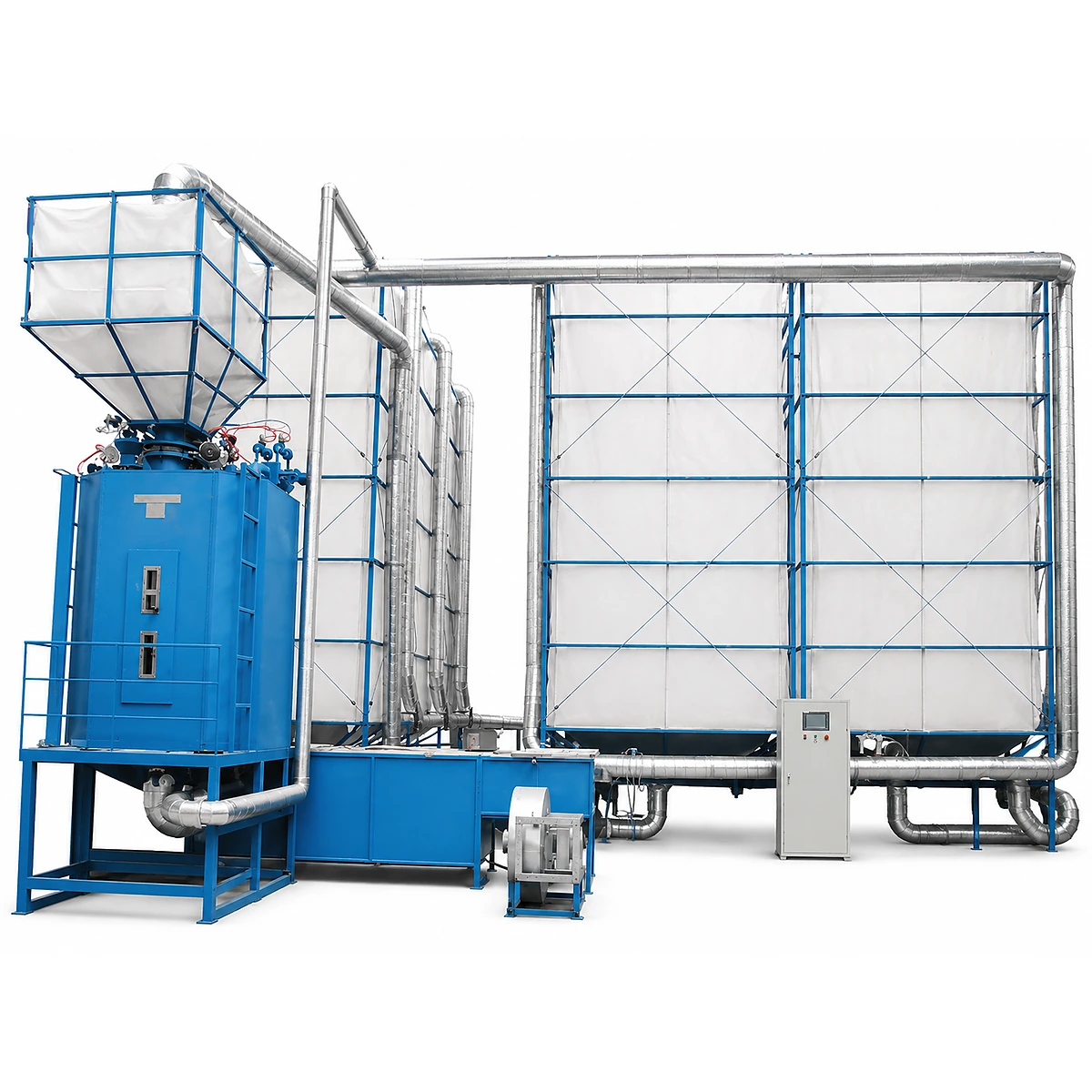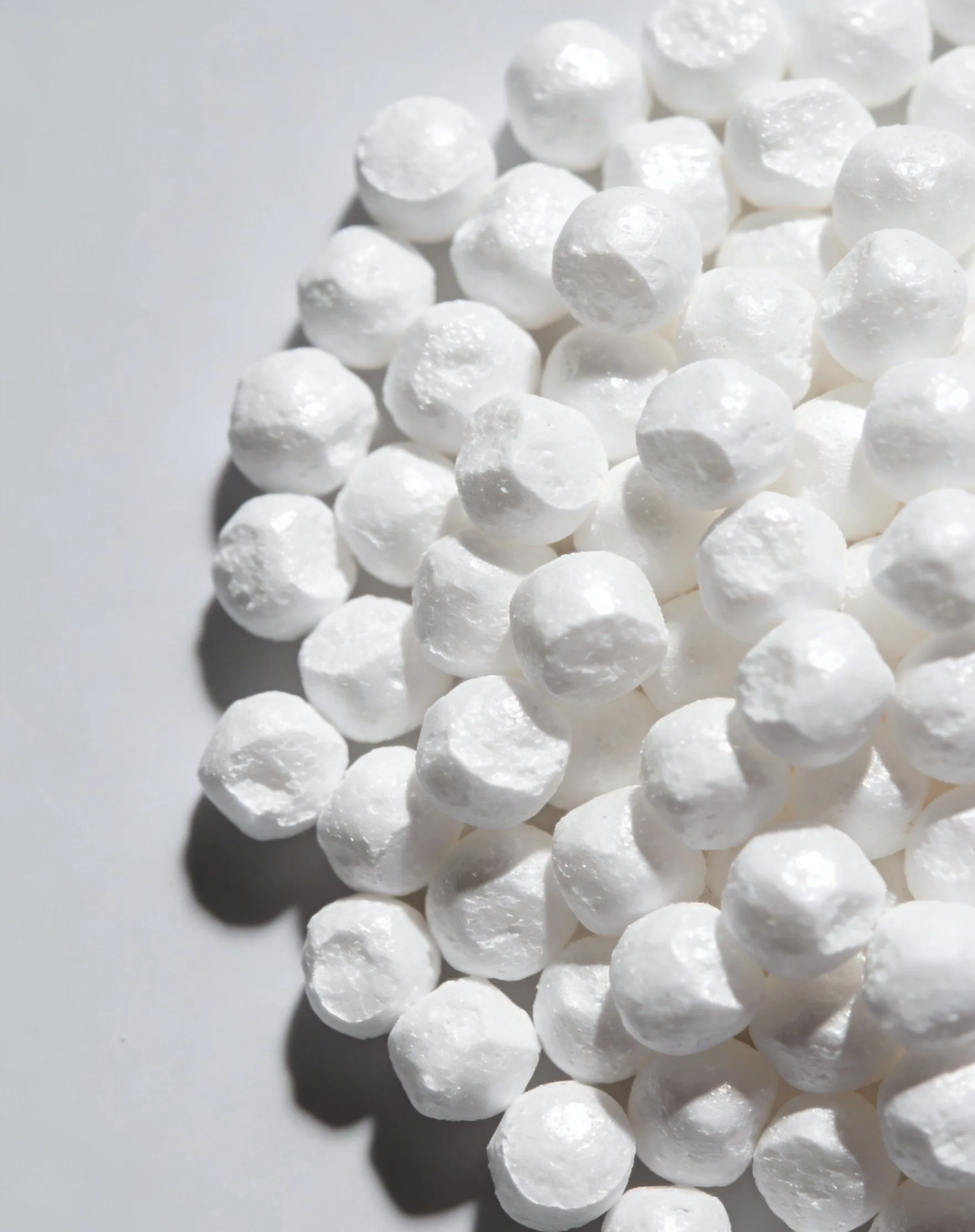
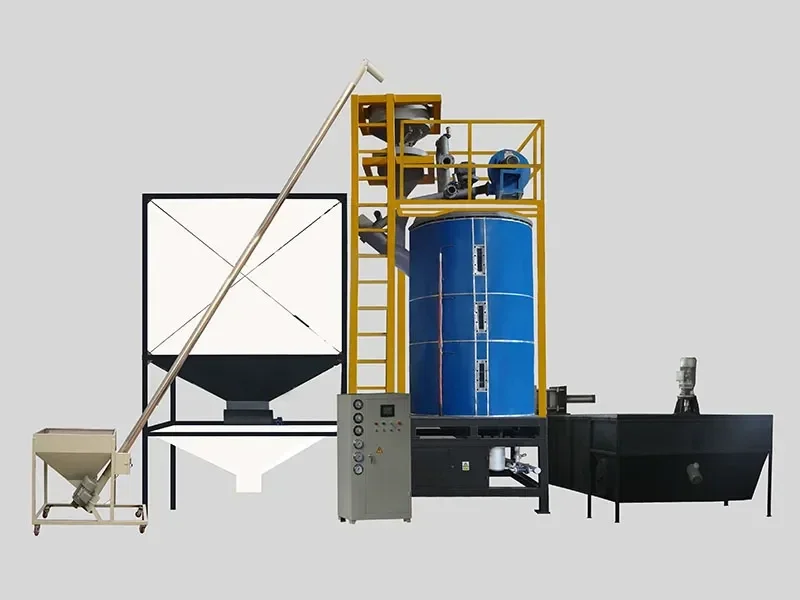
The pre-expander you need is decided by the densities you will sell, not by the tonnage on a brochure. A fish box plant running 18–22 kg/m³ all day, a packaging plant molding 35 kg/m³ inserts and a board plant switching between 12, 15 and 20 kg/m³ grades in one shift each ask something different of the same machine: how far every bead must expand, how long a batch takes, how much steam it draws and how tightly each batch lands on target. Settle the density question first and the model choice usually follows from it. Below is the method we use when a customer sends us a product list instead of a machine name, with the arithmetic shown so you can run it on your own numbers.
1. Why target density comes before the machine model
Expandable polystyrene arrives as a resin bead with a bulk density of roughly 600–650 kg/m³. To make 15 kg/m³ foam, the pre-expander has to grow that bead about 40 times in volume. At 8 kg/m³ the ratio is close to 80; at 30 kg/m³ it is only about 21. Every other number on the pre-expander follows from that ratio. The six-stage EPS process shows where pre-expansion sits in the line; here we stay inside the machine.
- Cycle time. On our PE-1400, an 8–12 kg/m³ recipe runs 5–6 minutes per batch and a 25–30 kg/m³ recipe runs 3–4 minutes. Low density buys more steam dwell for every kilogram.
- Hourly output. A batch vessel is filled by volume, so the same barrel discharges fewer kilograms per batch at low density and takes longer to do it. The 700–900 kg/h rating on a PE-1400 spans its density band; the bottom of that range belongs to the low-density recipes.
- Steam. Our published figure for batch pre-expansion is 15–25 kg of steam per cubic metre of expanded beads. A tonne of 10 kg/m³ beads is 100 m³, so it takes 1.5–2.5 tonnes of steam; a tonne at 25 kg/m³ is 40 m³ and takes 0.6–1.0 tonne. Halving the density more than doubles the steam per tonne of resin.
- Precision. Variance is quoted in kg/m³, so the same ±0.5 kg/m³ is a 6% error at 8 kg/m³ and a 1.4% error at 35 kg/m³. Low-density products are where a manual-sampling machine costs the most.
- Silo volume. Aging silos store beads by volume, so those same 100 m³ versus 40 m³ per tonne decide how many silos you build. Our aging silo sizing guide works that through.
That is why we ask for the product list first. A machine sized on tonnage alone is usually the wrong size in one direction or the other once the density mix is known.
2. What each density band asks of the pre-expander
The bands below use the products our customers actually run. Expansion ratios assume a 630 kg/m³ raw bead; your supplier's data sheet will move them a few percent either way.
| Target density | Expansion ratio (630 kg/m³ bead) | Typical products | What it demands from the machine |
|---|---|---|---|
| 8–12 kg/m³ | 50–80× | Void-fill and single-use shipping foam, lightweight fill blocks | Second-pass expansion below about 10 kg/m³, closed-loop steam control, dryer capacity for wet, fragile beads, roughly twice the silo volume of a 20 kg/m³ product |
| 12–18 kg/m³ | 35–50× | EIFS and roof insulation board, fruit trays (14–18), ultra-light insulated boxes (12–18) | The highest-tonnage band in most plants: batch-to-batch variance of ±0.5 kg/m³ or better, stored recipes, enough expansion hours per day |
| 16–22 kg/m³ | 28–40× | Standard fish boxes and cooler boxes | Per-batch density verification, because box weight is the customer's acceptance test; 4–5 minute cycles |
| 20–30 kg/m³ | 21–32× | High-strength export fish boxes, sandwich panel core, ICF forms | Steam pressure headroom (0.18–0.23 MPa on the PE-1400), shorter cycles, the upper limit of the PE-1400 recipe range |
| 30–45 kg/m³ | 14–21× | Electronics and appliance inserts (30–50), geofoam grades up to EPS46, flame-retardant and graphite board | Small-bead raw material grades, 0.20–0.25 MPa multi-zone steam control, PE-1600 to 35 kg/m³ or PE-1800 to 45 kg/m³, ATEX option for graphite dust |
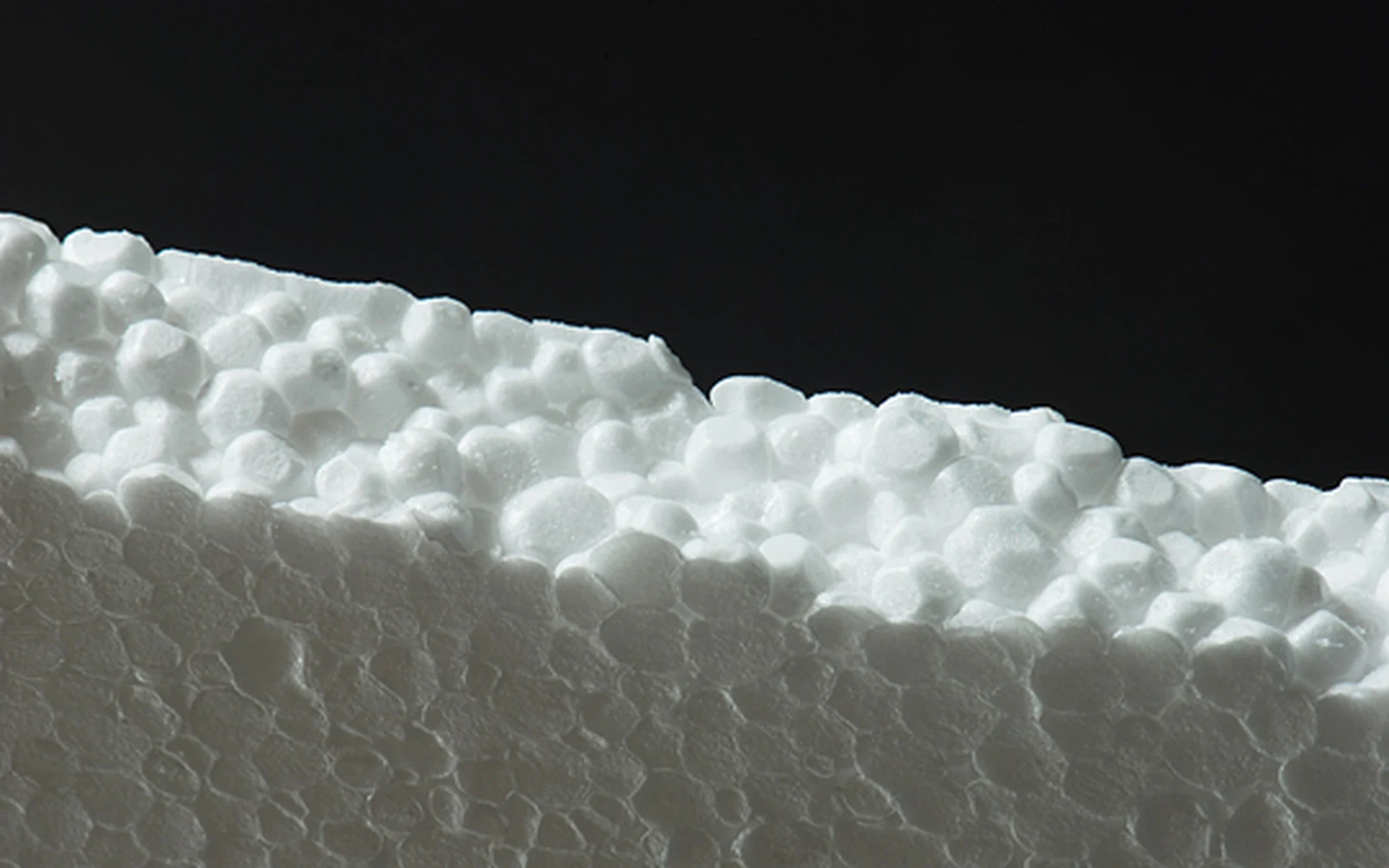
Below 12 kg/m³: the machine is working against the material
Growing a bead 60–80 times leaves a cell wall so thin that a few extra seconds of steam collapse it. Most plants therefore stop the first pass at 10–14 kg/m³, age the beads for the usual 6–24 hours so air diffuses back into the cells, then run a second, shorter expansion pass down to the final density. Two things follow. The pre-expander must return to recipe conditions quickly for the second pass, and a manual-sampling unit rated ±1.0 kg/m³ is a 10% error on a 10 kg/m³ product. Bead grade matters as much as the machine: high-expansion EPS grades are formulated for this band and standard grades are not.
12–25 kg/m³: where the tonnage is
Insulation board, fish boxes, fruit trays and most packaging block stock live here, and this is the band a batch pre-expander is designed around: 4–6 minute cycles on the PE-1400, the full 700–900 kg/h rating and the tightest variance. The selection question in this band is rarely capacity. A board plant making 150 m³ a day at 15 kg/m³ needs about 2.3 tonnes of bead, which a PE-1400 expands in a little over three hours. What you are paying for is how many grades the machine holds as stored recipes and how fast it moves between them: the PE-1400 changes from a 12 kg/m³ to a 25 kg/m³ recipe in under a minute, against 15–20 minutes of manual valve and timer adjustment on an older machine. If the plant will run one density for 20 hours a day, the batch versus continuous comparison is the next thing to read; below that duty cycle it is not.
Above 30 kg/m³: steam control and bead size take over
High-density inserts, ICF, geofoam and flame-retardant board use small-bead grades so that thin walls and sharp corners fill cleanly. Small beads heat through fast, so the window between under-expanded and over-expanded is narrower and pressure regulation has to be tighter, which is why our PE-1600 and PE-1800 run 0.20–0.25 MPa multi-zone control against 0.18–0.23 MPa on the PE-1400. The PE-1400 recipe range stops at 30 kg/m³; the PE-1600 reaches 35 and the PE-1800 reaches 45 kg/m³ with ±0.3 kg/m³ variance. Graphite EPS adds a dust-ignition risk in the heating zone, which is what the ATEX option on the PE-1800 addresses. For geofoam, the ASTM D6817 types run from EPS12 to EPS46 by nominal density, so a geofoam line needs the whole range covered rather than one point on it.
3. The precision arithmetic: what ±0.5 kg/m³ is worth
Every EPS product has a minimum density it must not fall below: a fish box has a weight spec, an insulation board has a compressive strength class under ASTM C578 or EN 13163. Because you cannot ship under-weight product, you set the pre-expander above the minimum by the machine's variance. The resin you buy to cover that margin is the real cost of a loose machine.
| Batch-to-batch variance | Setpoint for a 20 kg/m³ minimum | Extra resin on every part | Machine class |
|---|---|---|---|
| ±0.3 kg/m³ | 20.3 kg/m³ | +1.5% | PE-1800, automatic density controller |
| ±0.5 kg/m³ | 20.5 kg/m³ | +2.5% | PE-1400 / PE-1600, PLC closed-loop |
| ±1.0 kg/m³ | 21.0 kg/m³ | +5.0% | PE-1200, manual sampling |
| ±2.0 kg/m³ | 22.0 kg/m³ | +10% | Older manual-sampling machines |
For a plant expanding 2,000 kg of bead a day over 300 days, the gap between ±0.5 and ±2.0 kg/m³ is 7.5% of 600 tonnes: 45 tonnes of resin a year bought only to cover machine scatter. Multiply that by your delivered resin price and set it against the price difference between the two machines. The same scatter surfaces after molding as fusion and dimensional rejects; our defects guide shows how to tell a pre-expander cause from a mold cause.
4. Sizing method: from daily product volume to pre-expander class
Start from what you sell rather than from the machine rating.
- Daily bead demand (kg/day) = daily product volume (m³) × target density (kg/m³) × (1 + scrap allowance). Do this per grade and add them up. A 5% scrap allowance is a reasonable starting assumption for a new line.
- Expansion hours = daily bead demand ÷ the pre-expander's realistic hourly rate at your density. Use the bottom of the rated range for products under 15 kg/m³ and the top for products above 20 kg/m³.
- Grade count = the number of distinct densities per day. Each one needs its own stored recipe and its own silo group, because beads at different densities cannot share a silo.
- Density ceiling = the highest grade on the list. This, more than tonnage, is what usually moves a buyer from a PE-1400 to a PE-1600 or PE-1800.
Three illustrative scenarios follow, with every assumption shown. They are worked examples, not customer data.
| Illustrative scenario | Products and densities | Daily bead demand (5% scrap) | Expansion hours | What decides the choice |
|---|---|---|---|---|
| A. Insulation board plant | 150 m³/day across 12, 15 and 20 kg/m³ grades (average 15) | 2,360 kg | About 3.1 h on a PE-1400 at 750 kg/h | Three grades, so three recipes and three silo groups. ±0.5 kg/m³ matters because board is sold by strength class. Tonnage alone would have allowed a PE-1200 at ±1.0. |
| B. Fish box and fruit tray plant | 100 m³/day fish boxes at 20 kg/m³ + 40 m³/day fruit trays at 16 kg/m³ | 2,770 kg | About 3.5 h on a PE-1400 at 800 kg/h | Two densities switched daily: recipe changeover in under a minute and two silo groups. Both products sit inside the PE-1400's 8–30 kg/m³ range. |
| C. Packaging inserts and FR board | 40 m³/day inserts at 35 kg/m³ + 60 m³/day flame-retardant board at 30 kg/m³ | 3,360 kg | About 3.1 h on a PE-1600 at 1,100 kg/h, or 2.2 h on a PE-1800 | 35 kg/m³ is outside the PE-1400 recipe range. The PE-1600 reaches it at the top of its range; the PE-1800 covers it with margin, ±0.3 variance and the ATEX option if the board is a graphite grade. |
None of the three runs the pre-expander for more than four hours a day. Below roughly 300 m³/day of product the pre-expander is almost never the line bottleneck; the boiler and the molding machines are. That is the reason to choose on density range, variance and changeover, and to treat the kg/h rating as a check on the decision.
5. Which ChinaEps pre-expander for which density
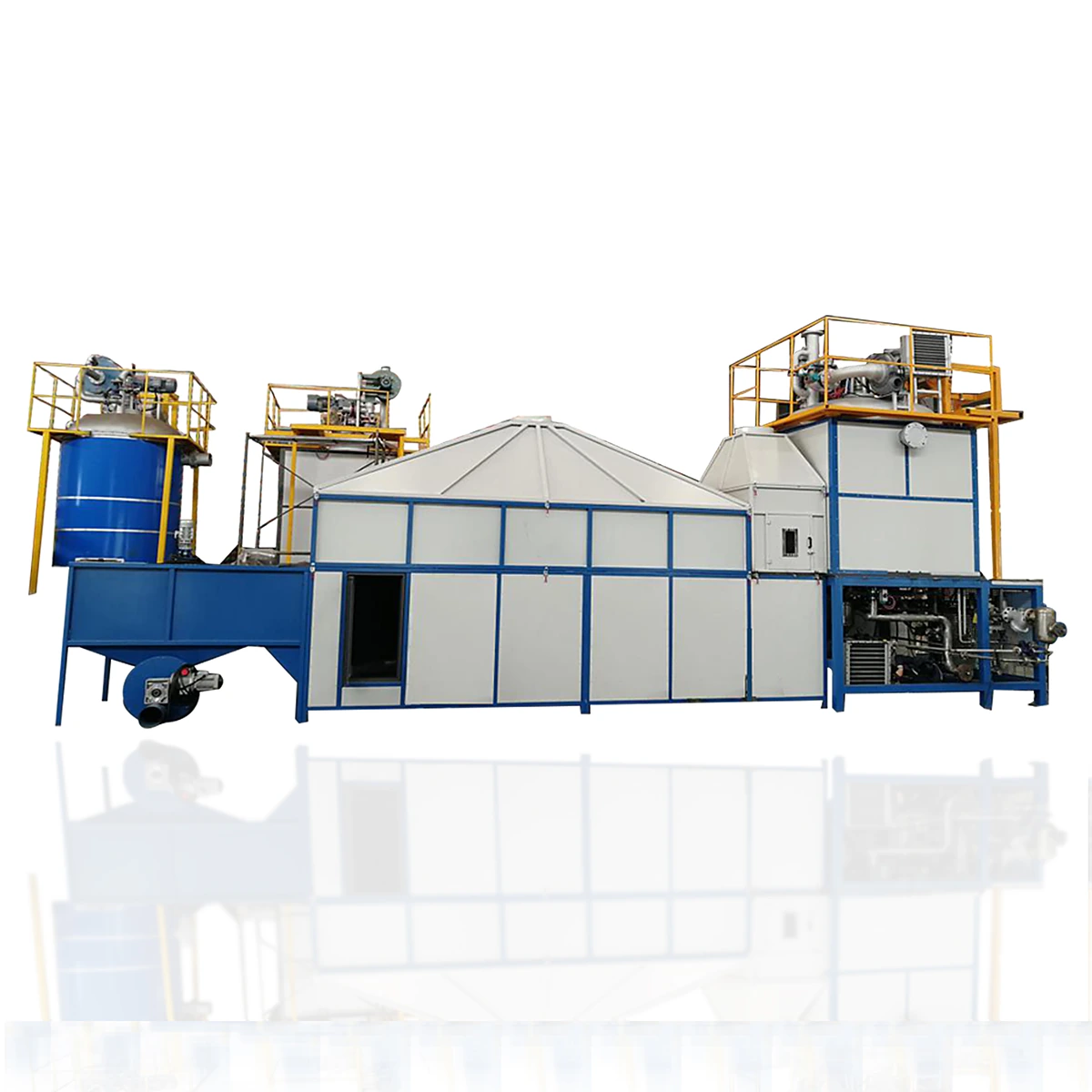
Our batch range runs from the PE-1200 to the PE-1800. All four share the bottom-driven agitator and Siemens PLC; they differ in barrel size, steam control and how density is verified. The full specification is on the PE-1400 pre-expander page, with the other three listed there for comparison. The pre-expander series is CE certified by SGS, and the certificate for the quoted model is available on request.
| Model | Recipe density range | Batch-to-batch variance | Rated output | Steam pressure | Best fit by density |
|---|---|---|---|---|---|
| PE-1200 | 12–40 kg/m³ | ±1.0 kg/m³ (manual sampling) | 500–700 kg/h | 0.15–0.22 MPa | Single-grade plants at 15–30 kg/m³ where a 5% resin margin is acceptable |
| PE-1400 | 8–30 kg/m³ | ±0.5 kg/m³ (PLC closed-loop) | 700–900 kg/h | 0.18–0.23 MPa | Multi-grade board, fish box, tray and packaging block plants up to 30 kg/m³ |
| PE-1600 | 8–35 kg/m³ | ±0.5 kg/m³ | 1,000–1,300 kg/h | 0.20–0.25 MPa | Larger plants, or a 30–35 kg/m³ grade on the list |
| PE-1800 | 8–45 kg/m³ | ±0.3 kg/m³ (automatic density controller) | 1,400–1,700 kg/h | 0.20–0.25 MPa, 8-port multi-zone | High-density inserts, geofoam, flame-retardant and graphite grades; ATEX option |
Read the table from your product list downward:
- Every product between 12 and 30 kg/m³, one grade or several: PE-1400. The PE-1200 only wins on price if you run one grade and can carry the resin margin.
- Anything under 10 kg/m³ on the list: PE-1400 or PE-1800 with a second-pass procedure written into the commissioning plan, a high-expansion bead grade, and silo volume sized on the lightest product.
- Anything between 30 and 35 kg/m³: PE-1600, unless the same plant also needs the volume of a PE-1800.
- Anything above 35 kg/m³, or any graphite grade: PE-1800.
- One density for 20 hours a day: run the duty-cycle test in the batch versus continuous article before buying either type.
6. Five mistakes we see in pre-expander enquiries
- Sizing on the nameplate kg/h without a density. A rating of 700–900 kg/h measured at 25 kg/m³ does not deliver 900 kg/h at 10 kg/m³. Ask the supplier which density the rating was measured at.
- Buying for one grade and planning three. Construction markets routinely demand 15, 18, 20, 25 and 30 kg/m³ from the same board plant. If the second grade arrives in year two, the silo count and recipe capacity need to be in the machine from day one.
- Forgetting that low density fills silos. Moving a product from 20 to 12 kg/m³ is a 67% increase in bead volume for the same tonnage. Plants find this out when the second silo group has nowhere to go.
- Accepting a variance figure without asking how it is measured. ±0.5 kg/m³ from an automatic fixed-volume sampler and ±0.5 kg/m³ from an operator with a bucket and a scale are different claims. Ask to see the sampling method running on the machine during factory acceptance.
- Undersizing steam for the low-density cycles. A pre-expander that runs 3-minute batches at 25 kg/m³ draws its 80–100 kg of steam over 6 minutes at 10 kg/m³, which is easier on the boiler per minute and worse per tonne. Check the boiler against the lowest density you will run, not the average.
7. What to send us before asking for a quote
With these ten items we can recommend a model and a silo layout in one reply instead of three:
- Every target density you will run, in kg/m³, and the minimum acceptable density for each product.
- Product type for each density (board, fish box, tray, insert, geofoam) and which molding machine it feeds.
- Daily volume per grade in m³, or finished pieces and their weight.
- Shifts per day and working days per year.
- Raw material grade and supplier, or the bead size you plan to buy.
- Whether any grade is flame-retardant or graphite EPS.
- Steam pressure available at the machine, or boiler capacity if it is already installed.
- Number and volume of existing aging silos, if this is a replacement.
- Supply voltage and frequency.
- Whether the machine feeds one molding machine or several.
Frequently Asked Questions
What density can a batch EPS pre-expander reach in one pass?
Our PE-1400 recipes run from 8 to 30 kg/m³. In practice most plants take the first pass to 10–14 kg/m³ and use a second expansion pass after aging for anything below about 10 kg/m³, because a single over-long steam cycle collapses the thin cell walls of a very low-density bead.
Does a lower target density reduce the pre-expander's hourly output?
Yes. The vessel is filled by volume, so each batch holds fewer kilograms of bead at low density and needs a longer cycle: 5–6 minutes for 8–12 kg/m³ against 3–4 minutes for 25–30 kg/m³ on the PE-1400. Expect the low end of the 700–900 kg/h rating, or below it, on the lightest recipes.
Which pre-expander do I need for 35 kg/m³ packaging inserts?
A PE-1600, whose recipe range reaches 35 kg/m³, or a PE-1800, which reaches 45 kg/m³ with ±0.3 kg/m³ variance. The PE-1400 recipe range stops at 30 kg/m³. High-density inserts also need a small-bead raw material grade, so specify the bead together with the machine.
How much does density variance cost in raw material?
You set the pre-expander above the product's minimum density by the machine's variance. On a 20 kg/m³ minimum, ±0.5 kg/m³ costs 2.5% extra resin on every part and ±2.0 kg/m³ costs 10%. For a plant expanding 2,000 kg a day over 300 days, that gap is about 45 tonnes of resin a year.
Can one pre-expander run several densities in the same day?
A PLC batch machine can. The PE-1400 stores recipes on the HMI and moves from a 12 kg/m³ to a 25 kg/m³ setting in under a minute. What each extra density really costs is a separate aging silo group, because beads at different densities cannot be mixed in storage.
Do I need a different pre-expander for graphite or flame-retardant EPS?
Standard flame-retardant grades up to 30 kg/m³ run on the PE-1400. Flame-retardant and graphite grades at 30–45 kg/m³ call for the PE-1800: it has the steam capacity for the higher density and an ATEX option for the carbon dust that graphite beads shed in the heating zone.
Send us your densities and we will send back a configuration
Use the contact form to send three things: the target density of each product you will make, the product type, and the daily volume or hourly output you are planning. We will reply with the pre-expander model, the number of silo groups and the steam requirement for that mix, and we will say so if the arithmetic points to a smaller machine than you expected. The PE-1400 page lists all four batch models side by side; for a whole-line view, the insulation board line, fish box line and packaging insert line pages show which molding machine each density band feeds.