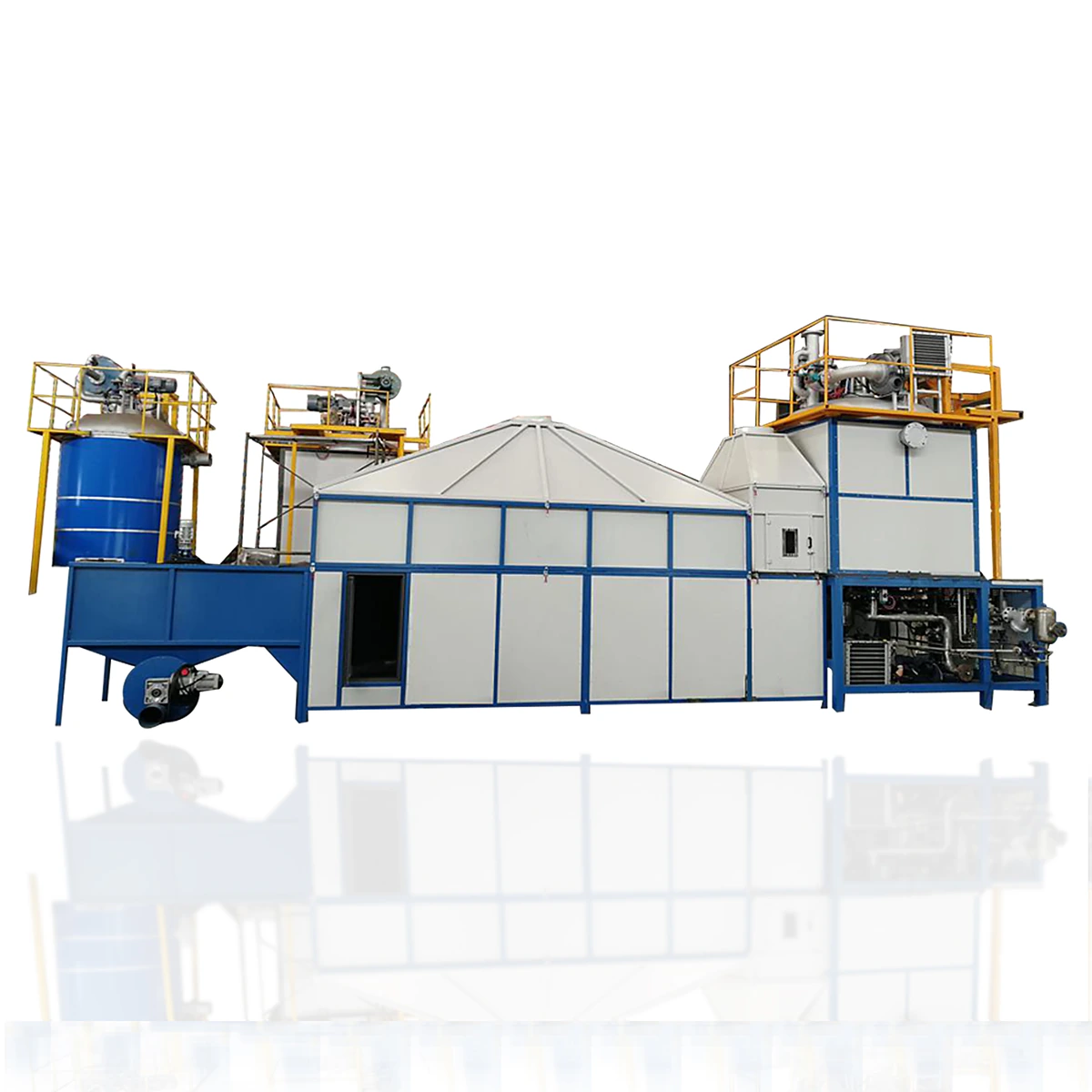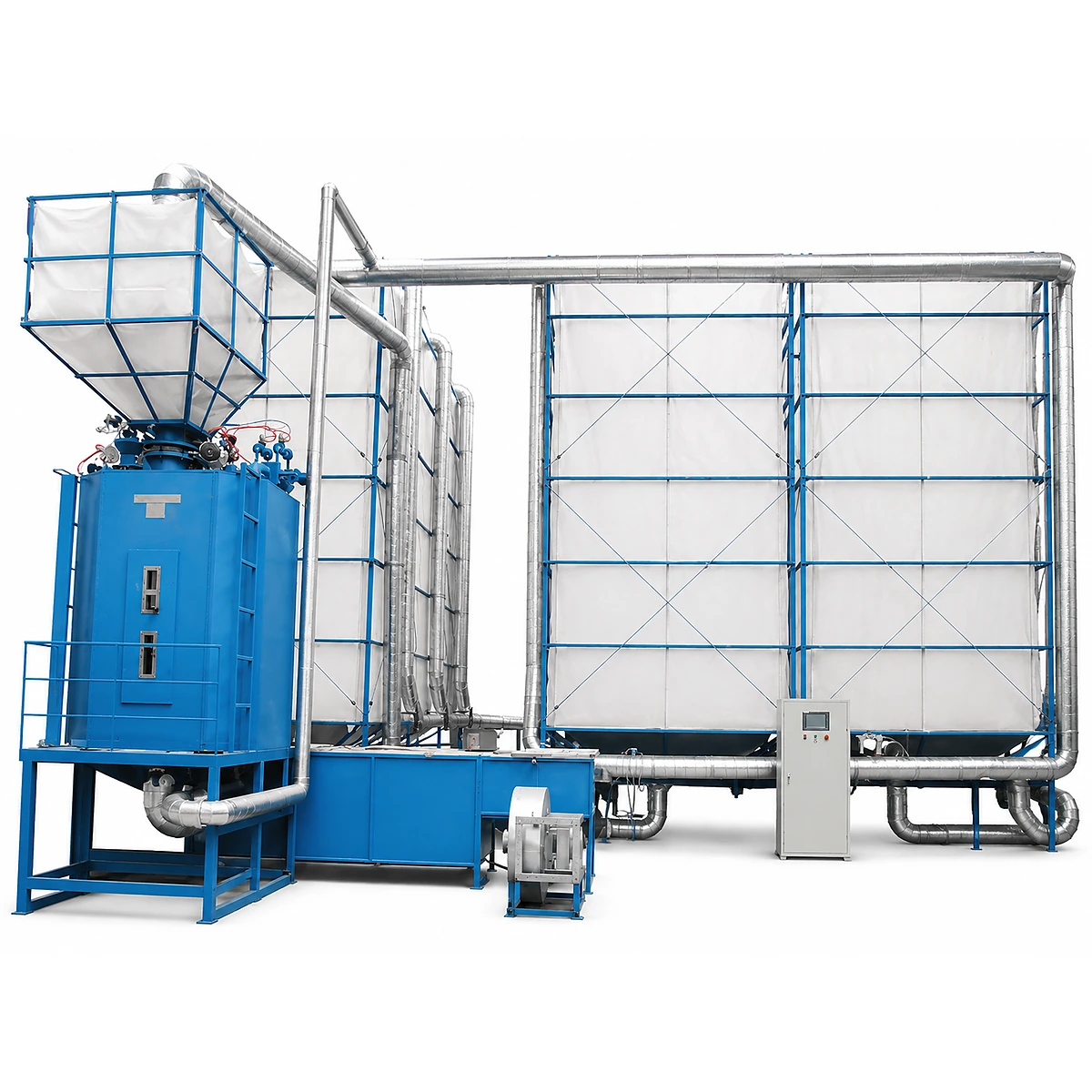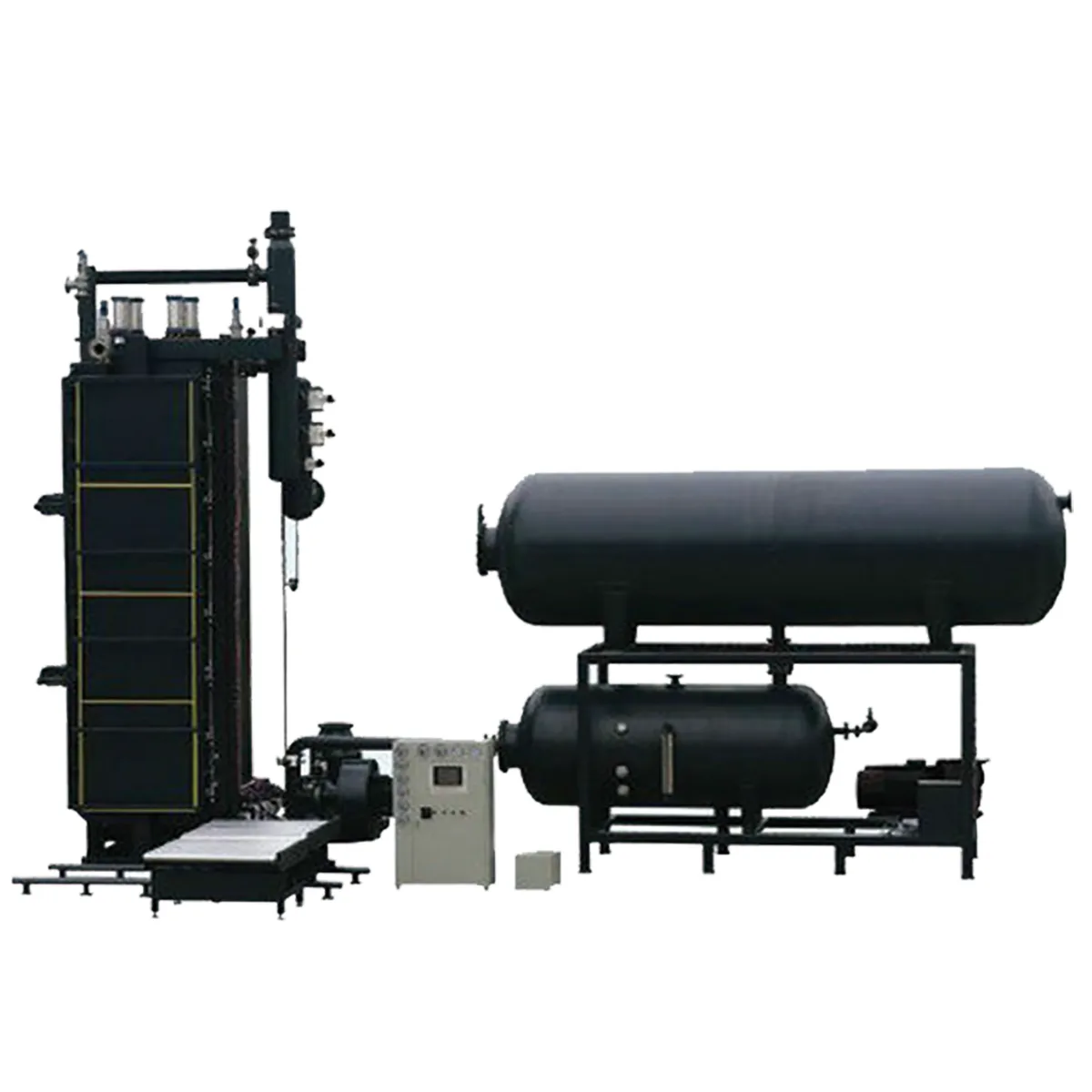
TL;DR: A continuous EPS pre-expander runs constant-feed instead of fixed cycles. Published industry figures put it at 30–50% higher throughput and 10–15% better steam efficiency than a batch unit. The common rule of thumb — "go continuous above 3,000 kg/day" — is the part worth questioning: a modern PLC batch machine rated 700–900 kg/h clears 3,000 kg in about 3.3–4.3 hours, so daily tonnage alone almost never justifies the switch. The real trigger is sustained duty cycle at a single density, not tonnage. This guide gives the arithmetic, the steam delta in kg rather than percentages, and a 5-point spec check to run against any supplier — including the questions that expose a continuous quote you don't need.
1. What "continuous" actually changes in the machine
Both machine types do the same job. Raw EPS beads containing pentane blowing agent meet saturated steam; the pentane vaporises and each bead expands 40–80 times its original volume. Target density is set by how much steam energy the beads absorb and for how long. Everything downstream — block density, fusion quality, reject rate — is decided here. The full EPS manufacturing process covers the stages either machine feeds into.
The difference is the feed regime:
- Batch. A fixed charge of beads is weighed in, expanded, discharged, and the chamber is reloaded. The machine heats up and cools down around every cycle. Density is verified per batch, which is why batch units are quoted with a batch-to-batch density variance figure.
- Continuous. Beads feed in and expanded beads discharge at the same time, with the chamber held at a steady operating temperature. There is no per-cycle reheat, which is where the steam advantage comes from.
That steady-state behaviour is the whole argument for continuous, and it is also the whole limitation: a machine optimised to hold one thermal equilibrium is at its best when you ask it to hold one setpoint for a long time.
2. The 3,000 kg/day rule, and why it misleads
The figure repeated across the industry — and in our own process guide — is that batch suits plants under 3,000 kg/day and continuous suits plants above it. Take that number and divide it by the rated capacity of current batch machines:
| Batch model | Rated capacity | Hours to produce 3,000 kg | Output in one 8-hour shift |
|---|---|---|---|
| PE-1200 | 500–700 kg/h | 4.3–6.0 h | 4,000–5,600 kg |
| PE-1400 | 700–900 kg/h | 3.3–4.3 h | 5,600–7,200 kg |
| PE-1600 | 1,000–1,300 kg/h | 2.3–3.0 h | 8,000–10,400 kg |
| PE-1800 | 1,400–1,700 kg/h | 1.8–2.1 h | 11,200–13,600 kg |
Capacities are the published ratings for our own batch range. Hours and shift output are straight division and multiplication at nameplate rate — they exclude changeovers, cleaning, maintenance and material handling stoppages, which in a real plant typically cost you a meaningful fraction of the shift.
Even the entry model clears 3,000 kg inside a single shift with hours to spare. The mid-range PE-1400 does it before lunch. A plant running two shifts on a PE-1400 has a nameplate ceiling somewhere around 11,200–14,400 kg/day.
The rule of thumb is not wrong so much as obsolete. It dates from a comparison against older batch machines with manual density sampling and long reheat times. Measured against a closed-loop PLC batch unit, 3,000 kg/day is not a ceiling — it is a few hours of running. If a supplier's case for a continuous machine rests on your daily tonnage alone, ask them to show the same division.
3. The real trigger: duty cycle, not tonnage
Continuous machines earn their premium through elapsed running hours, because the saving is per-hour-of-steady-state, not per-kilogram. That reframes the question from "how much do I make per day" to two harder ones:
- How many hours per day will the machine actually be expanding? Not how many hours the factory is open — how many hours this specific machine has beads moving through it. Below roughly two full shifts of genuine expansion time, the reheat losses a continuous unit avoids are simply not large enough to recover the capital difference.
- How many density setpoints does that time split across? A plant running 22 kg/m³ fish boxes all day is a different machine problem from one alternating between 12 kg/m³ packaging fill and 30 kg/m³ construction board.
A practical way to run the test on your own numbers: take last year's actual expanded-bead tonnage, divide by your real operating days, divide again by the rated capacity of the batch model you would otherwise buy. If the answer is under about 12–16 hours of expansion per day, the case for continuous rests on something other than throughput — and you should make the supplier name what that something is.
The honest counter-case: a plant genuinely running 20+ hours a day at one density is exactly where continuous belongs, and no amount of batch-machine arithmetic changes that. High-volume single-product operations — large insulation board plants, dedicated cold-chain box factories — are the real market for these machines.
4. Steam: the one hard number in continuous's favour
Batch pre-expanders consume roughly 15–25 kg of steam per cubic metre of expanded beads at final product density. Continuous units run about 10–15% better, because holding a steady operating temperature avoids reheating the chamber every cycle. Percentages are easy to quote and hard to act on, so convert them.
Take a plant expanding 3,000 kg/day at 15 kg/m³ — that is 200 m³/day:
| Item | Figure | Basis |
|---|---|---|
| Expanded volume | 200 m³/day | 3,000 kg ÷ 15 kg/m³ |
| Batch steam demand | 3,000–5,000 kg/day | 200 m³ × 15–25 kg/m³ |
| Continuous steam demand | approx. 2,700–4,250 kg/day | 10–15% below batch |
| Saving | 300–750 kg steam/day | the delta |
| Saving over 300 working days | 90–225 tonnes steam/year | daily saving × 300 |
Derived from the published consumption ranges above, at an assumed 15 kg/m³ product density and 300 working days. Substitute your own density and calendar — both move the result substantially.
Multiply the tonnage by your own delivered steam cost to get a currency figure; we are deliberately not publishing a steam price here, because boiler fuel, efficiency and local energy tariffs vary far too much for a single number to be useful. What matters is the shape of the result: the saving scales with running hours, which is the same variable as section 3. A machine that runs four hours a day saves you a fraction of what the annual figure implies.
One caveat that swallows a lot of this delta: the pre-expander is not where most of your steam goes. The block moulding machine is typically the largest single consumer in an EPS line, and across the whole plant only about 25–35% of the energy you pay for ends up in the product — loss ratios consistent with the thermal efficiency data published by the U.S. Department of Energy Advanced Manufacturing Office for industrial steam systems. Before spending the difference between a batch and a continuous pre-expander on steam efficiency, it is worth checking what distribution losses and boiler efficiency are costing you across the whole line. That work is usually cheaper per kilogram of steam saved.
5. What each type gives up
| Dimension | Batch | Continuous |
|---|---|---|
| Throughput | 500–1,700 kg/h across the PE-1200 to PE-1800 range | 30–50% higher than batch (industry figure) |
| Steam per m³ | 15–25 kg | 10–15% lower |
| Density verification | Per batch, quoted as batch-to-batch variance (±1.0 to ±0.3 kg/m³ by model) | Statistical over a running stream — ask how it is measured and reported |
| Density changeover | PE-1400 switches 12 to 25 kg/m³ from stored HMI recipes in under a minute | Not published by us — see the note below |
| Best fit | Mixed product mix, fragmented orders, one or two shifts | Sustained high duty cycle on a stable density |
On that changeover row, we are not going to invent a number. We do not build continuous pre-expanders and we have no measured changeover data for them. What we can tell you is which question to ask, because it is the one most likely to be answered vaguely: ask any continuous supplier for their documented time from stable output at density A to stable, in-spec output at density B, and the mass of off-spec beads produced during that transition. If they cannot give you both figures, you cannot model your own changeover cost — and on a mixed product mix, changeover scrap is exactly where the steam saving goes.
Density variance matters downstream regardless of which type you buy. Beads that drift off target produce blocks that fail on dimensional stability or fusion, and those defects surface after cutting, when you have already paid for the material and the steam.
6. Pentane handling changes when the machine never stops
Pre-expansion releases pentane, and this is the part of the continuous-versus-batch decision that gets least attention in equipment quotes. Pentane is a flammable hydrocarbon; exposure limits and flammability data are published in the NIOSH Pocket Guide to Chemical Hazards, and any pre-expansion room needs ventilation and gas detection engineered against those figures rather than against a supplier's assurance.
The relevant difference: a batch machine releases pentane in pulses tied to discharge events, while a continuous machine releases it steadily for as long as it runs. A ventilation system sized around batch peaks is not automatically correct for a machine running 20 hours a day, and vice versa. If you are switching architectures in an existing building, the room ventilation calculation has to be redone — not inherited.
Downstream of either machine, freshly expanded beads still need aging in silos for 6–24 hours, with 12 hours a common industry standard, while air diffuses into the cells and residual pentane falls from around 3% to under 1%. Higher throughput from a continuous machine means proportionally more silo volume, not the same silos working harder. That capital cost belongs in the comparison and is routinely left out of it.
7. Where ChinaEps stands
Our published pre-expander range is batch: PE-1200 through PE-1800, CE and ISO 9001 certified, with the PE-1400 as the mid-range model most customers select. We do not publish a continuous model.
We are stating that plainly rather than burying it, because the alternative — writing a comparison that happens to conclude in favour of the equipment we sell — is not worth anyone's time. If your duty-cycle numbers land in continuous territory, buy a continuous machine from someone who builds them. Our argument is narrower and, we think, more useful: most plants asking this question have not run the division in section 2, and when they do, the answer is a batch machine with better density control rather than a different architecture.
Quality management certification to ISO 9001 and CE marking are worth confirming on any pre-expander from any supplier — ask for the certificate number and the issuing body, then verify it, whichever architecture you choose.
8. Five questions to put to any pre-expander quote
- What is the rated capacity, and at what target density was it measured? A capacity figure without its density is not comparable to anything. Expansion at 12 kg/m³ and at 30 kg/m³ are different duty points.
- What is the density variance, and is it batch-to-batch or a running statistic? The two are not interchangeable, and a continuous machine quoted with a batch-style figure suggests the number was copied rather than measured.
- What is the documented density changeover time and the off-spec mass during transition? Section 5. This is where a mixed product mix quietly destroys the economics of a continuous unit.
- What steam pressure and flow does the machine require at the inlet, and does my boiler deliver it at peak? Under-sized boilers show up as inconsistent density, which then gets misdiagnosed as a machine fault for months.
- What silo volume does this throughput require at 12 hours of aging? If the answer is "the silos you have", ask them to show the calculation.
Working through those five with two suppliers usually separates a specified machine from a brochure. If you are at an earlier stage and still sizing the whole plant, our EPS factory setup guide and ROI calculation guide cover the surrounding equipment decisions.
Frequently Asked Questions
What is an EPS continuous pre-expander?
It is a pre-expander that feeds raw beads in and discharges expanded beads simultaneously, holding the expansion chamber at a steady operating temperature instead of heating and cooling around each cycle. Published industry figures put it at 30–50% higher throughput and 10–15% lower steam consumption per cubic metre than a batch machine.
At what production volume should I switch from batch to continuous?
Not at a volume — at a duty cycle. The widely quoted 3,000 kg/day threshold is misleading, because a batch machine rated 700–900 kg/h produces 3,000 kg in 3.3–4.3 hours. Use expansion hours per day instead: below roughly 12–16 hours of genuine running at a stable density, the continuous premium is difficult to recover.
How much steam does a continuous pre-expander actually save?
Around 10–15% of pre-expander steam. For a plant expanding 3,000 kg/day at 15 kg/m³, that works out to roughly 300–750 kg of steam per day, or 90–225 tonnes over 300 working days. Multiply by your own delivered steam cost. Note that the block moulding machine, not the pre-expander, is usually the largest steam consumer in the line.
Can a continuous pre-expander handle multiple densities?
It can run different densities, but the relevant question is what the transition costs. Ask the supplier for the documented time to reach stable in-spec output at the new density and the mass of off-spec beads produced getting there. For comparison, our batch PE-1400 switches between stored recipes — 12 to 25 kg/m³, for example — in under a minute.
Does ChinaEps manufacture continuous pre-expanders?
No. Our published pre-expander range is batch: PE-1200 to PE-1800, CE and ISO 9001 certified. If your duty cycle genuinely calls for a continuous machine, source it from a manufacturer who builds them.
Does switching to continuous change my silo requirements?
Yes. Aging time does not shrink because the machine is faster — beads still need 6–24 hours, commonly 12, for air to diffuse into the cells and residual pentane to fall from around 3% to under 1%. Higher throughput therefore needs proportionally more silo volume, and that capital cost belongs in the comparison.
Talk to a process engineer, not a salesperson
If you want the section 3 test run against your own tonnage, operating days and product mix, send us those three numbers and we will tell you which architecture the arithmetic points to — including when it points away from us. Our PE-1400 batch pre-expander page carries the full specification for the mid-range model, and the PE-1200, PE-1600 and PE-1800 variants are listed there for comparison.