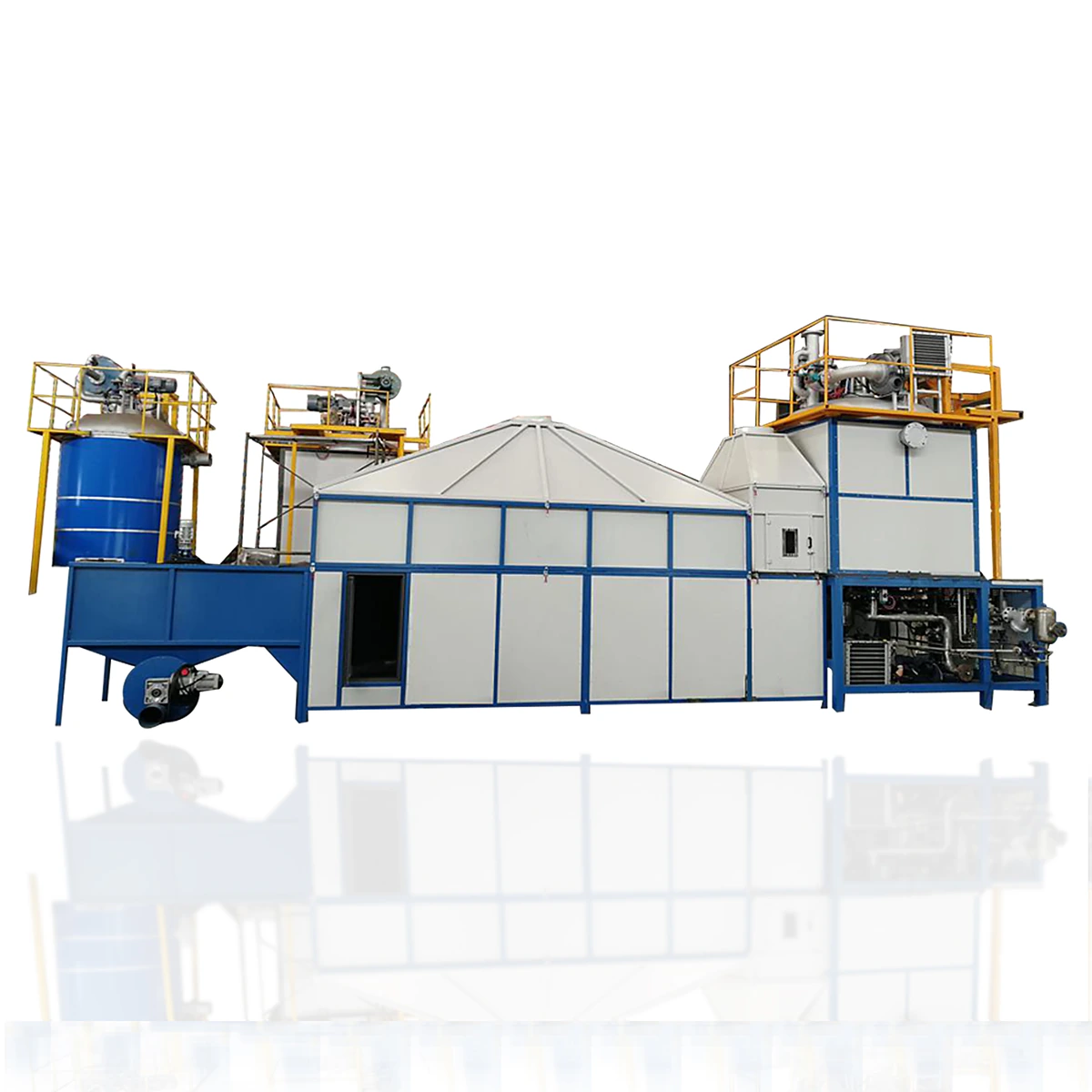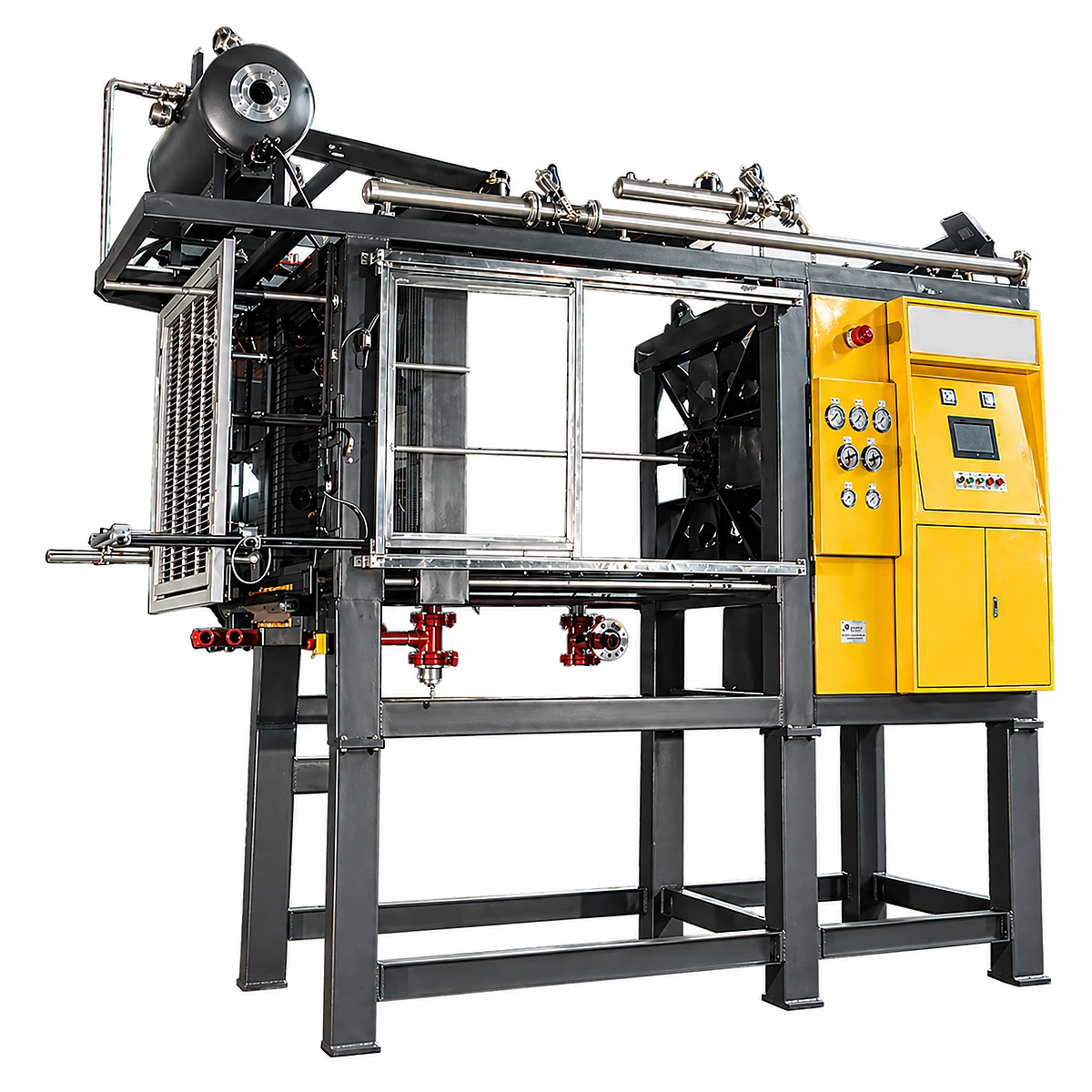

"EPS beads making machine" is used by buyers to mean three pieces of equipment that have almost nothing in common. One is a chemical plant that produces expandable polystyrene beads from styrene monomer. One is a pre-expander, which takes beads you already bought and puffs them up to working density. One is a molding machine, which does not make beads at all — it fuses them into finished products. They differ in footprint, utilities, lead time and capital by margins large enough that quoting the wrong one wastes months. The fastest way to place yourself: if you currently buy EPS in 25 kg bags, you almost certainly want a pre-expander, not a bead plant. This guide gives the distinction in full, the specification each route needs, and what to write in your enquiry so the quotations you get back are comparable.
Why One Phrase Covers Three Machines
The confusion is not the buyer's fault. It comes from the fact that EPS is expanded twice, and the word "make" fairly describes both events.
Polystyrene beads are produced by suspension polymerization: styrene monomer is reacted in water under controlled temperature and pressure, and pentane is infused as the blowing agent. What comes out is a small, hard, dense bead — expandable polystyrene, typically shipped in 25 kg bags or 1,000 kg jumbo bags. It looks like sugar and it does not float. That is one factory making beads.
That bead is then heated with steam at a second site, usually a different company, and expands 40 to 80 times its original volume into the light white bead everyone recognises as foam. That is a second factory making beads, in a completely different sense of the word.
Only after the expanded beads have aged does a third machine fuse them into a fish box, an insulation block or a thermocol plate. Buyers who describe "making beads" but then describe a finished product are usually looking for this third machine. Our full manufacturing process guide walks the chain end to end; the table below is the short version aimed at a purchasing decision.
| Route A — EPS raw material plant | Route B — Pre-expander | Route C — Shape or block molder | |
|---|---|---|---|
| What goes in | Styrene monomer, initiators, additives, pentane | Raw expandable beads, bought in bags | Aged pre-expanded beads |
| What comes out | Raw expandable beads, bagged by grade | Pre-expanded beads at your target density | Finished foam parts or blocks |
| Does it "make beads"? | Yes, in the chemical sense | Yes, in the volume sense | No — it consumes beads |
| Scale of installation | A plant: 8 process sections, tank farm, civil works | One machine plus a silo, on your existing floor | One machine plus molds |
| Typical footprint | 1,500–5,000 m² of plant area | Machine envelope from roughly 2.8 x 2.4 m | Machine envelope from roughly 3.8 x 2.4 m |
| Contract to first output | Around 8–12 months | Manufacturing plus shipping plus commissioning | Manufacturing plus tooling plus commissioning |
| Regulatory weight | Flammable liquid storage, chemical handling, emissions | Pentane venting and steam safety | Steam and machine guarding |
| Who it is right for | Investors entering raw material supply, or large molders integrating upstream | Anyone molding EPS products — this is the common answer | Anyone selling a finished foam product |
The One Question That Places You
Ask what you buy today and what you intend to sell.
- You buy EPS beads in bags and sell foam products. You need Route B and Route C, and you probably need them together. Route A is not on your path.
- You buy nothing yet and intend to sell foam products. Same answer. Every EPS product factory in the world starts by buying beads.
- You intend to sell beads to other factories. Route A. This is a chemical process business, not a machinery business, and it should be evaluated as one.
- You already mold EPS in volume and want to stop paying a bead supplier. Route A becomes worth modelling, but only against your actual annual bead tonnage. Backward integration into a licensed chemical process is a strategic decision with a long payback, not an equipment upgrade.
The mistake that costs the most time is the fourth case treated as the first. A molder who asks for "a beads making machine" and receives a raw material plant proposal will spend weeks on a document that answers a question they were not asking.
Route A: The EPS Raw Material Plant
This is the only equipment that literally makes EPS beads. It is a plant, not a machine, and it is engineered in eight sections.
| # | Section | What it does |
|---|---|---|
| 01 | Raw material storage | Styrene and additive tank farm, receiving and transfer stations, built to chemical storage regulation |
| 02 | Polymerization | Suspension polymerization reactors under controlled temperature and pressure, with pentane infused at a calibrated ratio |
| 03 | Washing and dewatering | Removes residual suspending agents and unreacted styrene, then centrifugally dewaters before drying |
| 04 | Drying | Fluidized bed dryer with hot air circulation, taking moisture below 0.5% for downstream stability |
| 05 | Screening | Multi-deck vibratory screens sorting beads into grades |
| 06 | Coating | Anti-static and mold-release coating applied to the recipe for the intended end product |
| 07 | Aging and storage | Multi-silo aging over 24–72 hours, with grades and densities routed separately by PLC |
| 08 | Packing | Automatic 25 kg bagging or 1,000 kg jumbo bags, with weighing, tag printing and pallet wrap |
Three things about this route are worth stating plainly before anyone requests a proposal.
It is a chemicals operation. The tank farm holds styrene monomer, and pentane is present through polymerization, drying and aging. Both are regulated. Bulk flammable liquid storage falls under standards such as OSHA 29 CFR 1910.106, and the exposure and flammability profile of the blowing agent is documented in the NIOSH Pocket Guide entry for pentane. Whatever jurisdiction you build in will have its own equivalents, and they will shape your layout before the equipment does. If your site permitting cannot carry a solvent tank farm, this route ends there regardless of budget.
The equipment is the smaller half of the problem. Bead quality is a recipe question: bead size distribution, pentane content, coating formulation and the aging window all determine whether your product molds cleanly at a customer's factory. A plant that runs mechanically but produces beads with an inconsistent size distribution will not hold customers. When you evaluate a plant supplier, weight their process and recipe support at least as heavily as their equipment list.
Capacity should be set from local demand, not from ambition. Plants in this class are typically sized between 5,000 and 30,000 tonnes per year, with the lower band serving a region and the upper band built for export. Sizing above your addressable market produces a plant that runs at partial load, which is the most expensive way to own one.
Our own scope on this route is described on the EPS raw material plant solution page: plant planning and layout drawings, supply of the eight sections as one package, installation and commissioning guidance, and operator training with continuing recipe support. Typical timeline from contract to first bead batch is around 8 to 12 months, and plant area is usually 1,500 to 5,000 m² depending on capacity and land shape. Grade definitions and what each is used for are covered separately in our EPS raw material grades guide.
Route B: The Pre-Expander
For most people typing "EPS beads making machine" into a search box, this is the machine they are picturing: raw beads go in, light expanded beads come out, and the density of everything you subsequently mold is decided here.
A batch pre-expander heats beads with steam in an insulated barrel while an agitator keeps them moving so they heat uniformly. Expansion ratio runs 40 to 80 times raw bead volume. The output is not usable immediately — beads go to a silo to age for roughly 24 hours so internal cell pressure equilibrates with air, and the sizing logic for that stage is covered in our silo storage guide.
Sizing is done in kilograms per hour, working backwards from the finished product volume you intend to sell. The four models below are our current batch range.
| Parameter | PE-1200 | PE-1400 | PE-1600 | PE-1800 |
|---|---|---|---|---|
| Positioning | Entry, small factories | Mid-range workhorse | Scaling up | Flagship |
| Barrel diameter | 1,200 mm | 1,400 mm | 1,600 mm | 1,800 mm |
| Capacity | 500–700 kg/h | 700–900 kg/h | 1,000–1,300 kg/h | 1,400–1,700 kg/h |
| Density range | 12–40 kg/m³ | 8–30 kg/m³ | 8–35 kg/m³ | 8–45 kg/m³, incl. flame-retardant grades |
| Density variance | ±1.0 kg/m³, manual sampling | ±0.5 kg/m³, PLC batch | ±0.5 kg/m³ | ±0.3 kg/m³ |
| Steam pressure | 0.15–0.22 MPa | 0.18–0.23 MPa, closed loop | 0.20–0.25 MPa | 0.20–0.25 MPa, multi-zone |
| Steam per batch | 65–80 kg | 80–100 kg | 100–120 kg | 120–140 kg |
| Cycle time | 5–7 min | 4–6 min | 3.5–5 min | 3–5 min |
| Installed power | 22 kW | 30 kW | 37 kW | 45 kW |
| Machine weight | 4,500 kg | 6,000 kg | 8,000 kg | 10,000 kg |
| Certifications | CE | CE, ISO 9001 | CE, ISO 9001 | CE, ISO 9001, ISO 14001, ATEX |
Two columns in that table deserve more attention than they usually get.
Density variance is a money figure, not a specification detail. Every kilogram of bead you expand less precisely than intended is either material given away in an over-dense part, or a reject in an under-dense one. The gap between ±1.0 and ±0.3 kg/m³ compounds across every batch for the life of the machine, which is why the precision tiers are priced apart.
Steam per batch determines your boiler, and the boiler is routinely left out of "complete line" quotations. Read the steam row, add the requirement of every other steam consumer on the line, and confirm in writing whether boiler and steam piping are inside or outside the price. Steam is also where the running cost of an EPS factory concentrates; the US Department of Energy's steam system resources are a reasonable external benchmark for what a well-specified plant should be losing, and we work the numbers through for foam specifically in our steam energy cost analysis.
The reference machine in this range is the PE-1400 batch pre-expander, which covers the majority of packaging and insulation factories.
Route C: The Molding Machine — Which Does Not Make Beads
Worth including because a real share of enquiries that use the phrase "beads making machine" describe a finished product in the next sentence. If you are selling fish boxes, cooler boxes, thermocol plates, helmet liners or insulation blocks, the machine you are picturing is a molder, and beads are its raw material rather than its output.
Shape molders fuse beads inside a steel or aluminium mold cavity with saturated steam, then cool by vacuum and water spray before ejecting. For reference, our SM-1200 shape molding machine runs a 1,200 x 1,000 mm platen, holds chamber pressure at 0.08–0.12 MPa under closed-loop PLC control against a 0.4–0.8 MPa tank supply, clamps at 25 tons, consumes 8–15 kg of steam per cycle and works a 15–50 kg/m³ density range. Cycle time is 60–90 seconds for a fish box and 120–150 seconds for thick-section parts — with an empty-machine figure of 30–45 seconds that is a timing baseline and should never be used for capacity planning.
Block molders are the other branch of this route, producing large blocks that are later cut into sheets for insulation. Regional vocabulary varies: in India and South Asia the same equipment is searched for as a thermocol machine, which we cover in the thermocol making machine guide. Whichever branch applies, a molder needs a pre-expander upstream, so Route C in practice means Route B plus Route C.
A Fourth Case: Loose Beads as the Product Itself
Some buyers want the beads to be the saleable item — bean bag filling, loose box filler, lightweight concrete aggregate. This does not need a polymerization plant either. It is a pre-expander tuned for small, uniform bead size, followed by aging and an automatic bagging or filling station rather than a mold. The configuration is described on our EPS bean bag filling line page. Say so explicitly in your enquiry if this is your product, because the pre-expander specification changes and the downstream equipment is entirely different from a molding line.
What to Put in Your Enquiry
Most quotation confusion on this term disappears if the first message answers these seven points.
| State this | Why it changes the quotation |
|---|---|
| Whether you intend to buy beads or produce them | This alone separates Route A from Routes B and C, and it is the single largest fork |
| The finished product you sell, or that you sell beads | Determines mold type and whether a molder belongs in the scope at all |
| Target density and tolerance | Selects the pre-expander precision tier and rules models in or out |
| Required output in kg/h or tonnes per year | The only correct basis for sizing; product-count targets have to be converted first |
| Steam availability, or that you have none | Boiler and steam piping are the items most often silently excluded from a line price |
| Voltage and frequency | 380V/50Hz is standard; other configurations are a build change, not a shipping change |
| Destination market and required conformity marking | Sets the safety and documentation package that must travel with the machine |
Two checks are worth running on whoever replies. First, ask which model or series the certificates name. Conformity marking and ISO 9001 certification are issued with a defined scope, and a certificate covering a pre-expander series does not cover a molding machine. Read the PDF, match the model to your order, and apply the check to us as readily as to anyone else. Second, ask a question that requires the machine to have been built rather than resold — steam consumption per batch at your target density is a good one. General supplier vetting for machinery bought from China is covered in our 8-question buying guide, and the sequencing of a whole factory build in our factory setup guide.
Where ChinaEps Sits
Eps Industry Engineering Co., Ltd manufactures EPS and EPP processing equipment across sites in Jiangyin, Wenzhou and Dongguan totalling more than 10,000 m², with equipment exported to over 60 countries. Since this article is about telling routes apart, here is our own scope stated in the same terms:
- Route B and Route C are our core manufacturing. Batch pre-expanders across the PE-1200 to PE-1800 range, shape molders, block molders, cutting lines, silos, material handling, recycling equipment and mold tooling.
- Route A we deliver as a turnkey plant project — plant layout and engineering drawings, supply of the eight process sections as one package, installation and commissioning guidance, operator training and continuing recipe support. This is plant integration work, and it is scoped and quoted differently from buying a machine.
- What we will tell you at enquiry stage: if you buy beads today and mold foam products, we will steer you to a pre-expander and a molder rather than quote you a plant. A raw material plant proposal for a factory that consumes a few hundred tonnes of beads a year is not a serious proposal, and it is the most common way this search term goes wrong.
On safety: machine guarding and interlocks are not optional extras on steam equipment and belong in your acceptance criteria whoever supplies the machine. OSHA's machine guarding standards are a workable common reference even outside the United States because they describe the hazard rather than one jurisdiction's paperwork. For finished product properties, ASTM C578 is the standard specification for rigid cellular polystyrene and is the document your insulation customers will cite back at you.
Frequently Asked Questions
What is an EPS beads making machine?
The phrase is used for three different machines. Strictly, it means a polymerization plant that produces expandable polystyrene beads from styrene monomer. In common usage it usually means a pre-expander, which expands purchased raw beads 40 to 80 times with steam to reach a working density. It is also used loosely for shape and block molding machines, which consume beads rather than produce them. Establish which one is meant before comparing any quotations.
Can I make my own EPS beads, or do I have to buy them?
You can, but it is a chemical plant rather than a machine purchase. It requires a styrene tank farm, suspension polymerization reactors, pentane handling, washing, drying, screening, coating, aging and packing — eight process sections, typically 1,500 to 5,000 m² of plant area, and roughly 8 to 12 months from contract to first batch. Nearly every EPS product factory buys beads in 25 kg or 1,000 kg bags instead.
Is a pre-expander the same as an EPS beads making machine?
It is what most buyers mean by the term. A pre-expander does not create polystyrene; it expands beads that already contain pentane, taking them from a hard dense granule to light foam beads at your target density. If your intended input is a bag of beads rather than styrene monomer, a pre-expander is the machine you are looking for.
Do I need a polymerization plant to start an EPS factory?
No. A standard EPS product factory buys raw beads and needs a pre-expander, aging silos, and a molding machine appropriate to the product. Backward integration into bead production is a separate strategic decision that should be modelled against your actual annual bead consumption, not treated as an equipment upgrade.
What is the difference between raw beads and pre-expanded beads?
Raw expandable beads are dense, hard and shipped in bags; they contain pentane as the blowing agent and have not been expanded. Pre-expanded beads have been steam-expanded 40 to 80 times in volume, are light and white, and must age roughly 24 hours before molding so internal cell pressure equilibrates with air. Pre-expanded beads cannot be stored or transported economically over distance, which is why expansion happens at the molding factory.
How do I size a pre-expander?
Work in kilograms per hour derived from the finished product volume you intend to sell, then match against the machine range: 500–700 kg/h at the entry tier up to 1,400–1,700 kg/h at the top of our batch range. Also fix the density band you must hold, because density variance differs across tiers from ±1.0 to ±0.3 kg/m³, and that tolerance decides material waste for the life of the machine.
Which machine makes loose EPS beads for bean bags or box filler?
A pre-expander configured for small, uniform bead size, followed by aging and an automatic bagging or filling station. No molding machine is required, because the beads are the finished product. Say so in your enquiry, as both the pre-expander specification and all downstream equipment differ from a molding line.
Does the EPS raw material plant include the machines to mold products?
No. A raw material plant ends at packed beads. Molding equipment is a separate scope, and a plant would normally sell its beads to molding factories rather than mold in house. A company that wants both is buying two different projects and should scope and schedule them separately.
How do I check a supplier actually builds the machine they are quoting?
Ask for the certificate PDF and read which model or series it names, then ask a question that requires the machine to have been built — steam consumption per batch at your target density, or the density band the machine has actually produced. A manufacturer answers immediately. A reseller returns the brochure. Conformity marking and quality-management certification describe scope and documentation, not that a specific machine passed a performance test.
What is the biggest sourcing mistake with this search term?
Requesting a raw material plant proposal when you needed a pre-expander. The two are separated by orders of magnitude in footprint, permitting and timeline, and the mistake typically costs weeks before anyone notices the mismatch. Stating in your first message whether you intend to buy beads or produce them prevents it entirely.
--- ## 评审说明(不发布,仅供人工审阅) ### 1. 规则 6 检查:为什么判定"值得新写" 站内所有可能覆盖这个词的页都查过了,结论是**没有一页在打这个意图**: | 已有页 | 覆盖什么 | 为什么不算覆盖本词 | 索引状态(GSC 实查) | |---|---|---|---| | `/en/solutions/eps-raw-material-plant/` | 聚合工厂整线(8 段 / 9 流程 / 5K-30K t/yr) | 标题、H1、meta 全篇**没有出现 bead making / beads machine 字样**,面向的是已经知道 "raw material plant" 这个术语的投资人 | ✅ Submitted and indexed(07-27 爬) | | `/en/products/spjy-1400-pre-expander/` | PE-1400 预发机 | 打 "pre expander",不打 "beads making machine" | 未在本次查询范围(同簇草稿 08-03 记为 indexed / 255 曝光 / 位 22.1) | | `/en/blog/how-eps-foam-is-made-manufacturing-process/` | EPS 全流程科普 | 工艺教育向,不做设备路线分诊 | 🔴 **Crawled - currently not indexed**(07-04 爬) | | `/en/blog/eps-raw-material-grades-guide/` | 珠粒牌号 | 材料向 | ✅ indexed(07-23 爬) | | `/en/blog/thermocol-making-machine-complete-guide/` | 印度 thermocol 成型机 | 区域词 + 成型机向 | 未查 | | `/en/solutions/eps-bean-bag-filling-line/` | 懒人沙发灌装线 | 松散填充珠粒,只是本文第四种情况 | 未查 | **本文认领的意图是"分诊"**:三台机器同名,买家不知道自己要哪台。这个意图站内确实空白,而且它是**上游路由型内容** —— 正文把三条路线分别导向 raw-material-plant 方案页、PE-1400 产品页、SM-1200 产品页,属于给现有页导权重而不是抢它们的词。 **互抢风险评估**:GSC 近 28 天 query 维度前 100 行里,**没有任何一条含 "beads making" / "bead machine"**。与珠粒相关且真有排名的是 `china eps beads resin raw material`(1 曝光 / 位 10)和 `china flame retardant grade eps bead`(7 曝光 / 位 3.6)—— 都是**材料词不是设备词**,与本文主词不同意图,不构成互抢。发布后 +14 天跑一次 `gsc_cannibalisation` 复核。 ⚠️ 数据口径提醒:本次 `gsc_search_performance` 返回的 summary(302 曝光 / 4 点击 / 位 19.9)是 **limit=100 返回行的合计**,不是全站真实总量(GSC 会隐藏长尾匿名 query)。同簇 08-03 草稿里写的"全站 5,320 曝光"是 page 维度口径,两者不可直接比较,别当成"站掉了 94%"。 ### 2. 为什么这个词值得做(不只是"没被覆盖") - **它是投资人级别的上游词**。搜这个词的人往往还没决定买什么,正处在最容易被销售引导的阶段。 - **本站有一个竞品很难复制的真实资产**:ChinaEps 同时能供 Route A(整厂)和 Route B/C(单机)。绝大多数同行只做其中一条,所以他们写不出这篇分诊 —— 写了就等于把客户推给别人。这让文章的可信度有真实来源,不是编的差异化。 - 正文里写了一条**反向销售**的话("你只吃几百吨珠粒的话,给你报整厂方案不是认真的方案")。这是本文最强的 E-E-A-T 信号,也是反 AI 味(门禁 #7)最有效的手段 —— 通稿不会劝退客户。 ### 3. 全文数字出处(无一处编造,可逐条核) | 数字 / 说法 | 出处 | |---|---| | 8 大工段 / 9 步流程 / 干燥后含水 <0.5% / 熟化 24-72h / 25kg + 1000kg 袋 / 悬浮聚合 + 戊烷注入 / 5K-30K t/yr / 1,500-5,000 m² / 合同到首批 8-12 个月 | `src/pages/[locale]/solutions/eps-raw-material-plant.astro`(sections / flow / customizable / advantages / Key Metrics 四卡)+ `src/data/solutions-deep-dive.ts:2409+` | | PE-1200/1400/1600/1800 全部规格(产能 / 密度 / 密度偏差 / 蒸汽压力 / 每批蒸汽 / 循环 / 功率 / 重量 / 认证) | `src/data/products-deep-dive.ts:88-159`(`spjy-1400.modelVariants`),逐格照抄 | | 膨胀倍率 40-80× | 同上,四个型号一致 | | PE-1400 外形 2,800 × 2,400 × 4,500 mm(正文写"约 2.8 x 2.4 m"占地) | `src/content/products/spjy-1400-pre-expander.yaml:41` | | SM-1200 平台 1,200×1,000 / 罐压 0.4-0.8 MPa / 腔压 0.08-0.12 MPa / 合模 25 t / 每循环蒸汽 8-15 kg / 密度 15-50 kg/m³ / 空循环 30-45s / 鱼箱 60-90s / 厚件 120-150s / 外形 3,800 × 2,400 × 3,000 mm | `src/content/products/sm-1200-shape-molding-machine.yaml:24-46` | | 江阴 / 温州 / 东莞 3 地、10,000+ m² | 客户档案 `clients/chinaeps/CLAUDE.md` | | 出口 60+ 国 | `spjy-1400-pre-expander.yaml:18` 站内已有表述 | | 预发后熟化约 24h 才能成型 | 站内 `eps-silo-storage-system-complete-guide` 已上线口径 | **刻意没写的:** - ❌ **任何价格数字。** 两个原因:① CLAUDE.md v10.4 决策表第 ① 类"钱 / 服务定价"必须运营人员拍板;② 站内已经做过一轮价格清洗(`thermocol-making-machine-complete-guide.md:146` 现在是 `costs Contact us for pricing FOB China` 这种被替换坏的句子),说明博客正文的价格是被有意撤掉的。本文改用**可溯源的非价格量级对比**(占地 / 工期 / 审批 / 工段数)表达"两条路线差着数量级",不需要价格也能把决策讲清楚。 > ⚠️ 顺带记一笔:`thermocol-making-machine-complete-guide.md` 第 146 / 155 / 158 行的价格替换是**坏句**("costs Contact us for pricing FOB China, including..."),语法断裂且已上线。不属于本簇,建议单独开一条修。 - ❌ 任何客户案例 / 客户评价 / quote(门禁 #19) - ❌ 任何 aggregateRating / testimonials 占位(门禁 #19) - ❌ PE-900 / PE-2000 的规格 —— `products-deep-dive.ts:480-486` 是空注释桩,库内无数据,写了就是编造 - ❌ 聚合反应釜的任何技术参数 —— 站内只有工段级描述,没有设备级规格 - ❌ 排名 / 询盘增长预测(CLAUDE.md 禁无数据支撑的预测) - ❌ 全文无 emoji(`feedback_no_emoji_on_websites`) ### 4. authorUrl 与任务指令冲突(按仓库现状执行) 任务要求 `authorUrl` 填 LinkedIn 个人页。**本仓库刻意不这么做**:`src/data/authors.ts` 第 6-7 行注释写明 "No external LinkedIn — E-E-A-T is carried by named person + role + expertise + on-site bio + company affiliation",且 memory 有全局禁规 `feedback_no_linkedin_dependency`(任何方案禁止依赖 LinkedIn 做 E-E-A-T 验真)。 故本稿 `authorUrl: /en/about/`,作者取 authors.ts 已登记实名 **Grace Ge(EPS Production Line Solutions Engineer)**。门禁 #17 的实质要求(真名、非集体名、Person schema + jobTitle + knowsAbout)满足,LinkedIn 那一条按站内规则豁免。**要改这条全局规则属于"建立未来规则"级决策,需运营人员点头。** ### 5. 权威外链 5 条,全部是仓库内已在用的 URL(门禁 #18 要求 ≥2) | URL | 用途 | 仓库内已在用处 | |---|---|---| | `osha.gov/laws-regs/regulations/standardnumber/1910/1910.106` | 苯乙烯罐区易燃液体储存合规 | `eps-silo-storage-system-complete-guide.md:46` | | `cdc.gov/niosh/npg/npgd0486.html` | 戊烷发泡剂暴露与易燃性 | `fast-cycling-eps-beads-roi-payback-guide.md:145` / `how-eps-foam-is-made-manufacturing-process.md:47` 等 4 处 | | `energy.gov/eere/amo/steam-systems` | 蒸汽系统能效基准 | `eps-machine-maintenance-cost-annual-budget-calculator-2026.md:60` | | `iso.org/iso-9001-quality-management.html` | 认证范围说明 | `used-eps-machine-price-guide-refurbished-vs-new-2026.md:112` 等 6 处 | | `astm.org/c0578-22.html` | ASTM C578 硬质发泡聚苯乙烯标准 | `eps-raw-material-grades-guide.md:188` 等 8 处 | **没有凭印象贴新 URL** —— 五条全部 grep 确认过站内已在使用,不需要发布前再逐个 curl(仍建议随发布批次抽验一次)。 ### 6. 站内内链 11 条,全部指向真实存在的页 `/en/solutions/eps-raw-material-plant/` · `/en/solutions/eps-bean-bag-filling-line/` · `/en/products/spjy-1400-pre-expander/` · `/en/products/sm-1200-shape-molding-machine/` · `/en/blog/how-eps-foam-is-made-manufacturing-process/` · `/en/blog/eps-raw-material-grades-guide/` · `/en/blog/eps-silo-storage-system-complete-guide/` · `/en/blog/steam-energy-cost-eps-production-optimization/` · `/en/blog/thermocol-making-machine-complete-guide/` · `/en/blog/eps-machine-buying-guide-china/` · `/en/blog/how-to-set-up-eps-factory-complete-guide/` **刻意没链 `/en/blog/how-to-choose-eps-pre-expander/`** —— 该页正文是三篇文章拼接的重复内容且 GSC 判 `Crawled - currently not indexed`(详见同簇草稿 [2026-08-03-eps-pre-expander-machine.md](2026-08-03-eps-pre-expander-machine.md))。往它导内链等于把权重送进一个 Google 已经拒收的页。**它修好之前,本文的预发机链接一律指产品页。** ### 7. 发布前必做(本稿未做,属发布环节) 1. **封面图**:`/images/blog-covers/eps-beads-making-machine-three-routes.webp` 现在是占位路径,**必须落真图**才能过门禁 #4。建议一张能同时看到"原料袋 / 预发机料筒 / 成型件"的车间实拍,正好呼应三路线主题。禁库存图。 2. **6 语种正文**:frontmatter 已给 7 语种 titles/descriptions,但门禁 #4 要求各语种 body ≥ 500 字符,只有骨架不算。ru/ar 需母语校对。 3. **templateType 排期冲突(门禁 #21)**:本稿 `X-vs-Y`,而 `2026-08-03-eps-continuous-pre-expander.md` 和 `2026-08-01-epe-vs-eps-foam-sheet-guide.md` 也是 X-vs-Y。14 天内同型 ≤ 1 篇,**这三篇不能连着发**。(补充:08-03/08-04 那批草稿里 how-to 有 3 篇、pillar 有 2 篇,四种类型都撞了 —— 这已经不是单篇排期问题,建议人工统一排本月发布序。) 4. **节奏熔断(门禁 #22)**:单站 ≤ 3 篇/周、≤ 8 篇/月。本月草稿存量已远超月上限,**发布顺序必须人工挑**,不能全发。 5. `pre-deploy-quality-check.sh` 7 道门禁 + `pre-deploy-fingerprint-guard.sh`,rsync **必带 `-c`**(memory 硬规则),部署后跑 `每日代码同步审计.sh`。 ### 8. 本次调研顺带发现(不属于本簇,另开动作) 1. **`eps-raw-material-plant` 有两套实现**:独立静态页 `src/pages/[locale]/solutions/eps-raw-material-plant.astro`,以及 `src/data/solutions-deep-dive.ts:2409` 里同 slug 的数据条目(走 `[type].astro` 动态路由)。Astro 里静态文件优先于动态路由,所以线上渲染的应该是 .astro 那份,deep-dive 里那条**可能是不生效的死数据**。我没有逐行读 `[type].astro` 的 `getStaticPaths` 去确认它是否排除了这个 slug,**所以这是待核项不是结论**。若确认为死数据,两份内容会随时间漂移,建议收敛成一份。 2. **`spjy-1400-pre-expander.yaml` 的 `names.en` / `descriptions.en` 写着 `80-400 kg/hr` + `±0.3 kg/m³`**,与同文件 specs 的 `700-900 kg/h` + `±0.5` 直接打架,且 `±0.3` 实际是 PE-1800 的指标。同簇 08-03 草稿已详细记过,**本文正文一律采用 specs 与 deep-dive 的真值**。这条挂在高曝光产品页上,优先级高。 3. **`thermocol-making-machine-complete-guide.md` 的价格替换坏句**(见第 3 节 ❌ 价格那条),已上线,建议单独修。 4. **`/en/blog/how-eps-foam-is-made-manufacturing-process/` 未被索引**(07-04 爬过)。它是本稿挂的 pillar。本文若上线并从正文链回它,能给它一条新的内链信号,但**不能指望单靠这个转正** —— 建议单独查一次它是不是也有重复内容问题(该文件同样值得跑一次"同文件两个 FAQ H2"的廉价检测)。 ### 9. 队列回填 `clients/chinaeps/软文计划/2026-08.md` L59(`eps beads making machine`)行尾已追加本草稿相对路径,`[ ]` **保持未勾**(勾 `[x]` = 已上线,由人来做)。本簇只有主词一个,无其他行需回填。 PLAN_OK clients/chinaeps/blog/drafts/2026-08-04-eps-beads-making-machine.md