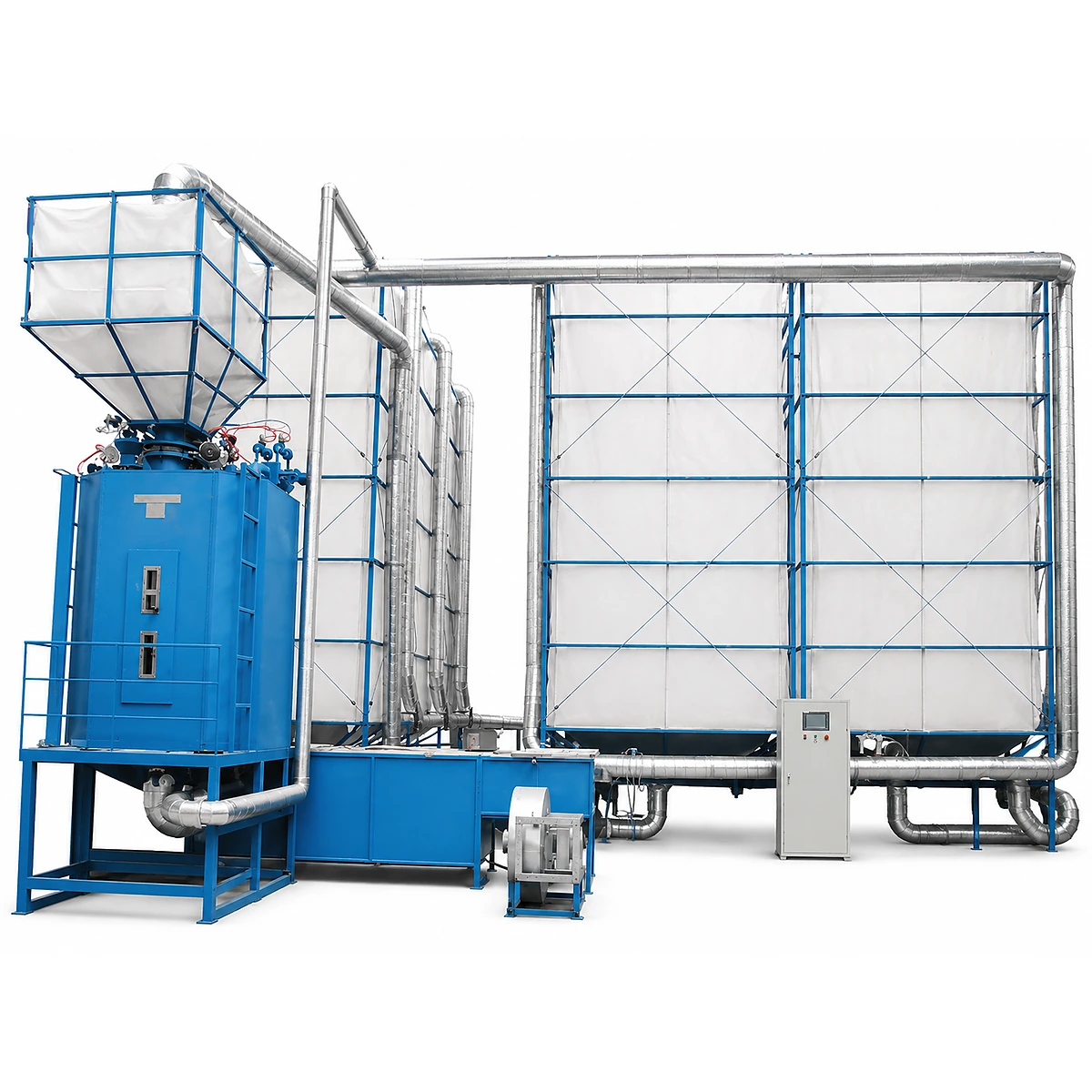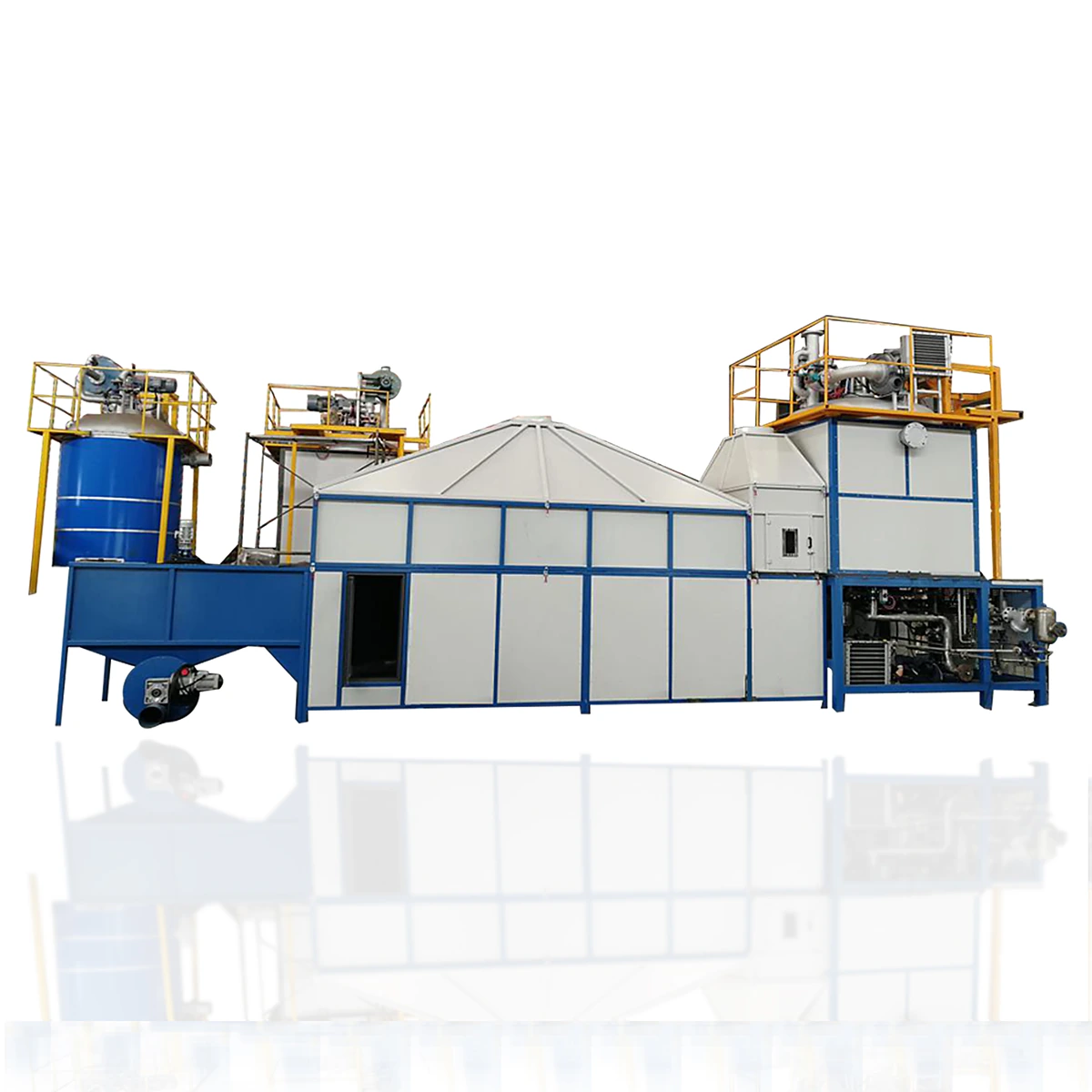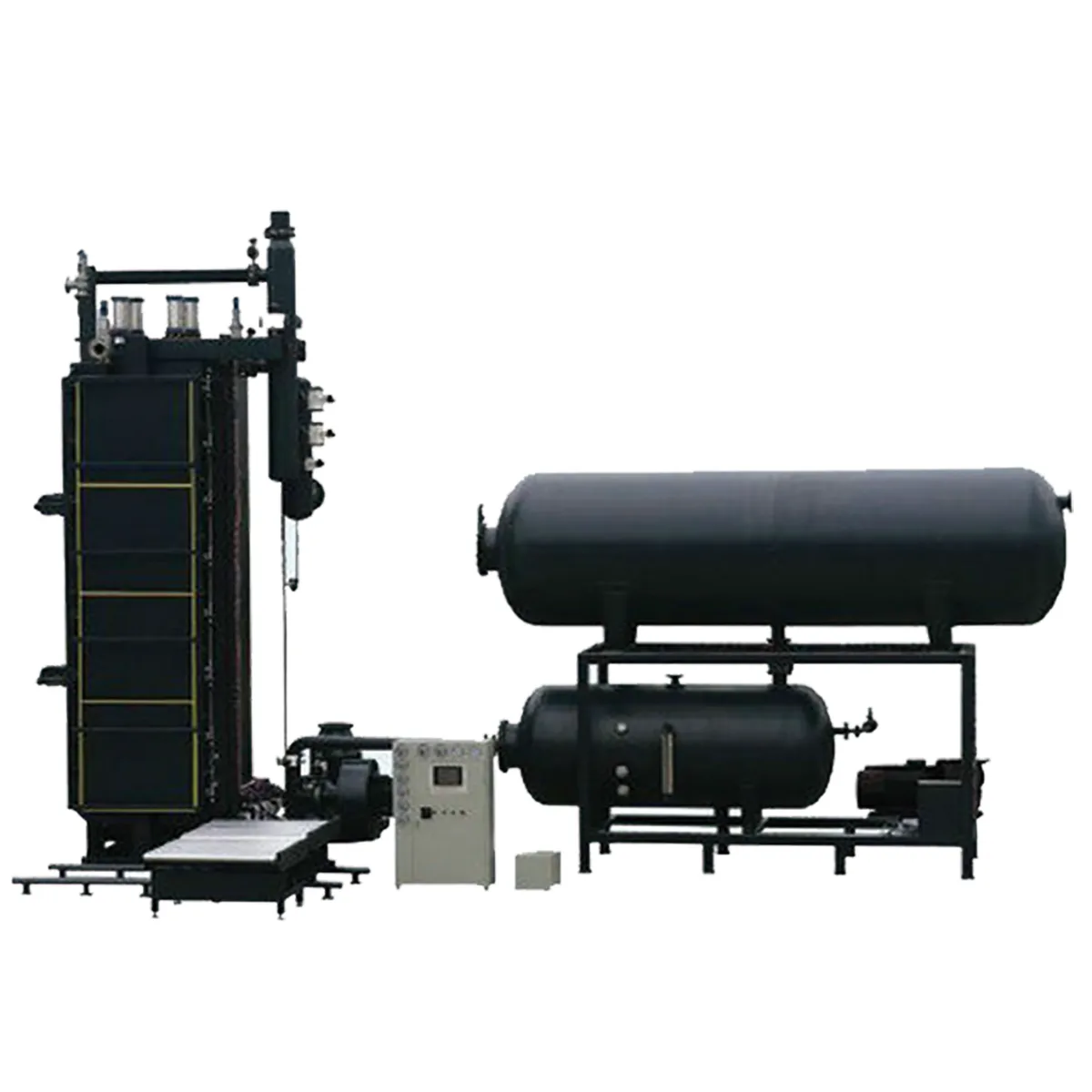
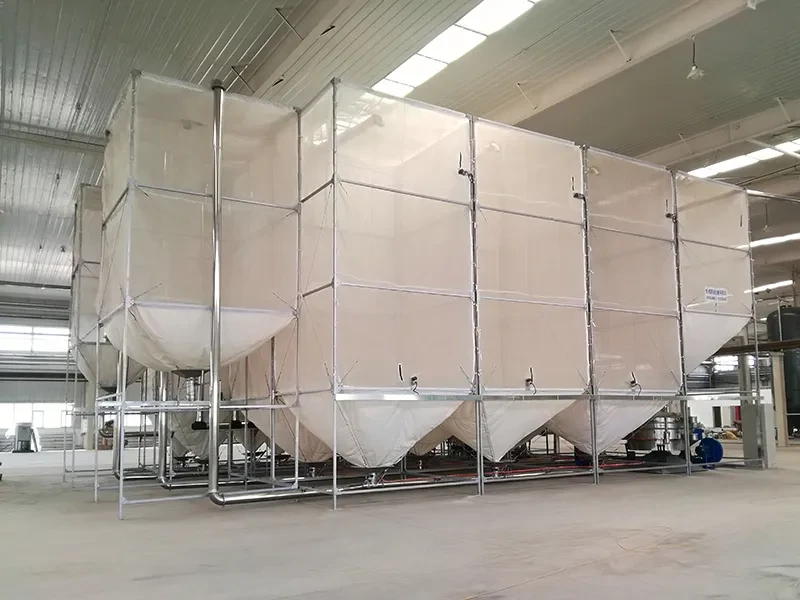
An EPS aging silo (also called a maturing or curing silo) is a vertical vessel where pre-expanded polystyrene beads rest 8–24 hours so air diffuses into the cells and residual pentane escapes. It sits between the pre-expander and the block molding machine. Skip it and block rejection runs 5–12% instead of under 1%.
During aging, air replaces the condensing steam inside each cell while residual pentane escapes, stabilizing the beads so they fuse evenly under steam pressure. Get the silo wrong — under-sized, too humid, or emptied too early — and you get soft blocks, surface defects, and reject rates that cost $8,000–$25,000 per year in wasted material. Because aging silos accumulate flammable pentane vapour, they must also be designed and ventilated to OSHA flammable-liquids (29 CFR 1910.106) standards.
The right EPS silo system ensures uniform bead aging across the entire volume, delivers beads to the molding machine at consistent moisture and pressure, and occupies the minimum floor space for your production capacity. This guide covers how to size your silo, the three main construction types, and the five most common mistakes that ruin bead quality downstream. (Already know your volume and want the unit count instead? See how many aging silos your factory actually needs.)
Why Aging Silos Are Critical (Not Optional)
After pre-expansion, EPS beads are hot, moist, and contain a partial vacuum inside each cell. If you mold these beads immediately, three problems occur:
- Poor fusion: Cells haven’t stabilized — steam pressure during molding crushes them unevenly, creating weak spots in finished blocks
- Shrinkage: Beads without adequate aging shrink 3–8% after demolding, causing dimensional rejects
- Surface defects: Excess moisture trapped between beads prevents proper inter-bead fusion, leaving visible gaps on cut surfaces
Industry data shows that proper aging (minimum 8 hours for standard density 15–25 kg/m³) reduces block rejection rates from 5–12% down to under 1%. For a mid-volume plant producing 100 blocks per day at $45/block average value, that’s $16,000–$45,000 in annual savings from aging alone.
How to Size Your EPS Silo: 3-Step Formula
Under-sized silos force you to rush aging or run double shifts. Over-sized silos waste capital and floor space. Here is the industry-standard sizing formula:
Step 1: Calculate daily bead volume
Daily block output (m³) × 1.05 (cutting waste factor) = daily bead requirement
Example: 30 blocks × 4.8 m³/block × 1.05 = 151.2 m³/day
Step 2: Apply aging time factor
Bead volume × (Aging hours ÷ 24) = minimum silo volume
Example: 151.2 × (12 ÷ 24) = 75.6 m³ minimum
Step 3: Add safety margin (1.3–1.5×)
Minimum × 1.4 = recommended silo capacity
Example: 75.6 × 1.4 = 105.8 m³ total silo capacity
For most plants, this translates to 4–8 individual silo units of 15–30 m³ each, allowing you to age different density grades separately and rotate stock on a first-in-first-out basis. If you would rather read the answer off a table than run the arithmetic, the sizing table below lists five common output levels already calculated.
Three Types of EPS Silo Construction
1. Mesh Fabric Silos (Most Common)
Breathable woven polypropylene fabric stretched over a welded steel frame. The mesh allows air circulation while containing the lightweight beads. Cost: $800–$2,500 per unit (15–30 m³).
- Pros: Lowest cost, excellent ventilation, easy to inspect fill level visually, simple to replace fabric (5–7 year lifespan)
- Cons: Requires indoor installation (UV degrades fabric), limited to 2–3 density grades without dedicated units, dust from fabric wear
- Best for: Standard EPS plants producing 1–3 density grades indoors
2. Steel Panel Silos (High-Volume)
Galvanized or stainless steel panels with perforated walls for airflow, typically in cylindrical or square configurations. Cost: $3,000–$12,000 per unit (20–80 m³).
- Pros: 20+ year lifespan, outdoor installation possible, integrated level sensors and temperature monitoring, better fire resistance rating
- Cons: Higher upfront cost, requires foundation engineering, condensation risk in cold climates without insulation
- Best for: Plants producing >200 m³/day or requiring outdoor storage due to floor space constraints
3. Automatic Silo Systems (PLC-Controlled)
Integrated systems with automatic fill/discharge valves, level sensors, aging timers, and pneumatic conveying connections — all managed by a central PLC. Our ES-AUTO system is a typical example. Cost: $15,000–$45,000 for a complete 6–8 unit installation.
- Pros: Zero manual intervention, FIFO enforcement via software, aging time alarms prevent under-aged beads from reaching molding, data logging for quality traceability, reduced labor (1 operator can manage 8+ silos)
- Cons: Highest upfront investment, requires PLC programming expertise for setup, sensor maintenance
- Best for: Plants targeting ISO 9001 quality certification, operations running 24/7, or factories with limited skilled labor
5 Silo Mistakes That Ruin Bead Quality
Mistake #1: Insufficient Aging Time
Rushing beads through in 4–6 hours to meet production pressure seems efficient but creates fusion defects that multiply downstream. Fix: Set a hard minimum of 8 hours for standard grades (15–25 kg/m³) and 12–16 hours for low-density grades below 15 kg/m³. Automatic systems with discharge lockouts prevent this mistake entirely.
Mistake #2: Over-Aging Beyond 48 Hours
Beads stored too long lose internal cell pressure as pentane continues to escape. After 48 hours, beads become “dead” — they won’t expand further during molding and produce blocks with 10–20% lower mechanical strength. Fix: Implement FIFO rotation. Label silo batches with fill time. Automatic systems flag over-aged inventory.
Mistake #3: Moisture Buildup in Humid Climates
In regions with >70% relative humidity, condensation forms inside silos and coats beads with excess water. This causes steam penetration problems during molding. Fix: Install dehumidified air circulation (dry air blowers) at the silo base. Target 40–60% RH inside the silo. Steel silos in tropical climates should include roof ventilation or forced-air fans.
Mistake #4: Mixing Density Grades
Adding freshly expanded 12 kg/m³ beads on top of partially aged 20 kg/m³ beads creates inconsistent blocks where different zones have different properties. Fix: Dedicate specific silos to specific density ranges. Color-code or label each unit. A minimum of 4 silos allows 2 densities × 2 batches (one aging, one feeding the molding machine).
Mistake #5: Poor Pneumatic Conveying Design
Sharp pipe bends, undersized blowers, or excessive conveying distances (beyond 50 meters) damage beads during transport from pre-expander to silo. Broken beads create fine dust that clogs silo mesh and reduces airflow. Fix: Use 200–300 mm diameter pipes with long-radius bends (minimum 5× pipe diameter radius). Keep total conveying distance under 40 meters where possible. Install cyclone separators before silos to remove broken bead dust.
Silo Layout Best Practices
Position silos between the pre-expander and block molding machine in a linear flow. The ideal arrangement:
- Minimum ceiling height: 5–7 meters clear (silos are typically 3.5–5 m tall plus 1–2 m clearance for top-fill pneumatic lines)
- Access spacing: 0.8–1.2 m between silos for inspection and fabric replacement
- Fire separation: EPS beads contain pentane (a flammable gas). Maintain 3+ meter separation from ignition sources. Install smoke detectors above each silo bank
- Floor loading: Full silos at low density (12 kg/m³) impose 0.3–0.5 tonnes/m² floor load — standard industrial floors handle this easily, but verify for multi-story installations
EPS Aging Silo Sizing Table (Quick Reference)
Every row below is the Step 1–3 formula already worked out (daily block output × 1.05 cutting waste × aging hours ÷ 24 × 1.4 safety margin). Use the formula directly if your output falls between these rows.
| Daily block output | Bead density | Aging time | Minimum silo volume | Recommended capacity (1.4×) | Typical unit split |
|---|---|---|---|---|---|
| 30 m³/day | 15–25 kg/m³ | 12 h | 15.8 m³ | 22 m³ | 2 units |
| 60 m³/day | 15–25 kg/m³ | 12 h | 31.5 m³ | 44 m³ | 3 units |
| 60 m³/day | <15 kg/m³ | 18 h | 47.3 m³ | 66 m³ | 4 units |
| 144 m³/day (30 blocks) | 15–25 kg/m³ | 12 h | 75.6 m³ | 106 m³ | 4–6 units |
| 240 m³/day | 15–25 kg/m³ | 12 h | 126 m³ | 176 m³ | 6–8 units |
Low-density beads (below 15 kg/m³) need the longer 12–24 hour window, which is why the same 60 m³/day output needs 50% more silo volume in row 3 than in row 2. Split the total across multiple units rather than buying one large vessel — you need at least one silo filling while another feeds the molding machine, plus separation by density grade.
How to Choose: Decision Matrix
| Factor | Mesh Fabric | Steel Panel | Automatic (PLC) |
|---|---|---|---|
| Budget per unit | $800–$2,500 | $3,000–$12,000 | $15K–$45K (system) |
| Lifespan | 5–7 years | 20+ years | 15+ years |
| Best daily output | <150 m³ | 150–500 m³ | >200 m³ |
| Labor requirement | Manual fill/check | Semi-manual | 1 operator / 8+ silos |
| Quality traceability | Manual logs | Manual + sensors | Full digital record |
| Indoor/Outdoor | Indoor only | Both | Both |
Frequently Asked Questions
What is an EPS aging silo?
An EPS aging silo is a vertical vessel that holds pre-expanded polystyrene beads for 8–24 hours so air enters the cells and residual pentane escapes. It sits between the pre-expander and the block molding machine, and is also called a maturing or curing silo.
What is the difference between an aging silo and a storage silo?
The two names are used interchangeably in the trade, but the function differs. Aging is the 8–24 hour window that brings beads to a stable, moldable state; storage is anything held beyond that window. Past roughly 48 hours beads lose internal cell pressure and go “dead” — they no longer expand during molding and yield blocks with 10–20% lower mechanical strength. A storage silo without FIFO rotation is therefore a quality risk, not extra capacity.
How long should EPS beads age in a silo before molding?
Standard density beads (15–25 kg/m³) need a minimum of 8–12 hours. Low-density beads (below 15 kg/m³) require 12–24 hours. The exact time depends on ambient temperature, humidity, and target block quality. Automatic silo systems enforce these minimums with discharge lockouts to prevent under-aged beads from reaching the molding machine.
What size silo do I need for my EPS production line?
Use the formula: Daily block output (m³) × (aging hours ÷ 24) × 1.4 safety factor. A plant producing 30 standard blocks per day (144 m³ total volume) with 12-hour aging needs approximately 106 m³ of total silo capacity, typically split across 4–8 individual units for density separation and FIFO rotation.
Can I use EPS silos outdoors?
Steel panel silos and automatic systems can be installed outdoors with proper weather protection (roof canopy, rain shields on discharge ports). Mesh fabric silos must be installed indoors because UV radiation degrades the polypropylene fabric within 12–18 months of direct sun exposure. Outdoor installations in cold climates need insulation or heated air circulation to prevent condensation.
How do I prevent fire risk in EPS silo storage?
EPS beads contain residual pentane (a flammable gas) that off-gasses during aging. Maintain good ventilation (minimum 6 air changes per hour in the silo area), install spark-proof electrical fittings, keep all ignition sources 3+ meters from silos, and install smoke/heat detectors above each silo bank. Many insurance providers require sprinkler systems for silo areas storing more than 200 m³ of expanded beads.