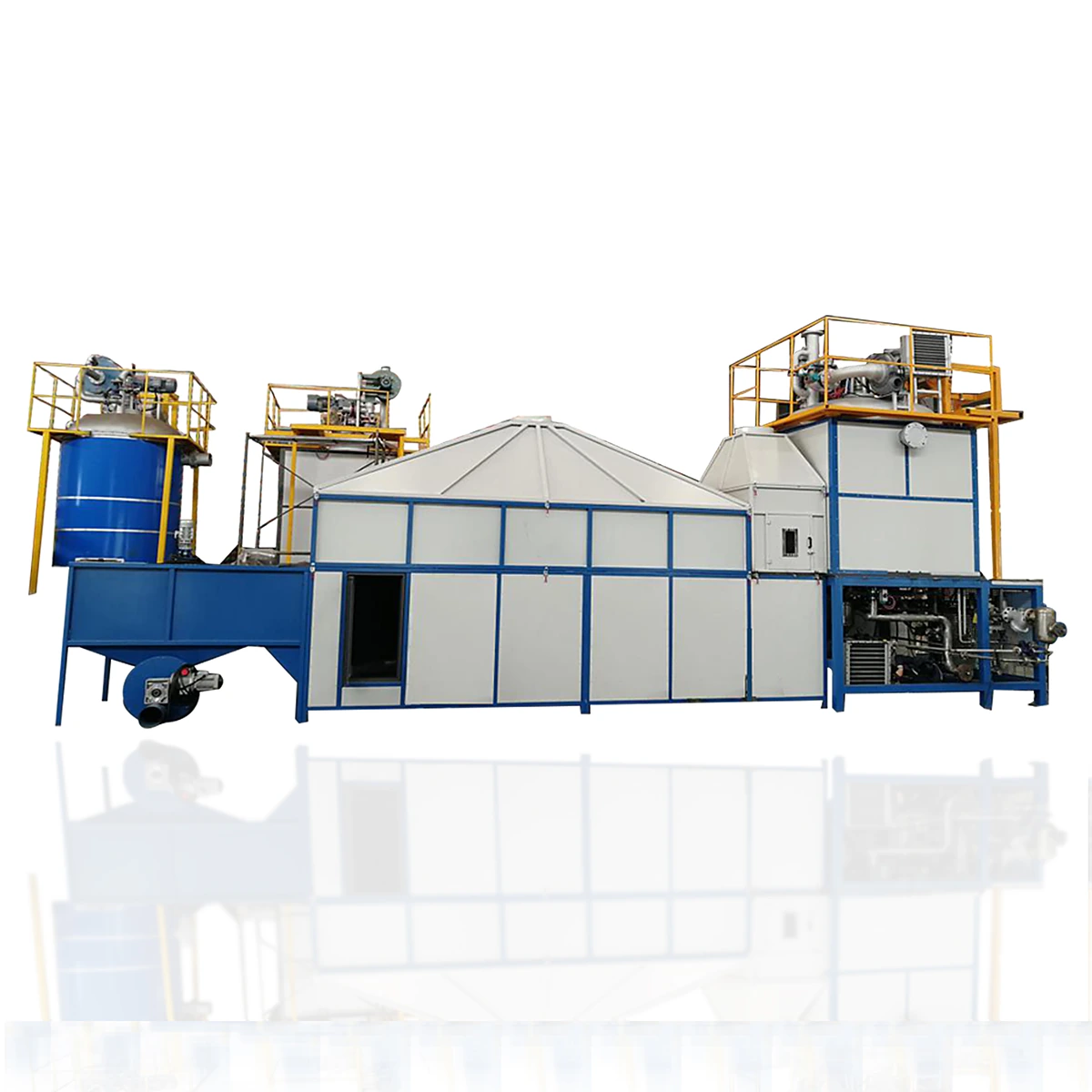
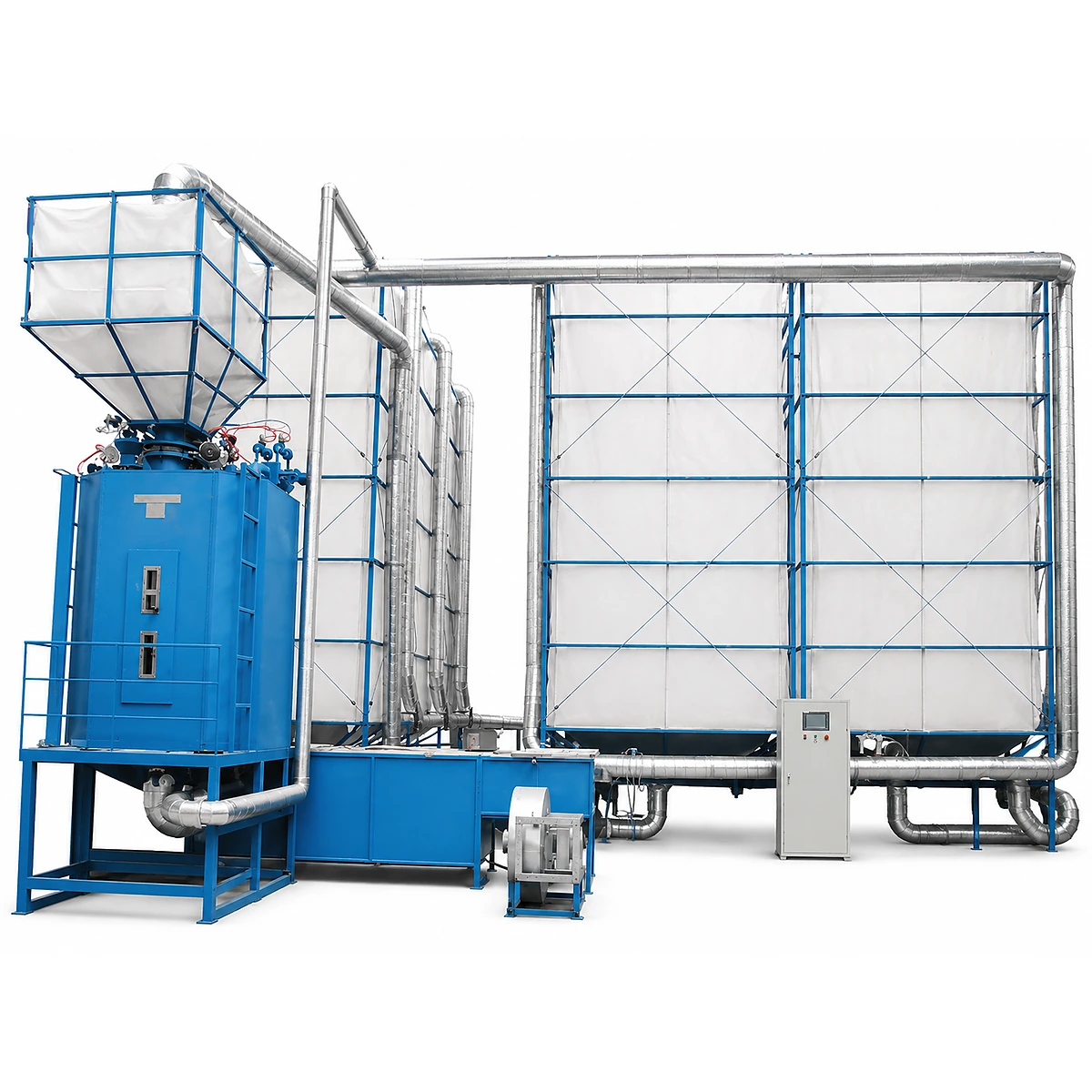
Most EPS plants need a minimum of two aging silos per density grade — one filling while the other discharges to the molding machine — plus one spare group once you run three or more grades or a 24/7 shift pattern. A single-density plant on one shift can run on 2 silos. A three-density operation running around the clock typically needs 6–9. The number that matters here is unit count, not the total cubic meters covered in our silo sizing formula guide — volume tells you how big each vessel should be, count tells you how many you can't run production without.
1. The short answer, by scenario
Total silo volume and silo count answer different questions. A factory can have the "right" 106 m³ of aging capacity from our sizing table split across one giant vessel — and still be unable to run production, because nothing can be filling and discharging at the same time. Count is set by how many things need to happen in parallel, not by how many cubic meters you need in total.
| Production pattern | Density grades run | Minimum silo count | Recommended count |
|---|---|---|---|
| Single shift, 1 grade | 1 | 2 | 2–3 |
| Two shifts, 1–2 grades | 1–2 | 4 | 4–6 |
| 24/7, 2 grades | 2 | 4 | 5–6 |
| 24/7, 3+ grades | 3 | 6 | 7–9 |
| 24/7, 3+ grades, growth planned | 3+ | 6 | 8–10 |
The jump from 2 to 4 silos when adding a second shift is not about extra volume — it is because a two-shift line cannot afford to wait on one discharge cycle before the next fill starts. The jump from 4 to 6+ across three grades is because each grade needs its own fill/discharge pair; grades cannot share a vessel without contaminating the batch, a point our aging silo guide covers under mixing-grade mistakes.
2. Why one silo per density is never enough
A single silo per density grade means the vessel is either filling from the pre-expander or discharging to the molding machine — never both. Every changeover between the two forces a production stop, because there is nowhere for freshly expanded beads to go while the last batch finishes aging. Two silos per grade let one vessel discharge while the other fills, which is the minimum configuration for continuous, unattended production.
This is also why our ES-AUTO aging silo system is sold in pairs per density line by default: the PLC routes incoming beads to whichever unit in the pair is not currently on a discharge lockout, and alternates automatically once the first hits its minimum aging window (typically 8–24 hours, covered in our aging time guide).
3. When two silos per density is not enough
Three situations push the count above the 2-per-grade minimum:
- 24/7 operation. With no downtime between shifts, the discharge window and the fill window overlap more tightly. A third unit per grade gives the line a buffer so a slow discharge on one silo does not stall the pre-expander feeding the next.
- Maintenance and mesh replacement. Mesh fabric silos need fabric replacement every 5–7 years, and any silo needs periodic inspection. Running exactly 2 units per grade means maintenance on either one drops the line back to the single-silo bottleneck described above. A third unit removes that risk.
- Planned output growth. Adding silo capacity later means a shutdown to install new units and re-route pneumatic conveying. Plants that expect to add a density grade or a second shift within 1–2 years typically size for one extra pair up front rather than retrofitting.
None of these change how big each silo needs to be — that stays a function of daily bead volume and aging hours per our sizing formula. They only change how many vessels you split that volume across.
4. Real configurations from customer production lines
The table below is drawn from silo layouts we have specified for customer lines at these approximate output levels, shown here to illustrate how grade count and shift pattern — not output alone — drive the final unit count.
| Factory profile | Grades | Shift pattern | Silo count installed |
|---|---|---|---|
| Small packaging plant, 30 m³/day | 1 (15–25 kg/m³) | Single shift | 2 |
| Mid-size insulation plant, 60 m³/day | 2 (standard + low-density) | Two shifts | 5 |
| Fish-box exporter, 90 m³/day | 1 (8–12 kg/m³) | 24/7 | 3 |
| Multi-product OEM, 150+ m³/day | 3 (technical, standard, low) | 24/7 | 8 |
The fish-box exporter is the clearest illustration: a single grade but round-the-clock output still needed a third silo purely for the maintenance and buffer reasons above — not because the total volume required it. The multi-product OEM shows the other driver: 3 grades × roughly 2.5 units each (with one shared spare) landed at 8, well above what a volume-only calculation would suggest for that output level.
5. Counting mistakes that cause bottlenecks
- Buying total volume, not units. Ordering "100 m³ of aging capacity" as one or two oversized vessels leaves no room for the fill/discharge overlap that keeps a line running. Split the same volume across more, smaller units instead.
- Sizing for today's grade count. Adding a density grade later without adding its own silo pair means it either shares a vessel with an existing grade (contamination risk) or starves for aging time on an undersized share of existing capacity.
- No spare during maintenance. Running the bare minimum of 2 per grade with no third unit means every fabric replacement or inspection cycle forces a production slowdown.
- Assuming batch/continuous pre-expanders need different counts. They don't — the silo count downstream is set by grades and shift pattern, not by which pre-expander type feeds them. What changes is fill rate per silo, not how many silos you need.
- Treating manual and automatic layouts the same way. A manually-tended plant needs the same minimum count as an automatic one to avoid stalls — the PLC in a system like ES-AUTO only removes the labor of tracking which silo is ready, it does not remove the need for a fill/discharge pair per grade.
6. What to send us before we recommend a silo count
With these four items we can confirm the right silo count for your line in one reply:
- How many density grades you run today, and any you plan to add within 1–2 years.
- Shift pattern — single shift, two shifts, or 24/7.
- Whether you currently run mesh fabric, steel panel, or manual bins, since replacement/inspection downtime affects the spare-unit decision.
- Daily bead volume per grade, so we can pair the unit count with the correct volume per unit from our sizing formula.
Frequently Asked Questions
What is the minimum number of EPS aging silos a factory needs?
Two per density grade on a single shift — one filling while the other discharges to the molding machine. Running only one silo per grade forces a production stop every time the vessel switches from filling to discharging.
Do I need more silos if I run 24/7 instead of one shift?
Yes, typically one extra unit per density grade. Continuous operation leaves no downtime buffer between fill and discharge cycles, and a spare unit absorbs maintenance or a slow discharge without stalling the pre-expander feeding it.
Can two different density grades share one aging silo?
No. Mixing grades in one vessel blends batches with different target densities and aging requirements, producing blocks with inconsistent properties across the mix. Each grade needs its own fill/discharge pair.
Does an automatic PLC silo system need fewer units than a manual layout?
No — the minimum fill/discharge pair per grade is the same either way. A PLC system like our ES-AUTO removes the labor of tracking batch age and routing discharge, but it does not remove the physical need for one silo to fill while another discharges.
How many silos do I need for 3 density grades?
At least 6 (2 per grade) on a single shift, and 7–9 for 24/7 operation once a maintenance/buffer spare is added. Multi-grade plants we have specified at this scale typically land at 8 units total.
Is it better to buy one large silo or several smaller ones for the same total volume?
Several smaller ones. A single large vessel cannot fill and discharge at the same time, so the same total capacity split across at least 2 units per grade keeps production continuous, while one oversized silo forces a stop at every changeover.
When should I add a spare silo beyond the 2-per-grade minimum?
When you run 24/7, when your silos are mesh fabric that needs periodic fabric replacement, or when you expect to add a density grade or second shift within 1–2 years. Any of these makes the bare 2-per-grade minimum a production risk rather than just a cost-saving.
Send us your grade count and shift pattern, and we'll size the silo group
Use the contact form to tell us how many density grades you run, your shift pattern, and your current silo type. We'll reply with the exact unit count and per-unit volume for your line. The ES-AUTO aging silo system page has the PLC routing and FIFO details for automatic layouts, and the European Manufacturers of EPS (EUMEPS) publishes broader guidance on conditioning practice if you want a second source before you finalize a layout. Aging silos also accumulate flammable pentane vapour and should be laid out per OSHA flammable-liquids standard (29 CFR 1910.106) regardless of unit count.