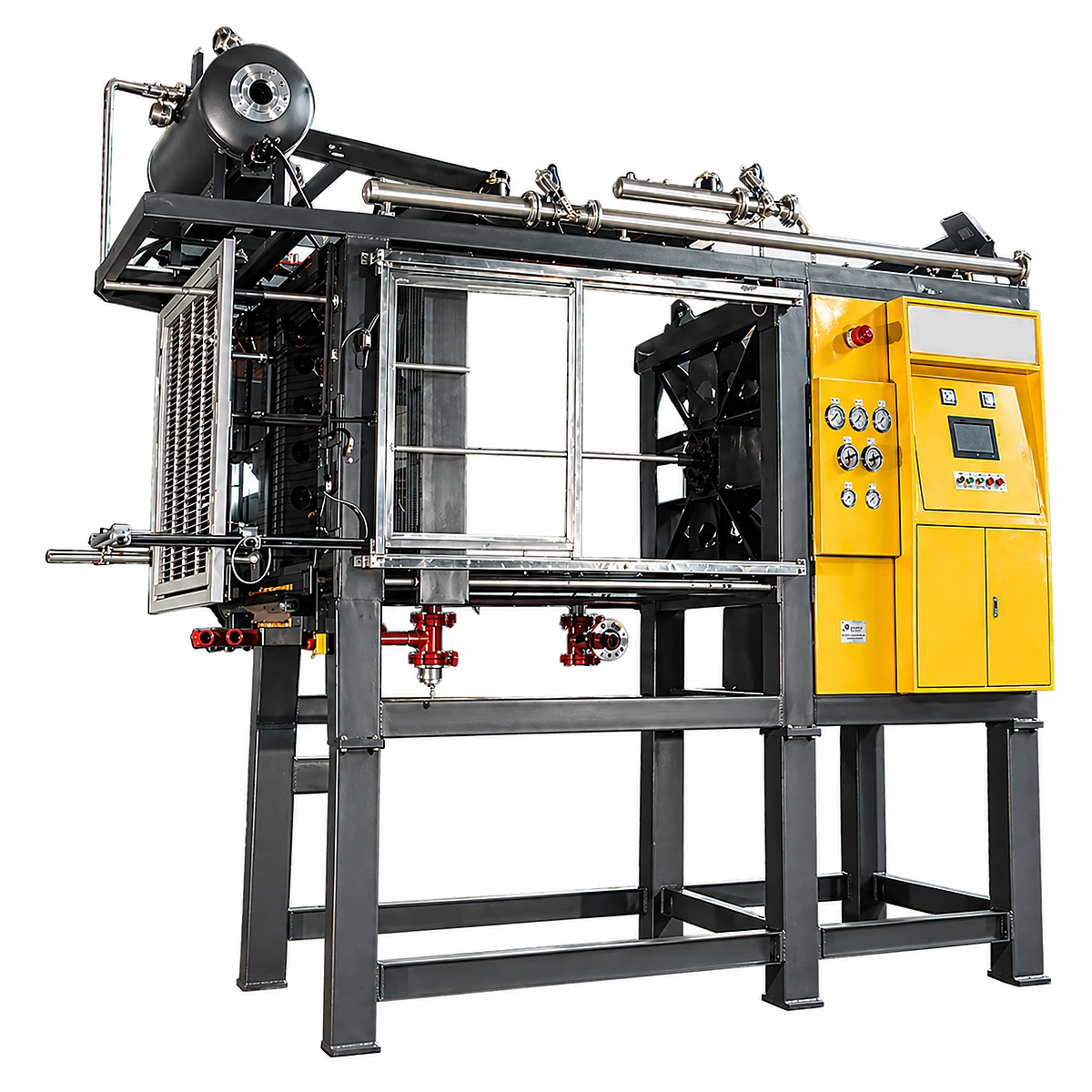

An EPS shape molding machine produces finished foam parts—fish boxes, electronics packaging, ICF blocks, helmet liners—directly in custom molds with no secondary cutting. Fitted with box tooling, this is the machine sold as a foam box molding machine: same platen, steam chest and control system, different cavity set. Prices range from $25,000–$45,000 for the SM-1000 (1,000×800 mm platen) to $55,000–$90,000 for the SM-1400 (1,400×1,200 mm). Key specs to compare: platen size (determines max part dimensions), cycle time (45–90 sec), steam consumption (15–30 kg/cycle), and automation level. Shape molding is best when you produce >5,000 identical parts/month; for lower volumes or frequent design changes, block molding + CNC cutting is more cost-effective.
Because shape-molded parts frequently serve food-service and protective-packaging uses, buyers should confirm the resin grade meets FDA food-contact packaging rules for the destination market and source from an ISO 9001-certified manufacturer.
EPS shape molding machines are the workhorses behind a vast range of everyday products — from the custom foam inserts protecting your new television during shipping, to the insulated fish boxes keeping seafood fresh across thousands of miles of cold chain, to the ICF blocks revolutionizing energy-efficient construction. Unlike block molding machines that produce large rectangular blocks for subsequent cutting, shape molding machines produce finished parts directly in custom molds, emerging from the machine ready for use with no secondary processing required.
For manufacturers evaluating an EPS shape molding machine purchase, the decision involves balancing numerous technical specifications against application requirements and budget constraints. A machine that excels for fish box production may be entirely wrong for automotive EPP parts. This buyer's guide provides the technical foundation and practical advice you need to make an informed selection, whether you are equipping a new factory or adding capacity to an existing operation.
How Shape Molding Works: The Production Cycle
Understanding the shape molding process is essential for evaluating machine specifications intelligently. Every cycle consists of four fundamental stages, and the machine's design directly influences the speed, quality, and energy efficiency of each stage.
Stage 1: Filling
Pre-expanded and aged EPS beads are pneumatically conveyed from aging silos into the mold cavity through fill guns (also called injectors). The number and placement of fill guns are critical — complex mold geometries with thin sections, deep pockets, or varying wall thicknesses require more fill guns positioned strategically to ensure uniform bead distribution. Under-filling or uneven filling leads to voids, weak spots, and inconsistent density in the finished part. Modern machines use adjustable fill air pressure and programmable fill gun sequencing to optimize this stage.
Stage 2: Steam Heating (Fusion)
Steam is injected into the mold cavity in a carefully controlled sequence. First, a purge phase displaces air from the bead bed. Then, cross-steaming passes steam through the beads from one mold half to the other (and then in reverse), heating and expanding the beads further so they fuse together. Finally, an autoclave phase applies steam pressure to both sides simultaneously, completing the fusion. The total steam time, pressure, and sequence directly determine the mechanical strength, surface finish, and density of the finished part. This is where machine control system quality matters most — precise steam valve timing (measured in tenths of a second) can mean the difference between perfect fusion and either under-fused (crumbly) or over-fused (warped, high-density) parts.
Stage 3: Cooling
After fusion, the part must be cooled until it is dimensionally stable enough to be ejected without warping or expanding further. Cooling is achieved by spraying water on the outside of the mold walls and, in energy-saving machines, by applying vacuum to the mold cavity. Vacuum cooling is significantly faster than water-only cooling (reducing cooling time by 30–50%) and also reduces the moisture content of the finished part. The cooling stage is typically the longest phase of the cycle and therefore the primary target for cycle time optimization.
Stage 4: Ejection
The mold opens and the finished part is ejected using mechanical ejectors (push pins) and/or air blow-off. The part drops onto a conveyor or into a collection bin. The machine then closes the mold and the cycle repeats. Ejection system design affects part surface quality (ejector marks) and cycle reliability (parts must release cleanly every cycle without sticking).
Cycle Time Factors
Total cycle time for shape molding typically ranges from 60 seconds for thin-walled, low-density parts (such as simple packaging inserts) to 180+ seconds for thick-walled, high-density parts (such as ICF blocks or heavy-duty packaging). The primary factors affecting cycle time are:
- Part wall thickness: Thicker walls require longer steam penetration and longer cooling times. Doubling wall thickness can more than double cycle time.
- Target density: Higher density parts require more steam energy input and longer cooling.
- Mold design: Well-designed molds with efficient steam venting, uniform steam distribution, and good cooling water coverage cycle faster.
- Machine capability: Steam delivery rate, vacuum capacity, and cooling water flow rate all set upper limits on how fast the cycle can run.
- Material: EPP (Expanded Polypropylene) requires significantly higher steam temperatures and pressures than EPS, resulting in longer cycle times.
Key Specifications to Evaluate
When comparing EPS shape molding machines from different manufacturers, focus on these critical specifications. Each one directly impacts your production capability, product quality, or operating cost.
Platen Size (Mold Mounting Area)
The platen size determines the maximum mold size the machine can accept, which in turn determines the maximum part size (or number of cavities for multi-cavity molds). Platen dimensions are specified as width × height.
| Platen Size (mm) | Typical Applications | Machine Class |
|---|---|---|
| 800 × 600 | Small packaging inserts, cups, small specialty items | Small |
| 1,000 × 800 | Medium packaging, small fish boxes, electronic product packaging | Small–Medium |
| 1,200 × 1,000 | Fish boxes, cooler boxes, medium packaging, ICF blocks | Medium |
| 1,400 × 1,200 | Large fish boxes, multi-cavity packaging, ICF blocks, automotive parts | Medium–Large |
| 1,600 × 1,200 | Large packaging, industrial parts, multi-cavity production | Large |
| 1,800 × 1,400 and above | Very large parts, high-cavity-count production molds | Extra Large |
Selection guidance: Choose a platen size that accommodates your largest planned mold plus a margin of at least 100 mm on each side for mold clamping fixtures. If you anticipate future products requiring larger molds, sizing up one class is often worth the modest additional cost. However, running small molds on an oversized machine wastes energy (heating and cooling unused platen area), so match the machine to your dominant product range.
Clamping Force
During the steam heating phase, internal pressure builds inside the mold cavity as the beads expand. The clamping system must hold the mold halves together against this pressure to prevent the mold from opening (which would cause flash — excess material squeezing out at the parting line — and potentially damage the mold or produce defective parts).
How to calculate required clamping force: Minimum clamping force (kN) = Maximum cavity pressure (bar) × Projected mold area (cm²) / 10. For standard EPS production, maximum cavity pressure during autoclave phase is typically 0.8–1.2 bar. For EPP, cavity pressure runs higher and rises with target density and wall thickness rather than sitting at one fixed figure — confirm the number against your specific part before sizing the clamp, and do not substitute the EPS figure. For example, a mold with 12,000 cm² projected area running EPS at 1.0 bar requires: 1.0 × 12,000 / 10 = 1,200 kN clamping force minimum. Always apply a safety factor of 1.2–1.5 above the calculated minimum.
Steam Consumption
Steam is the largest variable operating cost in shape molding. Machines vary significantly in their steam efficiency depending on mold chamber design, steam distribution, insulation, and whether they employ energy-saving features like vacuum cooling (which reduces the amount of steam needed per cycle by reducing cooling water usage and condensate formation).
Typical steam consumption for EPS shape molding ranges from 40 to 80 kg per cubic meter of finished product, depending on part geometry, density, and machine efficiency. Energy-saving machines with vacuum cooling can reduce this by 20–35% compared to conventional machines. For a detailed analysis of steam costs and optimization strategies, see our guide on Steam and Energy Cost Optimization in EPS Production.
Cycle Time
Cycle time directly determines production output and therefore revenue potential per machine. A machine that cycles 20% faster produces 20% more parts per shift — a significant economic advantage over the machine's lifetime. Factors under the machine manufacturer's control that affect cycle time include:
- Steam delivery rate: Larger steam valves and ports deliver steam faster, reducing heating time.
- Vacuum system capacity: Larger vacuum tanks and pumps remove moisture and reduce pressure faster, cutting cooling time.
- Cooling water flow: Higher water flow rates accelerate mold cooling.
- Mold opening/closing speed: Hydraulic system design determines how quickly the platens move.
- Control system response time: Faster PLC scan times and valve actuation speeds enable tighter process control and shorter transitions between phases.
Automation Level
Manual: Operator manually initiates each cycle phase, adjusts parameters, and removes parts. Suitable only for very low-volume production or prototyping. Rarely used in commercial production today.
Semi-automatic: The machine runs the complete cycle automatically once the operator initiates it. The operator loads/unloads inserts (if any) and monitors quality. This is the most common configuration for small to medium production runs.
Fully automatic: The machine cycles continuously without operator intervention. Parts are ejected onto conveyors and counted automatically. Robotic systems may handle part stacking, packaging, or insert loading. Essential for high-volume production (fish boxes, ICF blocks, commodity packaging) where labor cost per part must be minimized.
Control System
The PLC (Programmable Logic Controller) and HMI (Human-Machine Interface) are the brain of the shape molding machine. The control system manages the precise timing of fill, steam, cooling, and ejection phases, stores recipes for different products, monitors process parameters, and logs production data.
PLC brand matters: Premium PLC brands — Siemens (S7-1200 or S7-1500 series), Mitsubishi (Q or iQ-R series), or Omron (NJ/NX series) — offer faster processing speeds, better reliability, easier programming for complex sequences, and worldwide availability of spare parts and service engineers. Machines equipped with lesser-known PLC brands may be cheaper initially but can create headaches with spare parts availability, finding qualified technicians for troubleshooting, and limitations in process control sophistication. This is not where to cut costs.
The HMI should be an industrial touchscreen (7 inches minimum, 10–15 inches preferred) displaying real-time process data, recipe management, alarm history, and maintenance reminders. Remote monitoring capability via Ethernet connection is increasingly valuable for production management and for the equipment manufacturer to provide remote diagnostic support.
Machine Types
Horizontal vs. Vertical Configuration
Horizontal machines have the mold opening in a horizontal plane (the movable platen travels horizontally). This is the most common configuration for EPS shape molding. Advantages include easy part ejection (gravity assists), straightforward mold changes, and better visibility for operators.
Vertical machines have the mold opening in a vertical plane (the movable platen travels vertically). These are used primarily for specific applications where gravity-assisted filling is advantageous (filling from the top into deep cavities) or where floor space is constrained. Vertical machines are less common in standard EPS production.
For most EPS shape molding applications, horizontal machines are the standard and recommended choice.
Standard vs. Energy-Saving (Vacuum Cooling) Machines
Standard machines cool the mold and part using water spray only. This is effective but relatively slow, and the excess water creates moisture in the finished part that may need a drying period before packaging.
Energy-saving machines incorporate vacuum cooling in addition to water spray. After the water spray phase, a vacuum pump evacuates the mold cavity, rapidly evaporating residual moisture from the part surface. This phase change absorbs heat very efficiently, accelerating cooling. Benefits include 30–50% reduction in cooling time (and therefore total cycle time), 20–35% reduction in steam consumption per part (because less condensate forms), lower moisture content in finished parts, and significant reduction in overall energy cost per part.
The additional cost of the vacuum system (vacuum tank, vacuum pump, piping, and valves) is typically recovered within 6–18 months through energy savings and increased output. For any production volume above hobby-scale, energy-saving machines with vacuum cooling are strongly recommended.
EPS vs. EPP Shape Molding Machines: Capability Differences
An EPP shape molding machine is built on the same platen, steam chest, and control system as the EPS machines described throughout this guide — the difference is that its mold frame, steam chambers, and clamping system are rated for EPP's higher pressure and temperature range rather than the EPS baseline. Buyers searching for an EPP shape molding machine are, in practice, evaluating the same equipment class covered here with one additional capability box to check.
EPS (Expanded Polystyrene) machines operate at steam pressures of 0.8–1.2 bar and temperatures around 100–110 degrees Celsius. This is standard in the industry.
EPP (Expanded Polypropylene) requires significantly higher steam pressures and temperatures (roughly 130–155 degrees Celsius) than EPS, due to the higher melting point of polypropylene. Required pressure is not one fixed figure — it rises with part density and wall thickness, and quoted numbers also depend on where they are measured, since boiler, machine inlet, and mold jet pressure read differently. Machines designed for EPP must have reinforced mold frames and platens to handle the higher clamping forces, higher-pressure steam chambers and piping rated for the increased pressure, more powerful clamping systems, and enhanced cooling capacity.
An EPP-capable machine can always run EPS, but a machine that is not rated for EPP pressure and temperature cannot be pushed into EPP service by adjusting settings alone — the mold frame, platen, steam chambers, and clamping system all need the higher rating built in. How much headroom you need scales with the EPP density and wall thickness you are targeting. If you plan to produce EPP products now or in the future, specify EPP capability rated for your target density from the outset; upgrading an EPS-only machine after purchase is usually impractical and uneconomical.
Application-Specific Machine Selection
Different EPS/EPP products have different production requirements. Here is what to prioritize when selecting a machine for the most common applications.
Fish Boxes and Cooler Boxes: The Shared Machine Requirements
Fish boxes and cooler boxes are among the highest-volume EPS shape molding products globally. Key selection criteria include:
- Fast cycle time: These are commodity products with thin margins, so production speed is critical. Vacuum cooling is essential. Target cycle times of 60–90 seconds for standard fish boxes.
- Multi-cavity molds: Running 2, 4, or even 6 fish boxes per cycle dramatically improves productivity. Choose a platen size large enough for multi-cavity tooling — typically 1,200 × 1,000 mm or 1,400 × 1,200 mm.
- Full automation: High-volume fish box production requires fully automatic cycling with conveyor ejection and automatic stacking/counting systems.
- Hygiene: For food-contact applications, the machine and mold materials must meet food safety standards in your market. Stainless steel steam chambers or food-grade coatings may be required.
- Durability: Fish box production often runs 20+ hours per day, 6–7 days per week. The machine must be built for continuous heavy-duty operation with premium hydraulic components, oversized bearings, and heavy-gauge steel construction.
EPS Cooler Box Molding Machine: Where Insulated Boxes Diverge
An EPS cooler box molding machine is the same shape molder described above, tooled with a cooler box mold. What changes is not the machine class but which requirement sets the wall thickness — and on a cooler box that requirement is thermal, not structural. That single difference moves your wall to the thick end of the box range, and wall thickness is the variable that drives cycle time.
On a fish box the wall is sized to survive ice load and palletising. On a cooler box — food delivery, medical sample transport, vaccine cold chain — the wall is sized to hold a temperature for a stated number of hours, and the box is only as good as its worst-conducting path. Three consequences follow, and all three are worth settling before you specify the mold.
Wall thickness is a thermal specification, so it lands at the top of the range. Thermal resistance is simply thickness divided by conductivity. Using the white EPS conductivity published in our graphite EPS guide — λ roughly 0.036–0.038 W/(m·K) — the wall alone contributes:
| Wall thickness | Thermal resistance of the wall (m²·K/W) | Where this wall sits in the box range |
|---|---|---|
| 30 mm | 0.79–0.83 | 10–20 L short-haul formats |
| 40 mm | 1.05–1.11 | 40 and 60 L, the common cooler wall |
| 50 mm | 1.32–1.39 | 100 L long-haul and frozen formats |
Read that table for what it is: conduction through the wall only. It is not a hold time. Hold time depends on payload mass and starting temperature, ambient temperature, the coolant you pack, lid fit and how often the box is opened — none of which is a machine parameter and none of which a machine supplier can quote for you. Anyone who quotes you a guaranteed hold time from a wall thickness alone is selling, not engineering. Fix your hold-time target with a loaded test on your own payload and route, let that test set the wall, and only then specify the mold.
The thick wall is what changes your machine sums. As set out under cycle time factors above, doubling wall thickness can more than double cycle time, because steam has to penetrate further and the part has to cool longer. A cooler box specified at 40–50 mm therefore cycles slower than the thin-walled boxes that the day-rate figures in the box format section are built on, and it runs fewer cavities per platen for the same reason a 100 L box does. If you are budgeting a cooler box line on box-per-day numbers borrowed from fish box production, build in that penalty before you size the plant — otherwise the shortfall appears after commissioning, when it is a mold and platen problem rather than a spreadsheet problem.
Two mold-design decisions are specific to insulated boxes. First, drainage: fish boxes are commonly molded with a perforated bottom and a drain plug, which is required under EU import rules; a cooler box must be sealed, so that geometry has to be deliberately removed rather than inherited from a fish box tool. Second, the lid interface: on a cooler box the lid seat is a thermal joint as much as a mechanical one, and a stepped or rebated seat is what stops the shortest conduction path from running straight through the gap. Both are mold-design decisions, which is precisely why the mold, not the machine badge, is where a cooler box program succeeds or fails.
Everything else transfers. The same SM-1200 that runs fish boxes runs cooler boxes — its density range of 15–50 kg/m³ spans both, and a same-format mold swap takes about 45 minutes, against 4–6 hours when the platen and steam piping have to be reconfigured for a different format. For food-contact and medical uses, confirm the bead grade against FDA food-contact packaging rules for your destination market, and specify the material to ASTM C578 so the thermal and compressive properties on your datasheet are verifiable rather than asserted.
ICF Blocks (Insulated Concrete Forms)
ICF blocks are large, geometrically complex parts with interlocking features that demand tight dimensional tolerances. Key selection criteria include:
- Dimensional accuracy: ICF blocks must interlock precisely on the construction site. Machine platen parallelism and rigidity are critical. Look for machines with four-point guided platens and minimum deflection under clamping load.
- Large platen size: ICF blocks are typically 1,200 × 300 × 250 mm or larger. Multi-cavity production of ICF blocks requires platens of at least 1,400 × 1,200 mm.
- Higher density capability: ICF blocks are typically produced at 25–35 kg/m³ (higher than standard packaging EPS) for structural performance. The machine must deliver sufficient steam for thorough fusion at these densities.
- Consistent fusion: The interlocking features and web structures of ICF blocks require excellent steam distribution throughout the mold to ensure uniform fusion. Advanced steam valve sequencing and multi-zone steam control are advantageous.
Packaging Inserts (Electronics, Appliances, Industrial)
Packaging inserts are custom-shaped cradles and cushions designed to protect specific products during shipping. The molder is one machine inside a larger plant — the EPS packaging molding machine and line configuration page sizes the pre-expander, silos, molders and utilities against each other at 1, 2 and 4-machine scale. Key selection criteria include:
- Versatility: A packaging manufacturer typically produces hundreds of different part designs for different customers. Rapid mold changes (under 30 minutes) are important. Quick-change mold clamping systems save significant production time.
- Recipe storage: The control system should store at least 100–200 product recipes for one-touch changeover between products. Each recipe records the optimal fill, steam, cooling, and ejection parameters for that specific part.
- Moderate platen size: Most packaging inserts fit within 1,000 × 800 mm or 1,200 × 1,000 mm platens. Oversizing is less beneficial here because each product has different mold dimensions.
- Surface quality: Premium electronics packaging requires smooth, mark-free surfaces. The machine's ejection system must be adjustable to avoid visible ejector marks on cosmetic surfaces.
Automotive Parts (EPP)
Automotive EPP parts — bumper cores, side impact protection, headrest cores, tool box inserts, and trunk organizers — represent the highest-value application for shape molding technology. Key selection criteria include:
- EPP capability: This is non-negotiable. Automotive EPP parts sit at the high end of the density and wall-thickness range, so confirm the machine's rated steam pressure covers your specific part density — not just a general EPP rating — and that construction is reinforced throughout.
- Precision control: Automotive parts have strict density tolerances (often ±1 kg/m³) and dimensional specifications. Premium PLC control systems (Siemens S7-1500 or equivalent) with multi-zone steam and cooling control are required.
- Traceability: Automotive OEMs increasingly require part traceability — recording process parameters for every cycle and linking them to specific production batches. The machine control system should support data logging and export.
- Consistency: Automotive qualification audits (PPAP, SPC) require demonstrated process stability. Machines with tight mechanical tolerances, repeatable hydraulic positioning, and precise steam control pass these audits more readily.
- Energy efficiency: Automotive EPP parts consume significantly more energy per part than EPS products due to higher steam pressures. Vacuum cooling and steam recovery systems offer substantial cost savings at automotive production volumes.
Foam Box Molding Machines: Configuration by Box Format
A foam box molding machine is an EPS shape molding machine tooled with a box cavity set. Pre-expanded beads fill the mold, steam at 0.8–1.2 bar fuses them, water and vacuum cool the part, and ejectors release a finished box — typically in 60–90 seconds. Nothing in the machine is box-specific: the mold is. Platen size and cavity count decide your output, not the model badge.
This matters commercially, because buyers shopping for a "foam box molding machine" are usually specifying a product before they specify a machine. The box format you intend to sell — and the market you sell it into — sets the wall thickness and density, which set the mold, which set the minimum platen. Work in that order and you buy once.
| Box format | Wall thickness | Target density | Minimum platen | Multi-cavity headroom |
|---|---|---|---|---|
| 10–20 L bait, retail, short-haul |
30 mm | 18–22 g/L | 1,200 × 1,000 mm | Highest — smallest footprint per box, so the most cavities per cycle |
| 40 L the global standard box |
40 mm | 18–22 g/L | 1,200 × 1,000 mm | Moderate |
| 60 L larger catch, palletised |
40 mm | 18–22 g/L | 1,400 × 1,200 mm | Low |
| 100 L long-haul, frozen |
50 mm | 25–30 g/L | 1,400 × 1,200 mm | Single cavity in most tooling |
Volume, wall and density figures above follow the box specification table in our fish box cost and market guide, which also maps formats to buying markets — India favours 20 and 40 L, Indonesia 40 and 60 L, Vietnam 40 L, and Latin America 60 and 100 L. Once the format is fixed the rest of the plant follows from it: the EPS fish box production line page carries the 20-item configuration, the steam / compressed-air / cooling-water demand, and the container loading for 1, 2 and 4-machine builds. Two geometry decisions belong at mold-design stage, not after: whether the box is stackable with a locking lid (which decides return-shipping economics) and whether the bottom is solid or perforated with a drain plug, since perforated bottoms are required under EU import rules.
What Output Should You Expect?
Output follows the platen and the cavity count, not the model name. Across the three equipment tiers a box line runs roughly 4,000–6,000 boxes/day at entry level, 6,000–9,000 mid-tier, and 9,000–12,000+ industrial — but budget on 70–85% of nameplate, which is where real throughput lands once mold changes and operator maturity are accounted for.
Wall thickness is the variable most often underestimated. A 50 mm wall does not cycle like a 30 mm wall: doubling wall thickness can more than double cycle time. That is why the 100 L long-haul box is the one format capable of pushing a comfortable 60–90 second box cycle toward the 180-second end of the shape molding range, and why a factory planning to sell both 20 L and 100 L boxes should size its platen and its steam supply for the 100 L case.
EPS Fish Box Molding Machine: What Actually Changes
An EPS fish box molding machine is not a separate machine class — it is a shape molder specified around a fish box mold. The machine is identical; the mold, the platen it needs, and the density you run are what the application dictates. Buyers searching for one are almost always at the 40 L standard box, which lands on a 1,200 × 1,000 mm platen at 18–22 g/L and a 40 mm wall — the second row of the table above.
Three things do change once you commit to fish boxes specifically, and they are worth pricing before you sign:
- Density is fixed by the cold chain, not by your cost target. Fish boxes carry ice and stack wet. The 18–22 g/L band above is the floor for a box that survives palletising; dropping to 15 g/L to save bead cost produces boxes that crush in transit. For long-haul frozen at 100 L, the table already puts you at 25–30 g/L.
- Drainage and corner fusion drive your reject rate. Fish box corners are the thickest section and the last to fuse. This is the cycle-time constraint discussed above — running the 60–90 second cycle short shows up as crumbly corners, not as a visible surface defect.
- Cavity count is where the money is. Because box volume scales faster than platen area, a 20 L box can run several cavities on the same platen where a 100 L box runs one. Output per machine is set by cavities per cycle, not by the machine's model number.
For the surrounding equipment — pre-expander sizing, aging silos, steam demand and container loading — see the EPS fish box production line configuration page, and EPS fish box line cost by tier for CapEx bands.
ChinaEps Shape Molding Machine Lineup
ChinaEps offers a range of shape molding machines engineered for reliability, energy efficiency, and consistent part quality across applications from packaging to automotive. Our core lineup includes three models sized for different production requirements.
| Specification | SM-1000 | SM-1200 | SM-1400 |
|---|---|---|---|
| Platen Size (mm) | 1,000 × 800 | 1,200 × 1,000 | 1,400 × 1,200 |
| Mold Depth (mm) | 200–500 | 200–600 | 250–700 |
| Clamping Force (kN) | 800 | 1,200 | 1,800 |
| Steam Pressure (bar) | 0.8–1.5 | 0.8–1.5 | 0.8–3.5 |
| Fill Guns (max) | 16 | 24 | 32 |
| Ejector Pins (max) | 12 | 20 | 28 |
| Vacuum Cooling | Optional | Standard | Standard |
| PLC Control | Siemens S7-1200 | Siemens S7-1500 | Siemens S7-1500 |
| HMI | 10" touchscreen | 12" touchscreen | 15" touchscreen |
| Recipe Storage | 100 | 200 | 500 |
| EPP Capable | No | Optional | Yes |
| Best For | Packaging inserts, small parts, startups | Fish boxes, cooler boxes, ICF, general packaging | Large parts, multi-cavity production, automotive EPP |
All three models feature heavy-duty welded steel frames, precision-ground platen surfaces, proportional hydraulic systems for smooth and accurate platen movement, multi-zone steam distribution, integrated condensate recovery, and remote diagnostic capability via Ethernet. Visit the individual product pages for detailed specifications, dimensional drawings, and configuration options: SM-1000, SM-1200, SM-1400.
Mold Considerations
The mold is just as important as the machine — arguably more so, since mold quality directly determines part quality, cycle time, and per-part cost. When budgeting for a shape molding operation, allocate serious attention and investment to mold design and fabrication.
Mold Materials
Cast aluminum: The most common mold material for EPS shape molding. Aluminum offers excellent thermal conductivity (fast heating and cooling), good machinability, relatively low weight, and adequate durability for most production volumes. Cast aluminum molds are suitable for production runs up to approximately 500,000–1,000,000 cycles depending on part complexity and maintenance.
Machined aluminum: CNC-machined from solid aluminum billet, these molds offer tighter dimensional tolerances and better surface finish than cast aluminum. They cost more but are preferred for applications requiring high precision (ICF blocks, automotive parts) or superior surface quality (visible packaging).
Steel: Used for very high-volume production (millions of cycles) or EPP processing where the higher steam pressures and temperatures would degrade aluminum molds prematurely. Steel molds are heavier, more expensive, and have lower thermal conductivity (longer cycle times) but offer the longest service life.
Mold Cost Factors
Mold cost is influenced by part size and complexity, number of cavities, material (aluminum vs. steel), tolerance requirements, surface finish requirements, steam vent design, and ejection system complexity. As a rough guide, a simple single-cavity EPS packaging mold in cast aluminum sits at the lower end of the cost range, while a complex multi-cavity fish box mold or an automotive EPP mold sits well above it given the added cavities, tighter tolerances, and steel construction. Contact us with your part drawing for a firm mold quotation.
Importance of Mold Quality
Attempting to save money by purchasing cheap, poorly designed molds is one of the most common and costly mistakes in EPS shape molding. A poor-quality mold causes longer cycle times (poor steam distribution and cooling), inconsistent part quality (density variations, incomplete fusion, surface defects), higher scrap rates, frequent production stoppages for mold adjustments, and premature mold failure.
Always work with experienced mold makers who understand EPS/EPP process requirements. ChinaEps can supply molds designed specifically for our machines and your products — visit our products page for details on our mold design and fabrication capabilities.
Common Mistakes When Buying a Shape Molding Machine
After working with hundreds of EPS manufacturers worldwide, we have observed the same purchasing mistakes repeated frequently. Avoiding these will save you significant money and frustration.
Mistake 1: Undersizing the Machine
Buyers often select a machine based on their current largest product, with no margin for growth. When a new customer requires a slightly larger mold, the machine cannot accommodate it, and a sale is lost — or worse, a second machine must be purchased prematurely. Always consider your product roadmap over the next 3–5 years when selecting platen size and clamping force. Going one size larger than your current minimum is usually a wise investment.
Mistake 2: Ignoring Steam System Requirements
The shape molding machine is only as good as the steam supply feeding it. A high-performance machine connected to an undersized boiler through long, uninsulated pipes will deliver disappointing cycle times and inconsistent quality. Before purchasing the machine, verify that your boiler capacity, pipe sizing, and steam distribution system can deliver the required steam flow at the required pressure to the machine. If upgrading the steam system, include this cost in your machine investment budget, not as an afterthought.
Mistake 3: Choosing Based on Price Alone (Especially the PLC)
The least expensive machine on the market is rarely the best value. Machines with cheap PLC systems, thin-gauge steel, undersized hydraulic components, and basic control software may save 15–20% on purchase price but typically cost more over their lifetime through higher energy consumption, more frequent breakdowns, slower cycle times, and difficulty finding qualified service support. The PLC in particular is not the place to cut costs — a Siemens or Mitsubishi PLC costs modestly more than a generic brand but provides dramatically better reliability, process control, and global service support.
Mistake 4: No Spare Parts Plan
EPS shape molding machines operate in harsh conditions — steam, heat, moisture, and continuous cycling. Wear parts (seals, fill gun tips, valve seats, ejector pins) need regular replacement. If you do not stock critical spare parts, a single worn seal can shut down production for days or weeks while parts are shipped from the manufacturer. Before the machine ships, request a recommended spare parts list from the manufacturer and purchase at least a 6-month inventory of consumables and the most critical wear parts. This small upfront investment provides enormous production continuity insurance.
Mistake 5: Neglecting Mold Quality
As discussed in the mold section above, investing in a premium machine and then fitting it with a cheap mold is like putting worn tires on a sports car. Budget adequately for professional mold design and fabrication. A well-made mold will produce better parts, cycle faster, and last longer — more than justifying the higher initial cost.
Mistake 6: Not Evaluating After-Sales Support
During the purchasing process, everything works perfectly. The real test comes 18 months later when a hydraulic cylinder develops a leak at 2 AM during peak season. How responsive is the manufacturer? Do they maintain a parts inventory? Can they provide remote diagnostic support? Do they have service engineers in your region? These questions matter enormously for your long-term production reliability. Ask for references from existing customers in your region and contact them about their after-sales experience before making your purchasing decision.
Get Expert Guidance on Your Machine Selection
Selecting the right EPS shape molding machine is a decision that will impact your production capability, product quality, operating costs, and profitability for years to come. The investment in making the right choice — evaluating specifications carefully, matching the machine to your applications, and selecting a manufacturer with strong after-sales support — pays dividends throughout the machine's 15–20 year operating life.
ChinaEps brings decades of application engineering experience to every machine selection conversation. We do not simply sell machines — we engineer complete production solutions tailored to your specific products, production volumes, and growth plans. Our team will analyze your product requirements, recommend the optimal machine configuration, design your molds, plan your factory layout, and support you through installation, commissioning, and ongoing production.
Ready to discuss your shape molding requirements? Contact our application engineering team with details about your target products, production volumes, and timeline. We will provide a detailed machine recommendation with specifications, pricing, and delivery timeline — no obligation.
Frequently Asked Questions
What is a foam box molding machine?
A foam box molding machine is an EPS shape molding machine fitted with box tooling. Pre-expanded beads fill the cavity, steam at 0.8–1.2 bar fuses them, water and vacuum cool the part, and ejectors release a finished box — typically in 60–90 seconds. Nothing in the machine itself is box-specific: swapping the mold converts the same machine to helmet liners, ICF blocks, or packaging inserts.
Do I need a different foam box molding machine for each box size?
No — you need a different mold. One machine runs every box format that fits its platen, and recipe storage (100 to 500 recipes depending on model) holds the fill, steam, cooling, and ejection settings for each product. You only step up a machine size when the box itself, or the number of cavities you want per cycle, outgrows the platen.
Is an EPS cooler box molding machine different from a fish box molding machine?
No — it is the same shape molder with a different mold. What differs is which requirement sets the wall: on a fish box the wall is structural, on a cooler box it is thermal, which usually puts a cooler box at the 40–50 mm end of the range. That matters commercially because wall thickness drives cycle time — doubling wall thickness can more than double the cycle — so a cooler box line will not hit the boxes-per-day figures quoted for thin-walled formats. Two mold details are also specific to insulated boxes: no perforated bottom or drain plug, and a stepped lid seat so the joint is not the shortest conduction path.
What is the difference between a shape molding machine and a block molding machine?
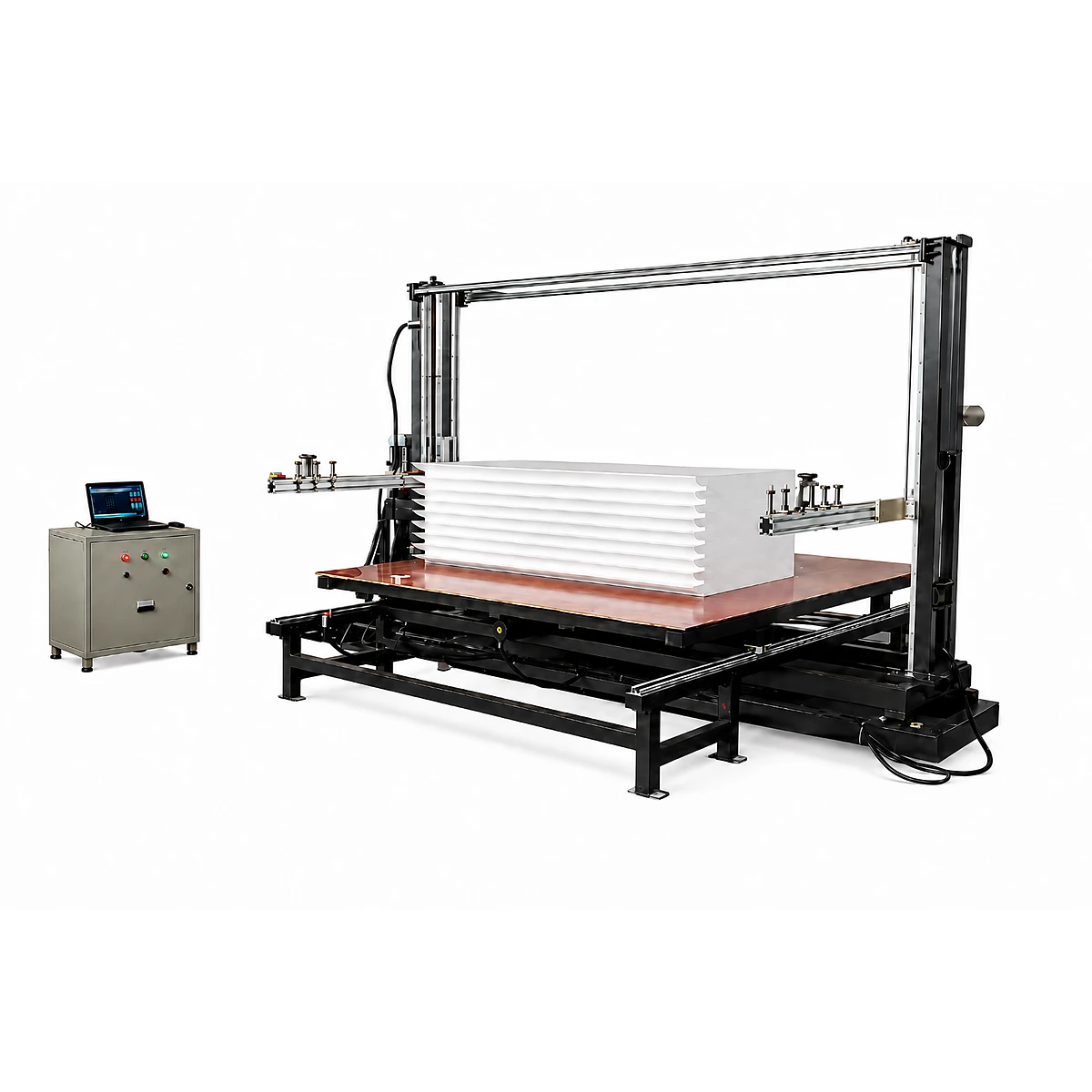
A block molding machine produces large rectangular EPS blocks (typically up to 6,000 × 1,200 × 1,000 mm) that are subsequently cut into sheets or custom shapes using hot-wire cutting machines. A shape molding machine produces finished parts directly in custom molds — the part emerges from the machine in its final shape with no secondary cutting required. Block molding is more efficient for producing flat insulation boards, while shape molding is necessary for complex 3D shapes like packaging inserts, fish boxes, and ICF blocks.
What is the typical cycle time for an EPS shape molding machine?
Cycle times vary widely depending on the product. Thin-walled, low-density parts (small packaging inserts) can cycle in 60–80 seconds. Standard fish boxes typically cycle in 70–100 seconds. Thick-walled, high-density products (ICF blocks, heavy-duty packaging) may require 120–180 seconds or more. EPP products generally cycle 20–40% slower than comparable EPS products due to higher processing temperatures. Machines with vacuum cooling systems achieve 30–50% shorter cooling times compared to water-only cooling machines.
What is an EPP shape molding machine?
An EPP shape molding machine is a shape molder — the same platen, steam chest, filling, cooling, and ejection stages described throughout this guide — built with a mold frame, steam chambers, piping, and clamping system rated for EPP's higher processing range: roughly 130–155 degrees Celsius and steam pressure that runs from about 2.5 bar up to 4.0 bar or more for automotive-grade parts, against the 0.8–1.2 bar and 100–110 degrees Celsius baseline for EPS. It is not a separate machine model; it is an EPS-class shape molder specified with EPP-rated construction from the outset.
Can one machine produce both EPS and EPP products?
Only if the machine is specifically designed for EPP processing. EPP needs meaningfully higher steam pressure than the 0.8–1.2 bar used for standard EPS, and the required pressure rises with EPP part density and wall thickness rather than sitting at one fixed figure. An EPP-capable machine has reinforced structure, higher-pressure-rated steam chambers and piping, and more powerful clamping systems. An EPP-capable machine can always run EPS (at lower pressures), but a machine not rated for EPP pressure cannot be safely or effectively used for it. If you plan to process EPP now or in the future, specify EPP capability rated for your target density at the time of purchase.
How much does an EPS shape molding machine cost?
Prices vary by machine size, configuration, and manufacturer. As a general range for Chinese-manufactured machines (which offer excellent value for performance): pricing scales with platen size, moving up from small machines (1,000 × 800 mm platen) to medium machines (1,200 × 1,000 mm) and large machines (1,400 × 1,200 mm and above). EPP-capable configurations and full automation packages add to the base price. Contact us with your target platen size and output requirements for a firm quotation. European-manufactured machines of comparable specifications are typically 2–4 times more expensive. The machine price is only part of the total investment — factor in molds, steam supply, auxiliary equipment, and installation.
How do I choose between a small and large machine?
Base your decision on your product range and growth plans, not just your current volume. A machine that is slightly larger than your current needs offers flexibility to accept larger molds, run multi-cavity tooling for higher output, and take on new products without purchasing additional equipment. However, significantly oversizing wastes energy and capital. The best approach is to discuss your product list and 3–5 year business plan with the machine manufacturer so they can recommend the optimal size for your situation.
What maintenance does a shape molding machine require?
Daily maintenance includes checking hydraulic oil level and temperature, inspecting fill gun tips for wear, verifying steam trap operation, cleaning mold venting slots, and inspecting ejector pins. Weekly tasks include lubricating guide rails and tie bars, checking vacuum system for air leaks, and inspecting electrical connections. Monthly tasks include hydraulic oil filtration analysis, steam valve inspection, and calibration checks. Annual overhauls should include a complete hydraulic system service, steam chamber inspection, and replacement of all worn seals and gaskets. Following the manufacturer's preventive maintenance schedule is the single most important factor in maximizing machine life and minimizing unplanned downtime.
Is an EPS fish box molding machine different from a standard shape molding machine?
No. It is the same machine with a fish box mold fitted. What the application dictates is the minimum platen size (1,200 × 1,000 mm for the standard 40 L box, 1,400 × 1,200 mm at 60–100 L), the density band (18–22 g/L for iced transport, 25–30 g/L for long-haul frozen), and the cavity count that sets your daily output. Specify the box format first, then the mold, then the machine — in that order you buy once.
Related Reading
- EPS Fish Box Production Line: Complete Guide 2026 (India, Indonesia, Vietnam) — Extended reading in the same cluster.