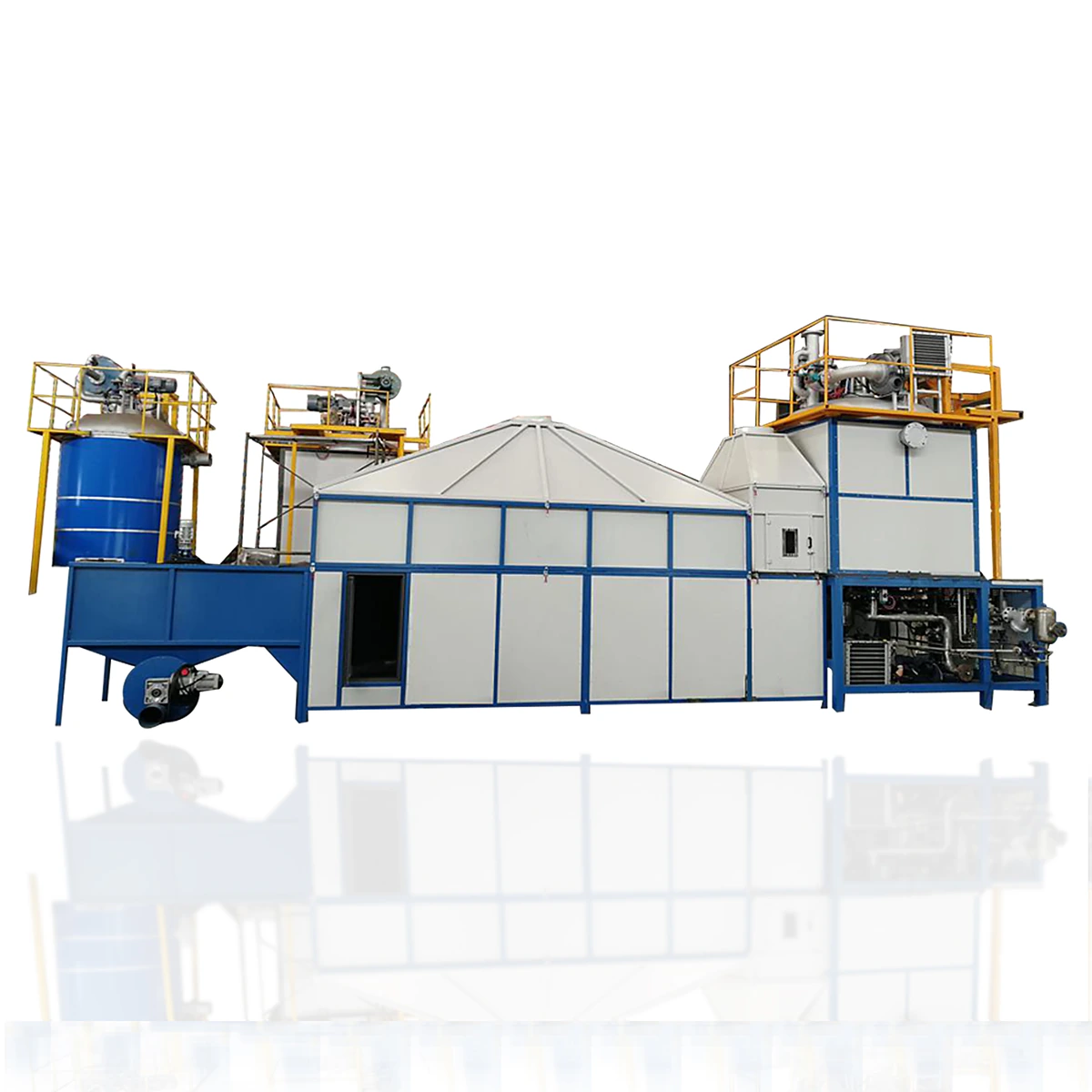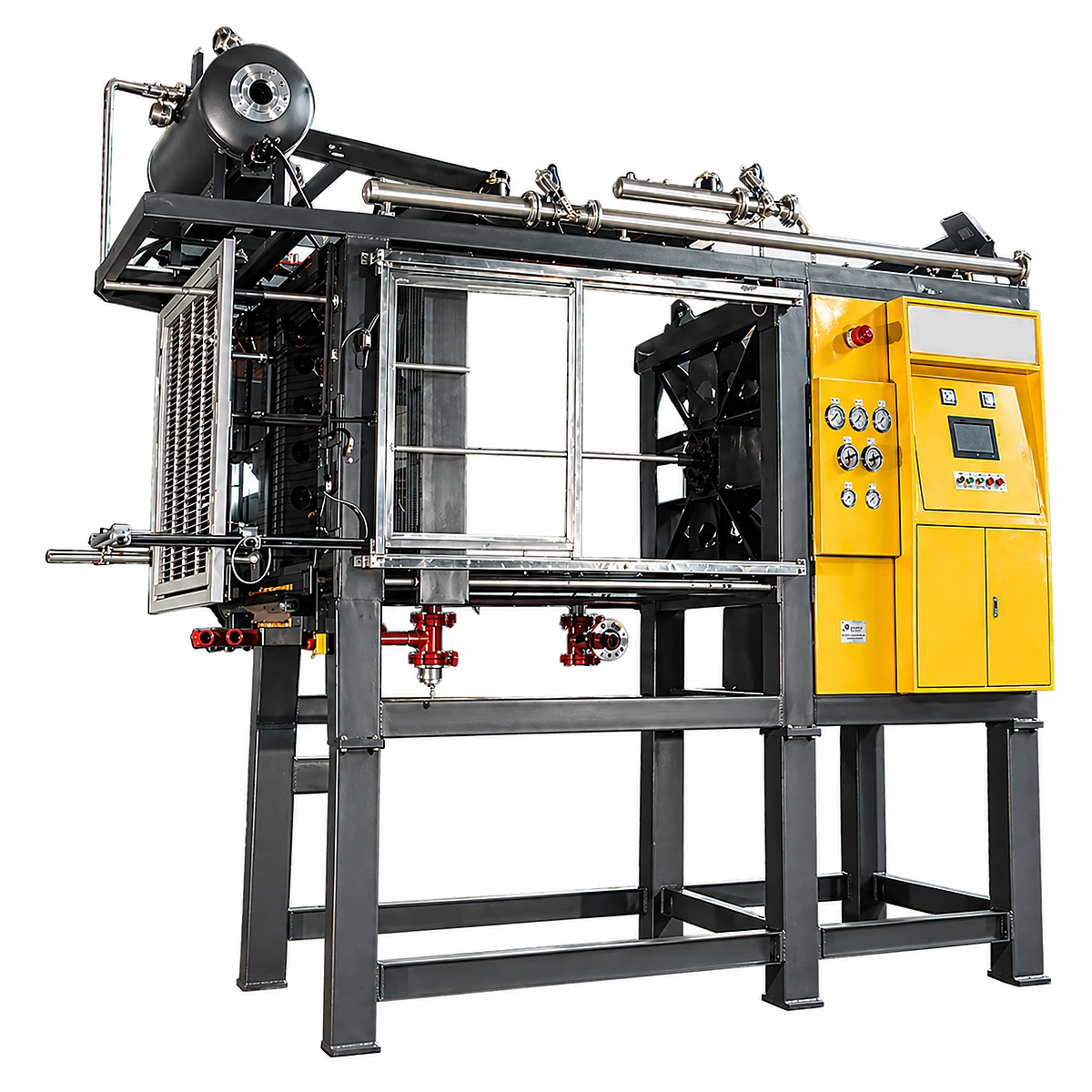
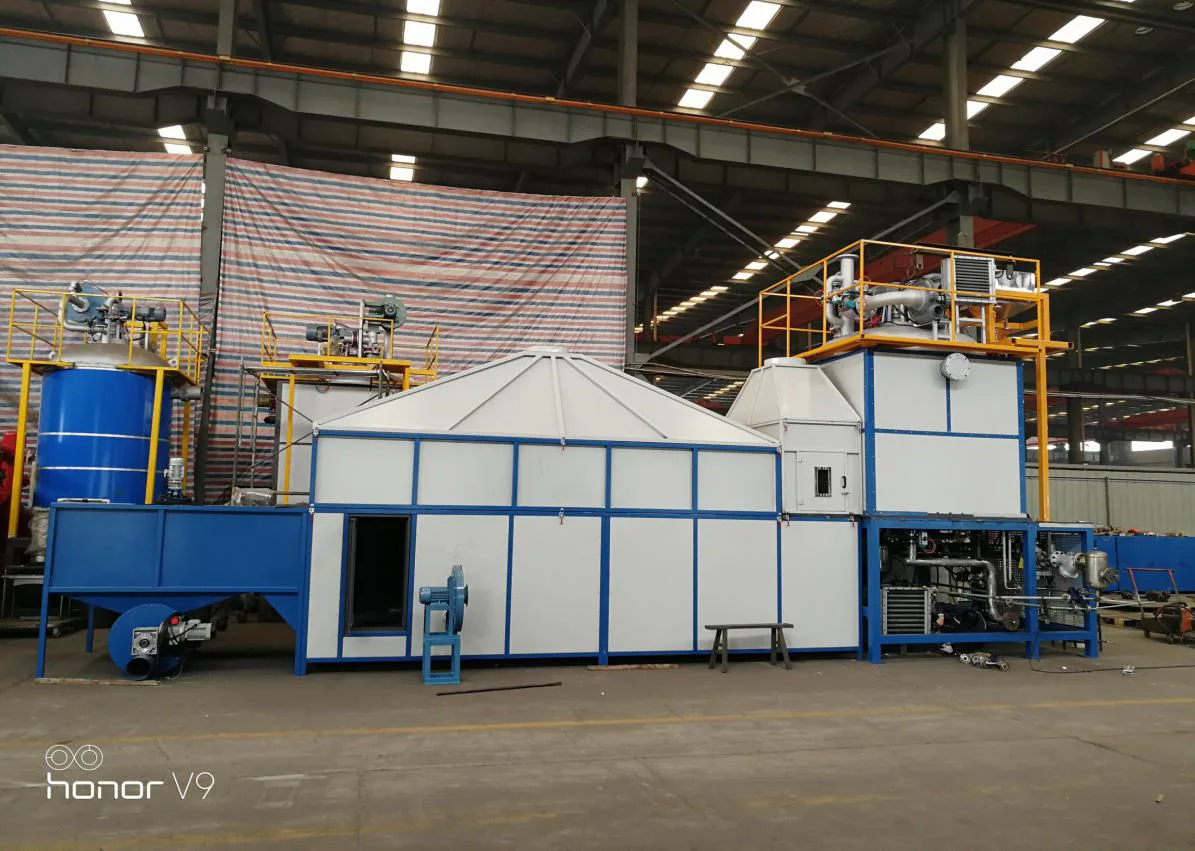
A complete EPS production line costs $80,000 (basic 200 ton/year output) to $850,000 (industrial 5,000+ ton/year). Procurement source dramatically affects price: China FOB pricing leads at $80K–$500K depending on configuration; India domestic at $95K–$650K; Vietnam/Turkey assemblers at $130K–$750K; European (Germany/Italy) at $280K–$1,200,000 — premium of 80–140% over China for similar specifications. Lead times: China 45–75 days FOB + 30–45 days shipping; India 30–60 days domestic; Vietnam 35–50 days; Europe 90–180 days. This buyer guide compares like-for-like pricing across 4 procurement origins, breaks down total landed cost (FOB + shipping + duty + commissioning), and gives you the 6-question vendor verification framework. Pair with our 8-question EPS machinery buying guide for vendor-level due diligence, and how to set up an EPS factory for full layout planning.
1. Why Factory Origin Matters in 2026
The B2B equipment market for cellular foam machinery has fragmented dramatically since 2022. China remains the largest exporter (approximately 65% of global EPS machinery exports per IEA petrochemical capacity tracking), but India has scaled domestic manufacturing to serve South Asian and African markets, Vietnam has emerged as a Tier-2 assembler with strong CE-certified offerings, and European OEMs (mostly Germany and Italy) remain the premium reference for technical excellence.
For a buyer placing a $200K+ order, the procurement decision hinges on three factors: total landed cost (not just FOB price), local serviceability (parts availability, technician access), and certification fit (which markets you can resell into, and what certifications your end customers require). This guide gives you the numbers to compare apples-to-apples across the four major procurement origins.
2. EPS Production Line Configurations — Apples-to-Apples Comparison Base
Before comparing prices across countries, we need to fix the configuration. The four production line tiers used in this comparison are:
| Tier | Output | Equipment Stack | Factory Footprint |
|---|---|---|---|
| Starter | 200–400 ton/year | 1 pre-expander (PE-900 class) + 1 aging silo + 1 block molder (BM-1200) + 1 cutting line (CM-2000) + small packing | 500–800 m² |
| Mid | 800–1,500 ton/year | 1 pre-expander (PE-1400) + 2 aging silos + 1 block molder (BM-1400) + 1 shape molder (SM-1200) + automated cutting + recycling crusher | 1,200–1,800 m² |
| Industrial | 2,500–5,000 ton/year | 2 pre-expanders + 4 aging silos + 2 block molders (BM-1800) + 2 shape molders + automated cutting + full recycling + densifier + warehouse automation | 3,000–5,000 m² |
| Premium/Industrial+ | 5,000+ ton/year | Continuous pre-expander + 6+ silos + 3+ block molders + full automation + ICF/insulation board cutting line + integrated mold-change system | 5,000+ m² |
Real-world configurations vary, but these four tiers cover roughly 95% of new EPS factory projects in emerging markets.
Illustrative Calculation — Not a Universal Guarantee
The prices, payback periods, and ROI numbers below use assumed inputs for raw-material cost, electricity, steam, labor, tariffs, sale price, and factory utilization. Actual results vary significantly by country and site. Send your local cost inputs to info@chinaeps.net for a country-specific model.
3. FOB Pricing by Country (2026)
FOB (Free On Board) pricing means the equipment is delivered to the export port in the country of manufacture. Buyer pays international shipping, duty, and import handling. These are 2026 Q2 prices from established manufacturers with documented export history:
| Tier | China FOB | India Ex-Works | Vietnam FOB | Turkey FOB | Germany/Italy FOB |
|---|---|---|---|---|---|
| Starter | $80K–$120K | $95K–$140K | $110K–$160K | $130K–$190K | $280K–$420K |
| Mid | $160K–$240K | $180K–$280K | $220K–$320K | $260K–$380K | $520K–$780K |
| Industrial | $280K–$450K | $340K–$520K | $420K–$580K | $480K–$680K | $850K–$1,200K |
| Industrial+ | $450K–$700K | $520K–$800K | $650K–$850K | $720K–$950K | $1.1M–$1.8M |
China leads on FOB by 15–45% versus regional alternatives, and 80–140% versus Europe. The savings are real, but FOB is not the full picture — see total landed cost analysis in Section 5.
ChinaEps factory note (3-site network: Jiangyin / Wenzhou / Dongguan): Of the 60+ export markets we serve, the procurement pattern is consistent — buyers in India, Indonesia, Brazil, Pakistan, and Iran consistently choose China FOB for Starter and Mid tiers, while Industrial+ buyers in Europe and North America split between China FOB (for budget projects under $600K) and German equipment (for projects requiring >5,000 ton/year output with 15+ year amortization assumptions). What we hear most from new buyers: the FOB number is rarely the decision-clincher — landed cost + spare parts price-locked list + after-sales technician dispatch terms together determine the real cost of ownership.
4. Lead Time by Country
Lead time directly impacts factory commissioning schedule and working capital lock-up. Faster delivery often justifies a higher unit cost when project timelines are tight:
| Origin | Manufacturing Lead Time | Shipping to Major Destination | Total Door-to-Door |
|---|---|---|---|
| China FOB | 45–75 days | 30–45 days (sea, to India/Vietnam/MEA) | 75–120 days |
| India domestic | 30–60 days | 3–15 days (road/rail within India) | 35–75 days |
| Vietnam FOB | 35–50 days | 20–35 days (sea, regional) | 55–85 days |
| Turkey FOB | 40–65 days | 15–30 days (to MEA/Europe) | 55–95 days |
| Germany/Italy FOB | 90–180 days | 20–45 days | 110–225 days |
For India-based buyers, domestic procurement is fastest. For Middle East and Africa buyers, China and Turkey are roughly equivalent on door-to-door time. Europe is consistently 50–80% slower than alternatives — significant for buyers needing factory operational within 6 months.
5. Total Landed Cost — Beyond FOB
FOB pricing tells you what the equipment costs at the source port. Total landed cost includes everything required to get the equipment installed and operational at your factory. Here is the real math for a Mid-tier ($160K–$240K FOB) line landed in India (Mumbai port, 2026):
| Cost Component | China Origin | India Origin | Vietnam Origin | Germany Origin |
|---|---|---|---|---|
| FOB / Ex-Works price | $200,000 | $230,000 | $270,000 | $650,000 |
| International freight (40' container ×2) | $4,800 | $0 (domestic) | $3,200 | $5,500 |
| Import duty (India example, 10–15% basic) | $24,000 | $0 | $32,400 | $78,000 |
| GST/VAT (18% India) | $36,000 | $41,400 | $48,600 | $117,000 |
| Clearing + inland transport | $3,500 | $1,500 | $3,500 | $4,200 |
| Installation + commissioning | $18,000 | $15,000 | $22,000 | $45,000 |
| Total landed cost | $286,300 | $287,900 | $379,700 | $899,700 |
Notice the convergence at the landed level. China FOB at $200K becomes $286K landed in India — almost identical to India domestic at $288K. The 15% FOB advantage gets eroded by duty and shipping. Vietnam looks 12% worse than China; Europe remains 215% more expensive at the landed level — and that is before counting after-sales service costs (Europe travel + technician day rates run $1,500–2,500/day plus expenses).
For buyers in markets with low import duty (UAE, Saudi Arabia, parts of Africa), the China advantage is preserved. For buyers in heavily tariffed markets (Indonesia foam machinery 20–25% import duty, Brazil higher still), local or regional sources become competitive. Verify the specific HS code (typically 8477.20 for plastics processing machinery) and applicable Free Trade Agreement rates with your customs broker; cross-reference equipment specifications against ASTM C578 (rigid cellular polystyrene specification) and ISO 9001 quality management requirements that customs authorities increasingly request for industrial machinery imports.
6. After-Sales Reality — The Hidden Long-Term Cost
FOB and landed cost dominate the purchase decision conversation, but after-sales costs accumulate over the 10–15 year equipment lifecycle and often exceed initial purchase cost.
- Parts availability: China and India suppliers typically maintain 2–4 week parts dispatch for wear items (cutting wires, heating elements, vacuum seals, control boards). Vietnam and Turkey suppliers run 4–8 weeks. European parts can take 6–12 weeks for non-standard items.
- Technician travel: When a major fault requires on-site repair, Chinese suppliers will dispatch a technician for $200–400/day plus economy travel. European technicians charge $1,500–2,500/day plus business-class travel and per diem.
- Software updates: Modern PLC-controlled lines need periodic firmware updates. Chinese suppliers typically include remote updates free in warranty period; European suppliers often charge $3,000–8,000/visit for on-site programming.
- Spare parts inventory: Plan to hold 8–12% of equipment value in spare parts inventory for any tier; Chinese parts are cheaper to stock, European parts are expensive to hold.
For a mid-tier $200K FOB line over 10 years, total after-sales costs typically run: China $40K–$70K, India $50K–$80K, Vietnam $55K–$85K, Germany $180K–$280K. Add these to landed cost for true 10-year ownership comparison.
7. 6-Question Vendor Verification Framework
Once you have selected a country of origin, vendor selection within that country is critical. Use these 6 questions for any quote you receive:
- Export track record: "Show me 3 reference customers in my target country/region installed in the last 24 months." Reputable vendors will provide names and contact details. Avoid those who only show domestic-market references.
- Certification scope: "Provide CE (MD + LVD) and ISO 9001 certificates with validity dates and scope clearly defined." Verify scope includes the specific equipment model you are buying, not just a generic company-level cert.
- Factory acceptance test (FAT): "I will witness FAT in your factory before shipment, with my actual feedstock material. Confirm available." Suppliers refusing FAT for any reason are red flags.
- Total warranty coverage: "12-month warranty must cover all wearing parts, labor for on-site repair, and travel for technician dispatch within first 90 days." Generic 12-month warranties without these specifics often turn into long disputes when something fails.
- Spare parts price list: "Provide spare parts price list for the top 30 wearing items at order time, locked for 24 months." This protects you against parts inflation after purchase.
- Payment terms with milestone protection: "30% deposit, 60% before shipment, 10% after installation and acceptance." Avoid vendors demanding 50%+ before shipment, and never pay 100% before installation completes.
For broader vendor verification methodology, see our EPS machine buying guide with 8 questions. The 6 questions above sit on top of that framework with country-of-origin specifics.
8. Procurement Decision Matrix by Market
Combining all factors above, here is the recommended primary procurement source by destination market:
| Destination Market | Primary Source | Reason |
|---|---|---|
| India | India domestic OR China FOB (toss-up) | Landed cost similar; India faster delivery, China broader configuration options |
| Indonesia, Philippines, Vietnam | China FOB | Low regional duty, strong shipping lanes, large supplier choice |
| UAE, Saudi Arabia, Kuwait | China FOB | Low import duty, fast sea route via DP World, strong China supplier presence |
| Egypt, Nigeria, South Africa | China FOB OR Turkey FOB | China for price, Turkey for shorter sea route to Africa |
| Brazil, Mexico, Colombia | China FOB OR specialized regional | Heavy local duty (20–35%); China still competitive at landed level for industrial+ tier |
| Eastern Europe (Poland, Romania, Bulgaria) | Turkey FOB OR China FOB | Turkey shorter lead time + EU customs union benefits |
| Western Europe | Germany/Italy domestic OR China FOB for budget | Premium buyers stay European; budget buyers go China and absorb landed cost |
9. Frequently Asked Questions
What is the typical price range for an EPS production line?
$80,000 for a starter line (200–400 ton/year) to $850,000+ for industrial-tier (5,000+ ton/year). Most B2B buyer questions fall in $160K–$450K range for Mid to Industrial tiers serving 800–5,000 ton/year output.
Why are Chinese EPS lines so much cheaper than European?
Three structural reasons: (1) Chinese manufacturing scale — over 200 EPS equipment manufacturers compete domestically, driving prices down; (2) lower labor and overhead in tier-2 Chinese manufacturing cities; (3) different engineering approach — Chinese suppliers optimize for cost-effective configurations, European suppliers optimize for ultra-long lifespan and edge-case performance. The 60–70% Chinese price advantage is real and structural.
Is China-made EPS equipment quality comparable to European?
For 90% of B2B production use cases, yes — provided you buy from established Chinese exporters with CE certification and verified reference customers. Quality variance within Chinese suppliers is high (some are excellent, some are poor), so vendor selection matters more than country of origin. For specialty applications (R&D, ultra-low-density grades, automotive-tier 1) European equipment often still has edge.
What is the import duty on EPS machinery into India?
India basic customs duty on cellular foam machinery is 10–15% as of 2026, plus 18% GST on the duty-inclusive value, plus 1.5% social welfare surcharge. Total effective duty rate is approximately 30–35% on FOB value for non-Free Trade Agreement origins (China). India-China trade does not have a comprehensive FTA covering this equipment, so full duty applies.
How long does it take to commission an EPS factory after delivery?
For Mid-tier lines, plan 4–8 weeks from delivery to first commercial production. This includes: equipment installation (2–3 weeks), utility commissioning (steam, electric, water — 1–2 weeks), trial runs and operator training (1–2 weeks), and quality stabilization (1–2 weeks). Industrial-tier lines run 8–14 weeks. Allow 30% schedule buffer for any first-time installation in a new factory.
What payment terms are standard for international EPS equipment purchase?
Industry standard is 30% deposit on order, 60% before shipment (against B/L copy), and 10% after installation and acceptance test. Letter of Credit (LC) is common for larger orders. Avoid vendors demanding 50%+ upfront or 100% before shipment; these terms create unacceptable buyer risk if anything goes wrong.
Can I split equipment across multiple country origins?
Yes, and many sophisticated buyers do this. Common splits: Chinese block molder + Indian aging silos + European control system. Be aware that mixed-origin lines complicate after-sales service (one vendor cannot diagnose another vendor's equipment) and may invalidate end-to-end warranty coverage. Budget extra commissioning time.
What is the resale value of EPS production equipment after 5 years?
Typically 25–40% of original FOB price for Chinese equipment, 35–55% for European equipment. Resale market is active in emerging Asian markets and Africa. See our companion guide on used EPS machine pricing for resale market analysis.
Do Chinese suppliers offer financing for equipment purchase?
Yes, increasingly common in 2026. Sinosure (China Export & Credit Insurance) backs many large equipment exports with 1–3 year payment terms at competitive rates. Indian banks also offer LC-backed equipment financing. Always confirm financing terms in writing before signing equipment contract.
What certifications should the equipment carry for export to Europe?
Minimum: CE marking (covering Machinery Directive 2006/42/EC and Low Voltage Directive 2014/35/EU). For pressure vessels (large autoclaves), additional PED 2014/68/EU certification. For UK market post-Brexit, UKCA marking is required in addition to or instead of CE. Verify the specific equipment serial-number-level certification, not just generic company-level cert.
Related Reading
- EPS Machine Buying Guide: 8 Questions Before You Order from China — Vendor-level due diligence framework.
- How to Set Up an EPS Factory — Full factory planning beyond equipment selection.
- EPS Machine ROI: 14–22 Month Payback — Investment return analysis methodology.
- EPS Recycling Cost Per Ton: 2026 Pricing — Companion buyer guide for recycling line investment.
- Global EPS Supply Realignment 2026 — Market context driving new factory investment.
- Used EPS Machine Price Guide 2026: Refurbished vs New (Cost, Risk, Warranty) — Extended reading in the same cluster.