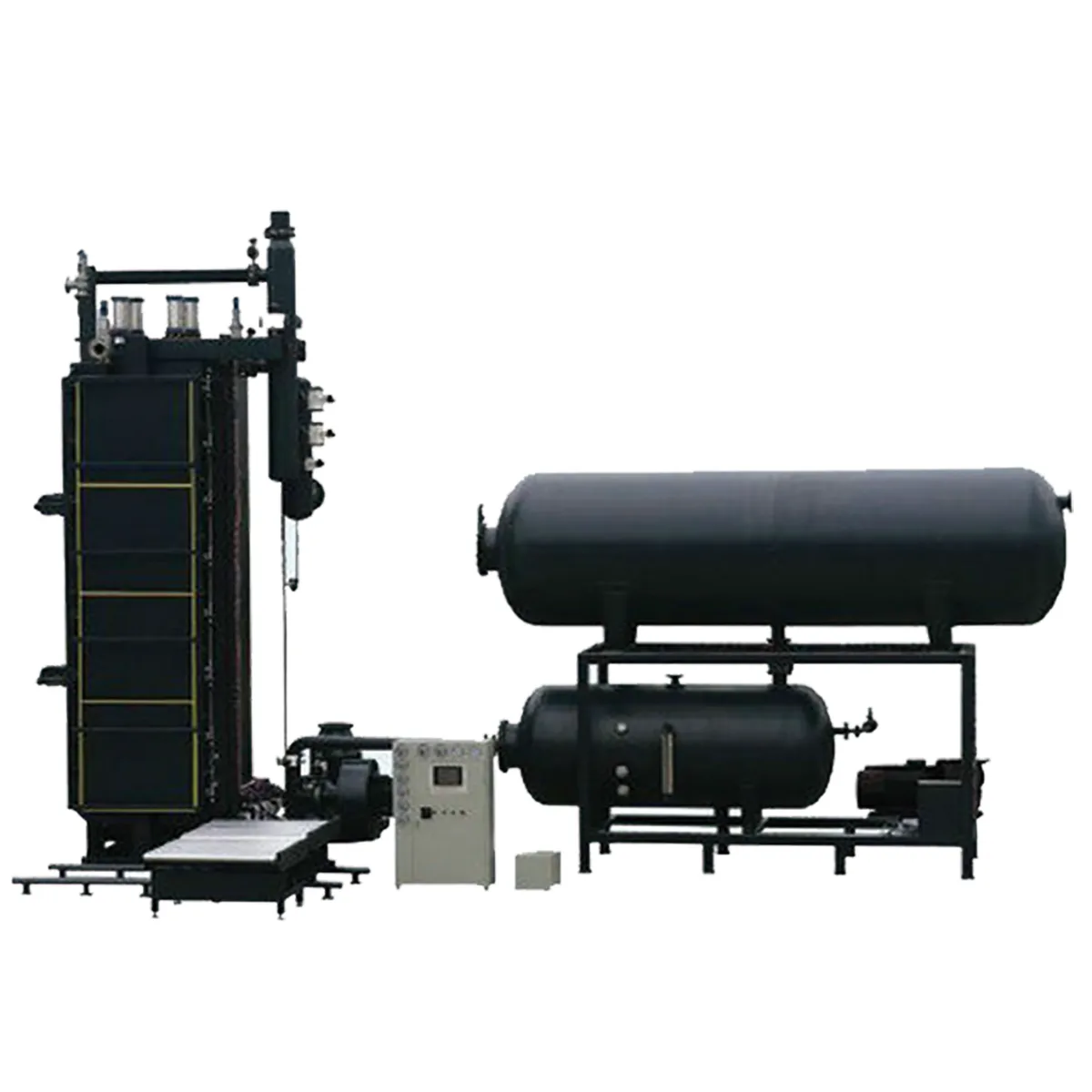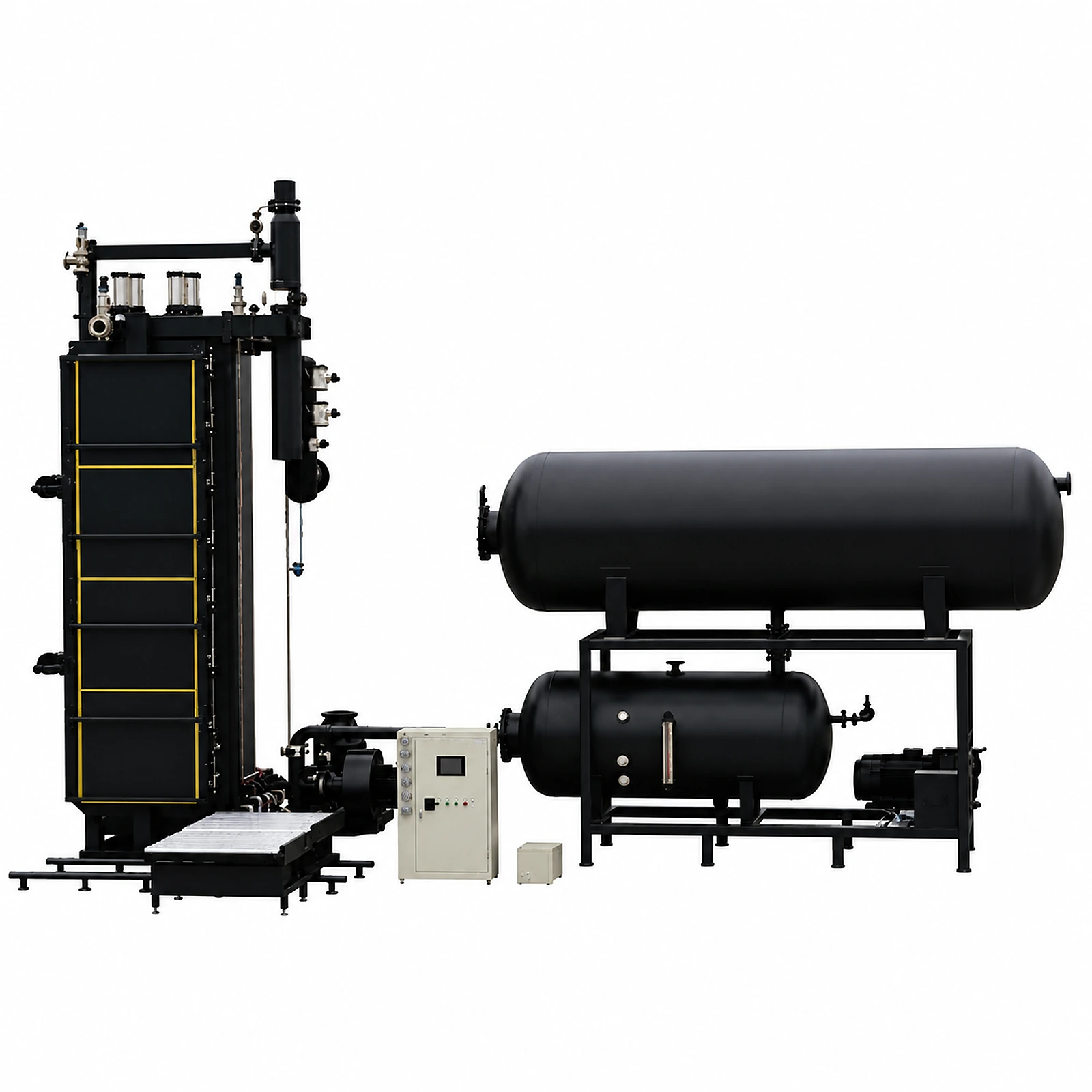
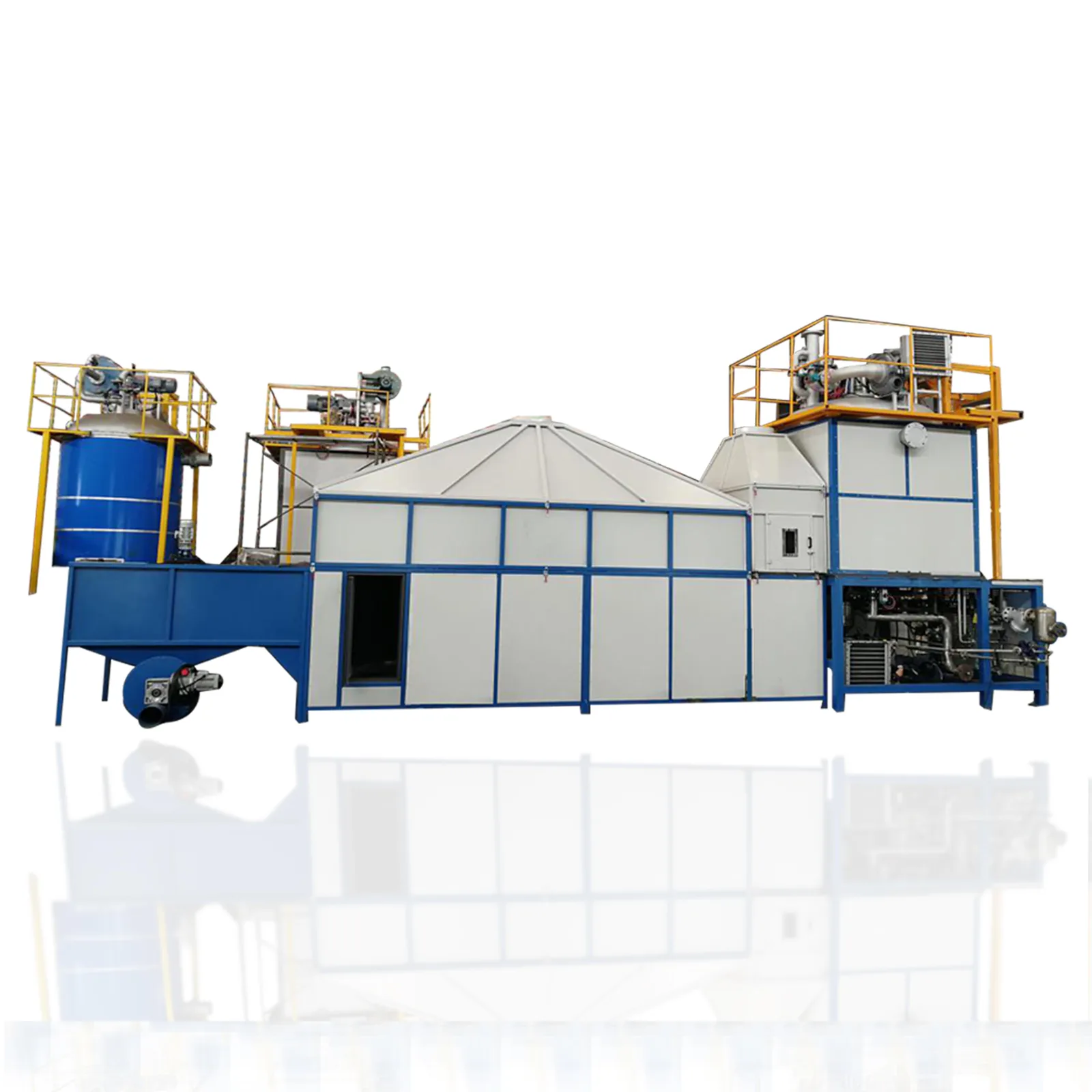
Vacuum cooling reduces EPS block molding cycle time by roughly 30–50% compared to water-only cooling, cutting a typical BM-1200 cycle from 7–8 minutes down to about 5 minutes. The trade-off is upfront cost: a vacuum system adds $8,000–$15,000 to the machine price and introduces a vacuum pump that needs its own maintenance schedule. Below is what each method actually does inside the mold chamber, the numbers that decide which one pays for itself, and where a water-only machine is still the right call.
1. What "cooling" has to accomplish after steam fusion
Steam fusion leaves the block at roughly 90°C or higher at its core, with beads still under internal vapor pressure from the fusion cycle. The block cannot be ejected at that temperature — it is dimensionally unstable and will deform under its own weight or the pusher mechanism. Cooling has to pull the core below roughly 60°C before the hydraulic clamp can safely open and eject, and both vacuum and water-based methods are solving that same problem through different physics.
This stage sits between fusion and ejection in the six-stage EPS block molding process, and it is consistently the longest single stage in the cycle — which is why the cooling method has more influence on total throughput than almost any other spec on the machine.
2. How water cooling works
Water-only cooling sprays or mists water directly onto the mold chamber walls and, in some designs, the block surface after the steam valve closes. Heat transfers from the hot block into the water film through direct conduction and convection, and the water is drained or evaporates off as it absorbs heat. It is a mechanically simple system: a spray manifold, a water supply line, and a drain — no vacuum pump, no sealed chamber requirement beyond what fusion already needs.
The limitation is that conductive cooling through a water film is comparatively slow, especially toward the block core, where the water film has no direct contact. Water-only machines rely mostly on time and residual evaporation to finish the job, which is why their cycle times run longer.
3. How vacuum cooling works
Vacuum cooling uses a vacuum pump (our BM-1200 uses a built-in water ring pump for this) to drop the pressure inside the sealed mold chamber after fusion. At reduced pressure, the moisture already present in and around the beads flash-evaporates at a much lower temperature than it would at atmospheric pressure. That phase change from liquid to vapor absorbs a large amount of heat very quickly — latent heat of vaporization, not simple conduction — and it pulls that heat from inside the block, not just its surface.
Because the cooling effect reaches the block's interior directly rather than working in from the surface, vacuum cooling both finishes faster and produces more even core-to-surface temperature, which is also why vacuum-cooled blocks tend to show less post-demold dimensional drift than water-only blocks of the same density.
4. Cycle time and throughput compared
| Metric | Water-only cooling | Vacuum cooling |
|---|---|---|
| BM-1200 cycle time | 7–8 minutes | ~5 minutes |
| Cycle time reduction | Baseline | 30–50% faster |
| Steam consumption per block | Baseline | 20–35% lower (less condensate re-forms) |
| Blocks per 8-hour shift (approx.) | 60–68 | 96–110 |
The steam savings is a secondary effect worth noting on its own: a faster, more complete cooling phase means less condensate re-forms inside the mold chamber on the next fusion cycle, so the machine uses less steam per block even before counting the throughput gain. Our steam and energy cost guide covers this in more detail for factories evaluating a retrofit.
5. Cost comparison: upfront, operating, and payback
| Cost factor | Water-only cooling | Vacuum cooling |
|---|---|---|
| Additional machine cost | — | +$8,000–$15,000 |
| Extra maintenance item | Spray nozzles only | Vacuum pump service schedule |
| Water consumption | Higher (continuous spray/drain) | Lower (closed-chamber evaporation) |
| Annual energy/output saving | Baseline | $5,000–$12,000 (higher throughput + lower steam use) |
| Typical payback period | N/A | 6–18 months |
The payback period moves mostly with utilization. A factory running close to full shifts recovers the vacuum system's added cost from throughput gains alone within a year; a factory running well under capacity, where the machine sits idle between orders anyway, sees a longer payback because the extra cycles the vacuum system frees up are not being used.
6. When water-only cooling is still the right choice
Water-only is not an inferior fallback — it is the correct spec for a specific set of buyers. It makes sense when:
- Output volume is below roughly 25 blocks per shift. Below that threshold, the throughput gain from vacuum cooling has little idle capacity to fill, so the faster cycle mostly means more downtime between orders rather than more shipped output.
- Capital budget is the binding constraint. A first machine for a new EPS operation, or a factory adding a second line on a tight budget, often gets into production faster and with lower risk on a simpler, cheaper machine.
- Local technical support for vacuum pump service is limited. A water spray system has no vacuum pump to maintain, which matters in regions where qualified service technicians are harder to reach on short notice.
7. When vacuum cooling pays for itself
Vacuum cooling is the better spec once a factory is running consistent volume and the machine is a throughput bottleneck rather than sitting idle between jobs. As a working threshold, operations producing more than roughly 25–30 blocks per shift typically recover the added machine cost within 6–18 months through the combination of more blocks shipped per shift and lower steam consumption per block. Multi-shift operations and factories exporting into markets with tight delivery windows see the fastest payback, since cycle time directly limits how much they can promise customers.
8. Retrofitting an existing water-only machine
Vacuum systems can sometimes be added to an existing water-only block molding machine, but it depends on whether the mold chamber and control system were designed to accept a sealed vacuum stage. Machines built without vacuum provision from the start often cannot be retrofitted without chamber modifications that cost close to what a vacuum-equipped machine would have cost new. If your current line is water-only and you are evaluating an upgrade, send us the machine model and age — we can tell you whether a retrofit is realistic or whether the better path is a new vacuum-equipped machine alongside the existing line.
9. What to send us before we recommend a cooling configuration
With these details we can tell you which cooling method fits your line in one reply:
- Blocks per shift you need to produce, and how many shifts per day.
- Block density range and dimensions you run most often.
- Whether this is a first machine or an addition to an existing line.
- Available capital budget and how it compares to your expected payback window.
- Local access to vacuum pump service and spare parts, if outside major industrial hubs.
Frequently Asked Questions
Does vacuum cooling really cut EPS block molding cycle time in half?
Not quite in half, but close on a typical BM-1200: cycle time drops from 7–8 minutes with water-only cooling to about 5 minutes with vacuum cooling, a 30–50% reduction depending on block density and dimensions.
How much does adding vacuum cooling cost?
A vacuum system typically adds $8,000–$15,000 to the machine price, covering the vacuum pump, sealed chamber hardware, and controls. Most factories running above roughly 25–30 blocks per shift recover that cost within 6–18 months through faster cycles and lower steam use.
Does vacuum cooling reduce steam consumption too?
Yes. Faster, more complete cooling means less condensate re-forms in the mold chamber before the next fusion cycle, which typically lowers steam consumption per block by 20–35% compared to water-only cooling.
Is water-only cooling a lower-quality option?
No — it is a correctly sized option for lower-volume production, tighter capital budgets, or regions with limited access to vacuum pump service. The blocks it produces meet the same density and dimensional specs; the difference is cycle time and throughput, not part quality at a given density.
Can I add vacuum cooling to my existing water-only machine?
Sometimes, if the mold chamber was built to accept a sealed vacuum stage. Machines without that provision from the start usually cannot be retrofitted economically, and a new vacuum-equipped machine is the more practical path. Send us your current machine's model and age and we will tell you which applies.
At what production volume does vacuum cooling start to pay off?
Roughly 25–30 blocks per shift is the working threshold. Below that, idle time between orders absorbs most of the cycle-time gain; above it, the extra throughput and steam savings recover the added machine cost within 6–18 months in most cases.
Does vacuum cooling affect block dimensional stability?
It generally improves it. Because vacuum cooling pulls heat from the block's interior rather than working in from the surface, core-to-surface temperature is more even at ejection, which per the American Society for Testing and Materials EPS insulation standard (ASTM C578) correlates with lower post-demold dimensional drift compared to blocks cooled unevenly from the outside in.
Send us your target output and we will recommend a cooling configuration
Use the contact form to send your target blocks-per-shift, density range, and whether this is a new line or an upgrade. We will reply with a cooling recommendation, expected cycle time, and payback estimate against your current setup. The BM-1200 block molding machine page has full specs for both configurations, and the European Manufacturers of EPS (EUMEPS) publishes broader production guidance on block molding energy efficiency if you want a second source before you specify a system.