The BM-1400 EPS block molding machine produces 1,400 × 800 × 400 mm blocks at 80–120 blocks/day (two-shift), sized for finished-block factories of 30–50 t/day. 2026 China FOB pricing runs $80,000–$110,000 depending on configuration, with documented energy savings up to 32% versus older Chinese block molders (verified Russian deployment, 2025). This guide walks through specifications, capacity math, total-installed cost, and the BM-1200 / BM-1400 / BM-1800 decision matrix.
The BM-1400 sits at the heart of mid-capacity EPS production lines worldwide — from Russian insulation board factories to Egyptian ICF construction suppliers. Buyers comparing block molding machines often see manufacturer spec sheets that list block dimensions but skip the metrics that actually drive economics: density variance, mold-change time, steam consumption per cycle, and configuration trade-offs. This guide fills those gaps with verifiable data, real deployment outcomes, and references to the relevant ISO 845 and ASTM D1621 standards every procurement specification should reference.
1. What Is the BM-1400 EPS Block Molding Machine?
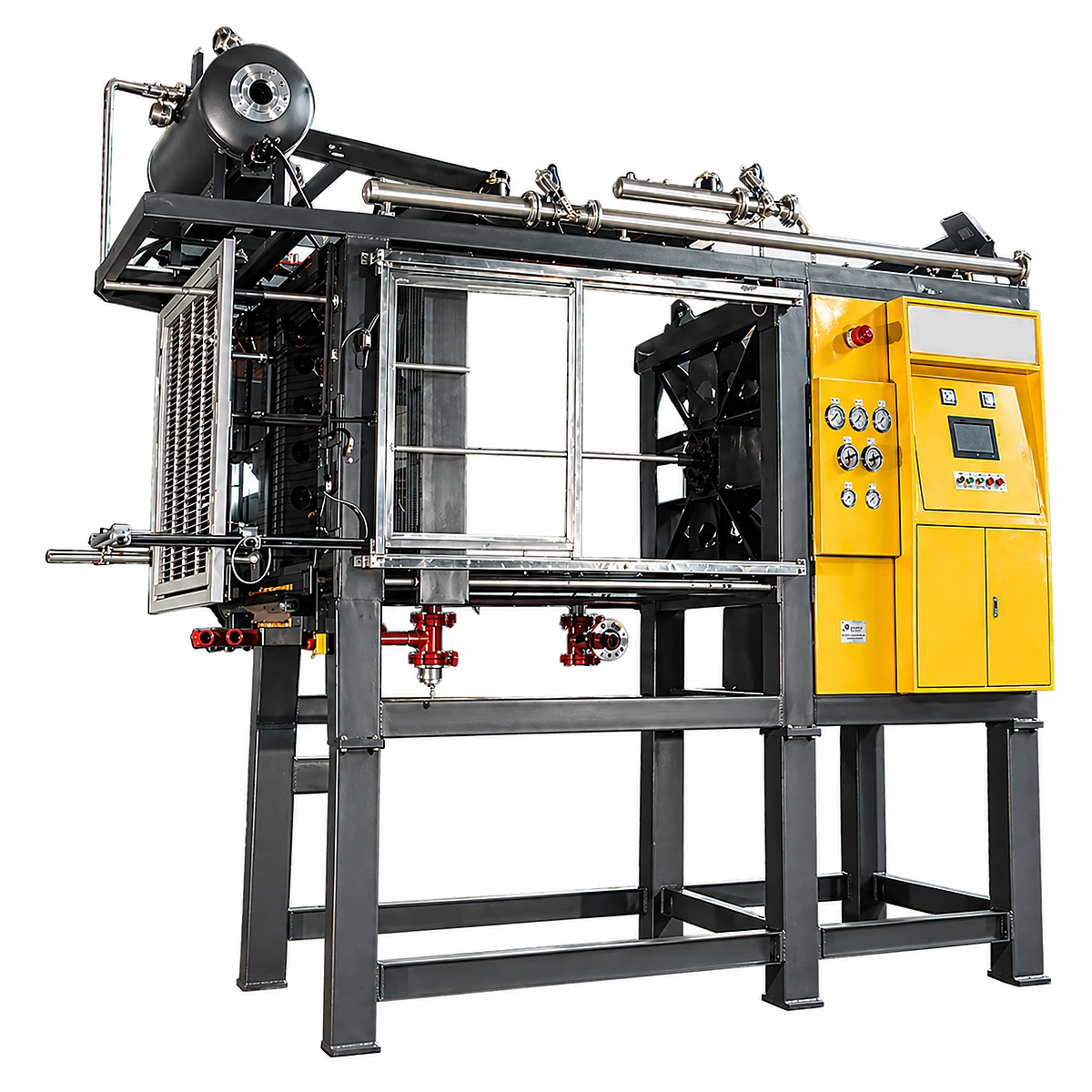
The BM-1400 is a vertically-clamped, steam-chest EPS block molding machine designed to fuse pre-expanded polystyrene beads (aged 8–24 hours in aging silos) into structurally uniform foam blocks. The "1,400" refers to the block-cavity width in millimetres. Standard block geometry is 1,400 × 800 × 400 mm (length × width × height), and the cavity is built as a quick-change insert that supports thicker blocks (up to 600 mm height) or ICF-cavity inserts for construction-block production.
It is the natural downstream pair for a PE-1400 pre-expander and feeds either a CM-6000 cutting line (insulation board factories) or an ICF workflow (construction-block factories). Across China-export block molding shipments, the BM-1400 is the most-deployed model in the 30–60 t/day finished-block segment.
2. Technical Specifications
The table below summarises the BM-1400 specifications most relevant to procurement decisions. Compressive-strength references follow ASTM D1621 (rigid cellular plastics); density figures follow ISO 845; machinery safety requirements should reference ISO 13854 (minimum gaps to avoid crushing parts of the body).
| Specification | Value | Notes |
|---|---|---|
| Standard block size | 1,400 × 800 × 400 mm | Quick-change cavity insert supports 1,400 × 800 × 600 mm and ICF cavity |
| Density range | 10–35 kg/m³ | Compatible with standard, fast-cycling, FR, and graphite-enhanced beads |
| Density variance per block | ±0.8 kg/m³ | PLC-controlled steam keeps batch consistency within spec |
| Cycle time | 5–9 min | Density-dependent: lower density = shorter cycle |
| Hydraulic clamping force | 200 t | Twin cylinders; safety interlock prevents steam injection before full clamp |
| Steam pressure | 0.08–0.15 MPa | PLC-controlled steam-chest fusion |
| Steam consumption | 35–55 kg/cycle | Vacuum-assisted cooling reduces residual steam load |
| Installed power | 25 kW | Hydraulics + vacuum pump + control circuit |
| PLC controller | Siemens / Mitsubishi (standard) | 7-inch HMI; cycle recipes for multiple bead grades |
| Mold-change time | 4–6 hours | Quick-change cavity insert kit (block-size or ICF swap) |
| Machine footprint | 5.5 × 3.0 m | Add 3 m clearance on each side for mold handling |
3. Production Capacity & Output Math
A BM-1400 in two-shift operation produces 80–120 blocks/day depending on density, cycle time, and mold-change frequency. Translating block count to tonnage of finished product depends on density:
| Bead Density | Cycle Time | Blocks / 16 h (2-shift) | Daily Tonnage | Typical End Product |
|---|---|---|---|---|
| 12 kg/m³ (lightweight packaging) | 5 min | ~120 | ~6.5 t | Single-use shipping foam |
| 18 kg/m³ (insulation board) | 6 min | ~100 | ~8 t | EIFS / roof board / EPS panel |
| 25 kg/m³ (ICF / geofoam) | 7 min | ~90 | ~10 t | Construction ICF / road embankment |
| 32 kg/m³ (high-density) | 9 min | ~80 | ~11.5 t | Heavy-duty packaging / structural |
A single BM-1400 is therefore sized for finished-block factories in the 30–50 t/day range when running mixed densities. Above ~60 t/day, most factories install two BM-1400 units in parallel (more flexible than upgrading to BM-1800) so the Russian deployment example below scales by simply doubling cells.
4. 2026 Price Range & What Drives Cost
BM-1400 China FOB pricing for 2026 runs $80,000–$110,000, with the spread driven primarily by automation level, PLC brand, vacuum-cooling specification, and ancillary kit. Below is a representative installed-cost breakdown for a mid-config machine landed in a typical export destination.
| Cost Component | USD Range | % of Total Installed |
|---|---|---|
| BM-1400 machine (FOB China, standard config) | $80,000–$95,000 | ~60% |
| Premium config (Siemens PLC, vacuum-assisted cooling) | +$10,000–$15,000 | ~8% |
| Extra cavity inserts (per size or ICF) | $6,000–$12,000 each | ~5–8% |
| Sea freight 40HQ to typical export port | $3,500–$6,500 | ~4% |
| On-site installation & commissioning | $5,000–$9,000 | ~6% |
| Steam boiler ancillary (if not in place) | $15,000–$35,000 | depends on plant |
| 12-month warranty + spare-parts kit | included | — |
For destination-specific quotes, freight cost, import duty, and local installation rates vary significantly. Contact our technical team for a configured quote with current FOB and freight numbers.
5. Real-World Deployment: Russia & Egypt Case Data
Russia, 2025 — 2 × BM-1400 + CM-6000 cutting, 60 t/day insulation board. A top-3 Russian EPS-panel producer replaced four older Chinese block molders with two BM-1400 units feeding a single CM-6000 cutting line. Outcome over the first 12 months: energy cost down 32% per finished tonne, board yield up 8% (less off-cut waste from more uniform block density), and floor-space requirement halved (two BM-1400 occupy less than the four units they replaced).
Egypt, 2024 — 1 × BM-1400 + ICF mold cavity, 30 t/day. An Egypt-Saudi joint venture producing ICF blocks for residential construction installed a single BM-1400 with both a standard cavity and an ICF cavity insert. Cavity changeover (standard block ↔ ICF) was measured at 6 hours, allowing the factory to run standard EPS panels for two weeks then switch to ICF runs for a week without buying a dedicated machine.
6. BM-1200 vs BM-1400 vs BM-1800 — Decision Matrix
| Model | Block Size | Daily Output | 2026 FOB Price | Best Fit |
|---|---|---|---|---|
| BM-1200 | 1,200 × 600 × 300 mm | 300–800 blocks/month | $60,000–$80,000 | Entry-level fish-box / packaging factory |
| BM-1400 | 1,400 × 800 × 400 mm | 80–120 blocks/day | $80,000–$110,000 | 30–50 t/day insulation / ICF factory |
| BM-1800 | 1,800 × 1,000 × 500 mm | 100–150 blocks/day | $130,000–$180,000 | 60+ t/day large-format insulation panel |
Above 50 t/day, the decision is rarely BM-1400 vs BM-1800; it is two BM-1400 vs one BM-1800. Two parallel BM-1400 units typically beat a single BM-1800 on flexibility (you can run two densities concurrently, half the line stays up during maintenance) and downside risk, while a single BM-1800 wins on floor space and operator headcount.
7. Integration with Upstream and Downstream Equipment
The BM-1400 is not a stand-alone product; it is the middle stage of a 4-stage EPS production line. Buyer specifications should always include the surrounding equipment:
- Upstream: PE-1400 pre-expander (one PE-1400 feeds one BM-1400 cleanly) + EPS aging silo requirements (minimum 8–24 hours of bead aging before fusion, sized to daily block output)
- Steam: a steam boiler rated for 200–300 kg/h continuous (with peak capacity to handle simultaneous fusion + cooling demand)
- Downstream — insulation route: CM-6000 hot-wire cutting line for slicing blocks into panels (the Russian case above)
- Downstream — construction route: ICF cavity insert installed in the BM-1400 itself, producing finished ICF blocks directly (the Egypt case above)
8. Where the Energy & Yield Numbers Come From
Two BM-1400 specification details produce the 32% energy savings observed in the Russian deployment. First, vacuum-assisted cooling reduces residual steam load per cycle compared to older atmospheric-cooling block molders — saving roughly 20–25% of steam per cycle. Second, the PLC-controlled steam-chest fusion holds density variance within ±0.8 kg/m³ per block (vs. ±2–3 kg/m³ for older PLC-less machines), which means downstream CM-series cutting generates 6–10% less off-cut scrap, recovered as in-house EPS recycling material rather than landfill loss.
For deeper context on EPS production fundamentals and the steam-energy levers that drive both energy and yield, see our pillar guides on how EPS foam is made and steam energy cost optimization.
Frequently Asked Questions
What block size does the BM-1400 produce, and can it be changed?
Standard block 1,400 × 800 × 400 mm. The cavity is a quick-change insert: switching to a 600 mm-thick variant or to an ICF cavity takes 4–6 hours. Most factories run one standard cavity year-round and only swap if launching a new product line.
What density range and bead grades does BM-1400 handle?
10–35 kg/m³. Compatible with standard EPS, fast-cycling beads, FR (flame-retardant) grade, and graphite-enhanced beads. Above 35 kg/m³ or for fully structural geofoam (45+ kg/m³), specify BM-1400 with reinforced clamping.
What steam boiler size do I need to run one BM-1400?
200–300 kg/h continuous capacity, with peak capacity 400–500 kg/h to handle simultaneous fusion + cooling steam demand. Diesel, natural gas, biomass, and coal-fired boilers are all compatible; the choice depends on local fuel cost.
When should I buy two BM-1400 instead of one BM-1800?
If your finished-block output target is in the 60–100 t/day range, two BM-1400 typically deliver better economics: you can run different densities concurrently, half the line keeps running during maintenance windows, and resale value of the two smaller units is higher. Beyond 100 t/day or when block geometry requires the 1,800 mm width (large insulation panels), BM-1800 wins on operator headcount and floor space.
What is the typical payback period?
For a 30 t/day insulation-board factory at typical 2025–26 raw-material and energy costs, BM-1400 payback runs 18–30 months at 60%+ capacity utilisation. The 32% energy saving and 8% yield improvement documented in the Russian deployment shortened payback for that customer to roughly 16 months versus the prior generation of equipment they replaced. See our EPS machinery ROI guide for a step-by-step calculation framework.
What warranty and after-sales support comes with a BM-1400 from ChinaEps?
A standard 12-month comprehensive warranty plus a 5-year structural warranty on the hydraulic frame. The package includes installation supervision, operator training (on-site or remote), and a 30-piece spare-parts kit covering wear items typically replaced in the first 18 months of operation.
Sizing a BM-1400 for your production target? ChinaEps configures complete EPS lines — from pre-expander through cutting — with transparent FOB pricing, freight quotes for your destination port, and on-site commissioning. Request a configured quote.