
Choose shape molding when an electronics insert has stable geometry and enough repeat volume to justify a dedicated mold. Choose EPS block molding plus CNC hot-wire cutting when you have many low-volume SKUs, frequent design changes, prototypes, or uncertain demand. Neither route is automatically better: shape molding reduces labor and material waste at repeat volume, while CNC cutting avoids hard tooling and lets you revise the insert quickly. For a new product, the lowest-risk route is often hybrid—validate the package with CNC-cut samples, then move proven, high-volume designs into a shape mold.
The machine decision should come after the packaging decision. A television corner set, a server end-cap and an optical instrument cradle may all be called “electronics packaging,” but they place different demands on the foam. Product mass, fragility, unsupported spans, carton size, drop orientation and the number of designs shipped each year all affect the correct process. Comparing machine prices before fixing those inputs usually produces two quotations that solve different problems.
The Short Answer: Match the Process to Volume per Stable SKU
The most useful purchasing metric is not total annual output. It is annual volume per stable insert design. A factory may ship a large number of electronic products overall while running hundreds of models, revisions and regional variants. That profile behaves like low-volume production because each insert design consumes only a small share of the total.
| Production condition | Route that usually fits | Reason |
|---|---|---|
| Few SKUs, stable geometry, repeat orders | Shape molding | The mold is reused enough times to lower cost per insert. |
| Many SKUs, low volume per design | Block molding + CNC cutting | No dedicated mold is required for every insert. |
| Product dimensions still changing | CNC cutting | The cutting file can be revised without modifying hard tooling. |
| Validated design entering sustained production | Shape molding | Cycle repeatability, surface finish and material utilization become more important. |
| New program with uncertain demand | Hybrid | CNC supports samples and launch; molding follows only after volume is proven. |
Do not turn the table into a universal unit threshold. The crossover changes with insert size, nesting efficiency, number of pieces per set, mold complexity, local labor cost, EPS block cost, cutting loss, expected design life and required validation. A supplier who recommends one route from annual units alone is missing most of the cost model.
How the Two EPS Packaging Routes Work
Route 1: Direct Shape Molding
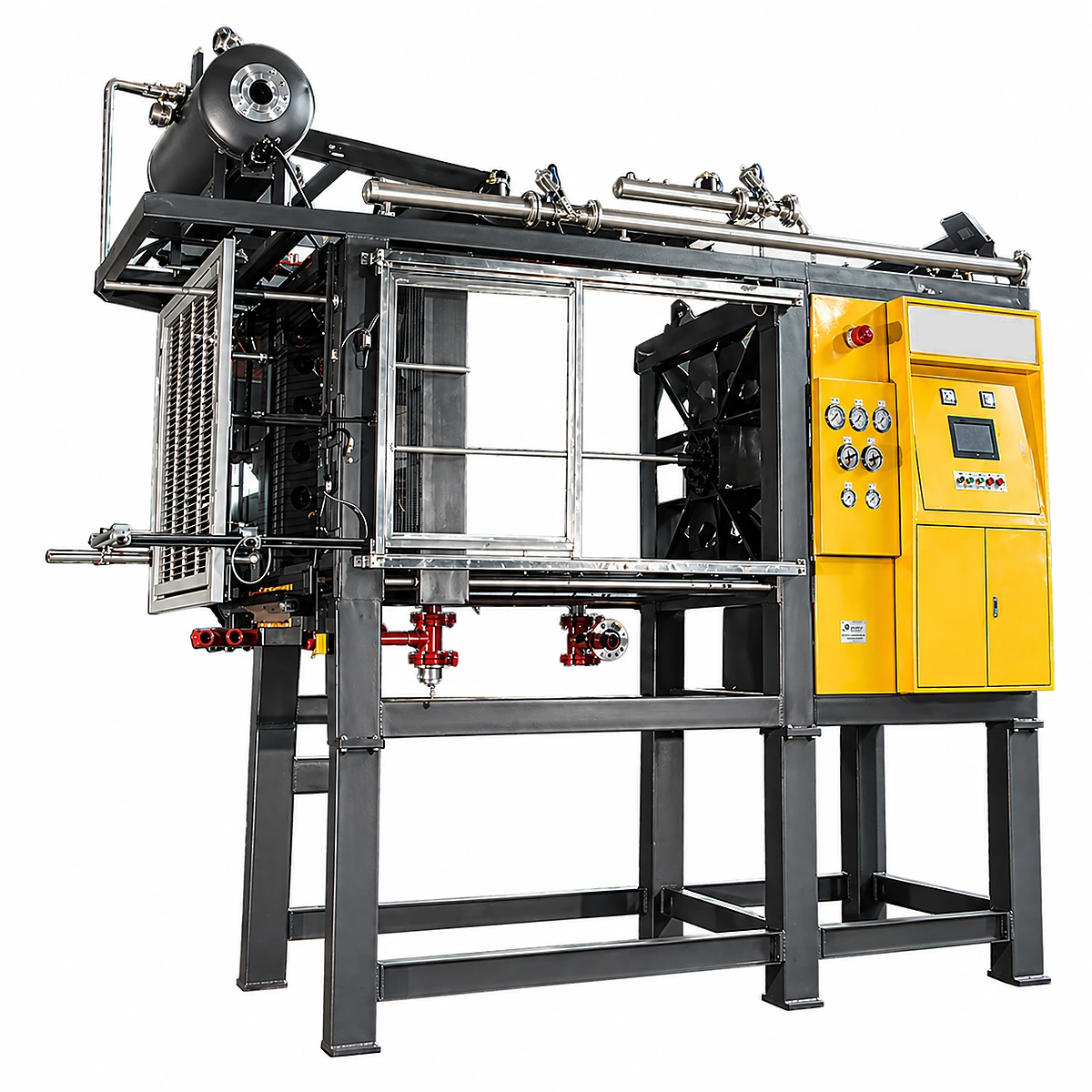
Pre-expanded and aged EPS beads are injected into a product-specific aluminum mold mounted on an EPS shape molding machine. Steam fuses the beads, the mold is cooled, and the finished insert is ejected in its final geometry. The process can produce corner protectors, end-caps, trays and multi-feature cradles with integrated ribs, pockets and locating surfaces.
The commercial advantage is repeat production. Once the mold and process recipe are validated, the machine reproduces the same geometry without cutting each feature separately. The trade-off is commitment: each design needs tooling, and a product revision may require a mold insert change or a new mold. Shape molding therefore rewards stable designs and penalizes design churn.
Route 2: EPS Block Molding Plus CNC Hot-Wire Cutting
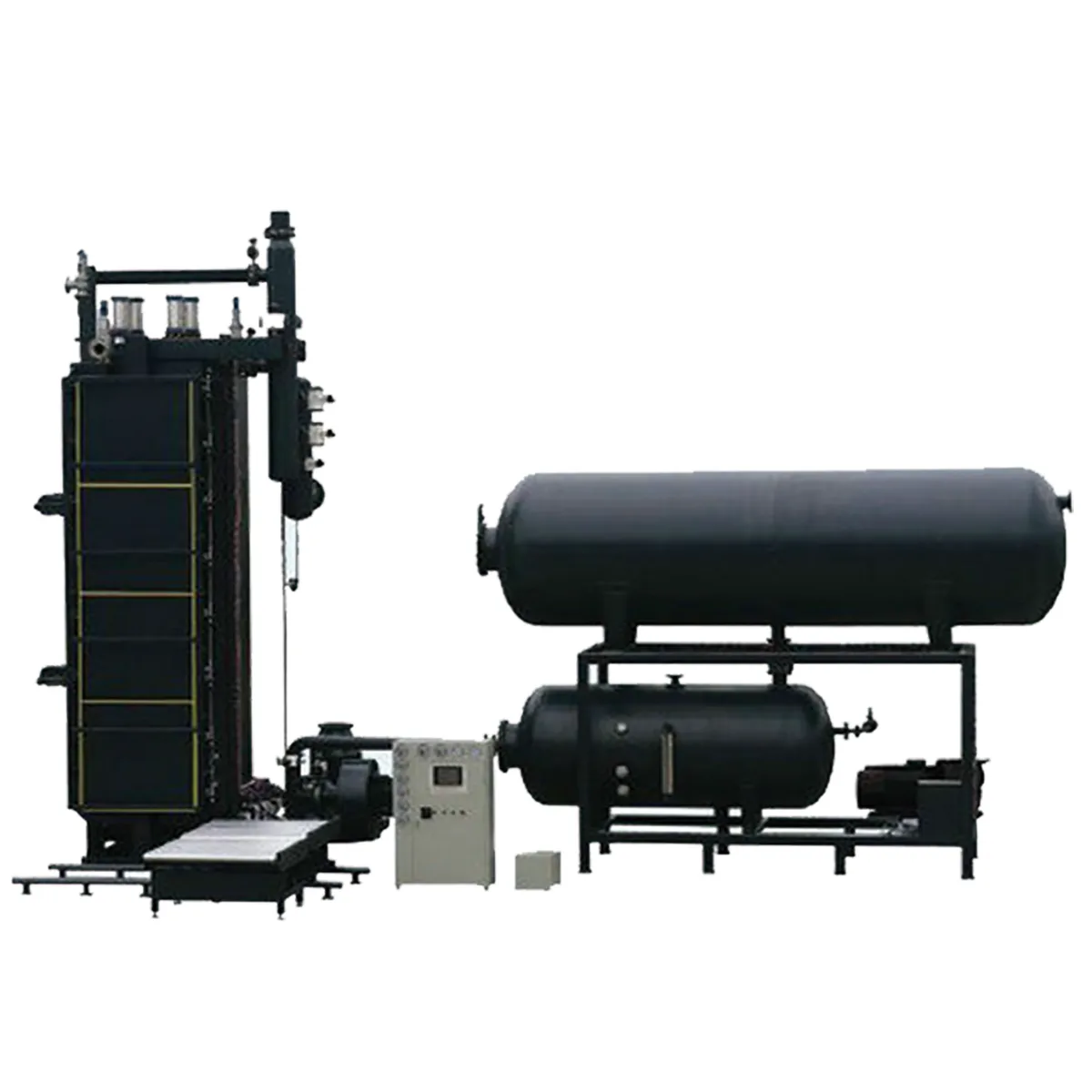
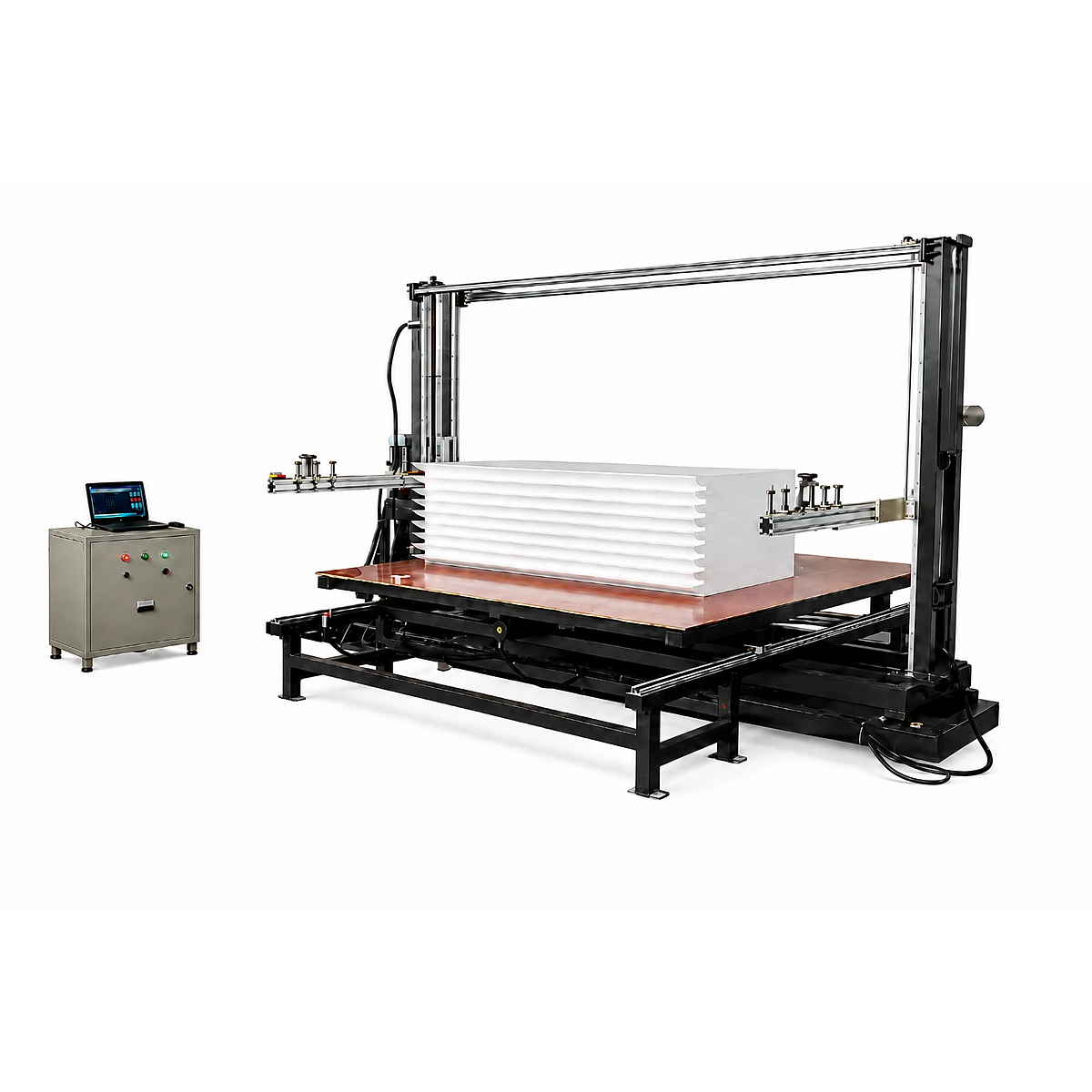
An EPS block molding machine first produces standard foam blocks. After stabilization, a CNC hot-wire cutting machine cuts profiles from the block according to a digital program. Changing a design usually means changing the cutting path rather than buying another mold.
This route is strong when the product mix changes faster than tooling can be justified. It is also useful for prototypes and pilot orders because sample geometry can be adjusted after a fit check or packaging test. Its disadvantages are cutting time, offcut management, nesting loss and geometric limits. Hot wire cuts continuous paths through the block; deep internal pockets, enclosed cavities, undercuts and some fully three-dimensional features may require multiple pieces, special cutting strategies or a different process.
Shape Molding vs CNC Cutting: The Buying Comparison
| Decision factor | Shape molding | Block + CNC cutting |
|---|---|---|
| Design commitment | Dedicated mold or mold inserts | Digital cutting program; no product-specific hard mold |
| Best production profile | Stable, repeat volume per SKU | Many SKUs, short runs or uncertain demand |
| Engineering changes | May require tooling modification | Usually handled by editing the cutting file |
| Geometry | Complex molded features possible within mold-design rules | Best for cuttable contours, layers and assembled sections |
| Surface and edge finish | Molded skin and repeatable surface detail | Visible cut texture; finish depends on wire, speed and bead structure |
| Material utilization | Near-net-shape production; runners and rejected parts still require handling | Depends on nesting; offcuts can be significant on irregular shapes |
| Changeover | Mold change plus recipe setup | Program and block setup change |
| First samples | After tooling is available | Can be produced from a revised digital file |
| Typical role | Serial production | Prototype, bridge production and high-mix production |
Use a Cost Crossover, Not a Guess
The correct comparison is the annual cost of producing one validated design by each route. Ask suppliers to separate fixed and variable costs instead of presenting a single line price.
For shape molding, include:
- product-specific mold design, manufacture and trials;
- tool maintenance and expected design changes;
- mold change and process setup time;
- molding labor, steam, cooling and rejected parts;
- expected output over the usable life of the design.
For block plus CNC, include:
- block production or purchased-block cost;
- stabilization, handling and storage;
- cutting time per insert set;
- nesting yield and offcut percentage;
- assembly or bonding if the insert uses several cut pieces;
- programming and inspection time for frequent revisions.
A simple decision model is:
Annual shape-molding cost = annualized tooling + molding cost per set × annual sets
Annual CNC cost = block and cutting cost per set × annual sets + revision and assembly cost
The crossover is where the two totals are equal. Use quotations for your actual insert geometry; do not copy a threshold from another factory. Large parts, poor CNC nesting or multi-piece assembly can move the crossover toward molding. Short product life, frequent revisions or many regional variants can move it toward CNC.
Three Illustrative Electronics Packaging Scenarios
The following examples illustrate the decision logic. They are not customer cases and contain no promised output or payback.
Scenario A: One Television Platform, Long Production Run
A television manufacturer uses the same left and right end-caps across a sustained production program. Geometry is frozen after validation, finish matters, and the same set repeats throughout the year. Shape molding is the likely production route because the mold serves one stable design many times and eliminates repeated contour cutting.
Scenario B: Contract Manufacturer With Many Industrial Electronics SKUs
A packaging converter supplies servers, instruments, control cabinets and small production batches. Dimensions change by customer and revision. CNC cutting is usually safer because a product-specific mold for every SKU would remain idle most of the year. The converter should focus on block quality, nesting software, cutting repeatability and a disciplined offcut-recycling plan.
Scenario C: New Device Launch With an Uncertain Forecast
A new electronics product needs qualification samples, but the final sales volume is not yet proven. The lowest-risk route is often CNC for fit checks, transit-test samples and early orders. If the design stabilizes and repeat demand rises, the approved geometry can be converted into a production mold. This hybrid route avoids committing to tooling before the packaging system is proven while preserving a path to lower serial-production cost.
Packaging Performance Must Be Validated Before the Machine Is Ordered
Foam density alone does not prove that an electronics package will protect the product. The insert works as part of a system that includes the product, carton, clearances, unsupported surfaces and expected distribution hazards. A heavier product does not always need the hardest foam; a fragile product may need a cushion that deforms in a controlled way rather than transmitting the shock.
Define the validation plan with the product owner or packaging engineer before freezing the process route. Packaged-product test procedures are available from ISTA, while ASTM D5276 covers drop testing of loaded containers by free fall. The applicable procedure, drop sequence, conditioning and acceptance criteria must come from the product and distribution requirement; a machine supplier should not invent them.
For a CNC-first program, use cut samples for fit and early testing, then repeat the required validation after converting to a molded insert. A molded part is not automatically equivalent to a cut part just because the CAD outline is the same. Bead fusion, molded skin, local stiffness, seams and orientation may change package behavior.
Geometry Checks That Can Eliminate One Route
Send a 3D model or dimensioned drawing before asking for a machine recommendation. The following details can change the answer:
- Undercuts and enclosed pockets: easy to draw, but they may complicate mold release or be impossible to cut with a continuous hot wire.
- Thin ribs and local projections: potentially moldable, but they require reliable bead filling and steam access.
- Deep cutouts: may force a CNC insert to be split into several pieces.
- Very large parts: must fit the molding platen and opening stroke or the available block and cutting envelope.
- Left/right or regional variants: may be combined with interchangeable mold inserts, or may favor CNC if revisions are frequent.
- Assembly interfaces: cable channels, accessory pockets and locating features may make a molded part more repeatable than a manually assembled cut set.
Common Selection Mistakes
- Using total factory output instead of volume per SKU. High total volume does not justify molding when it is divided across many designs.
- Buying a mold before the electronics enclosure is frozen. A connector, stand or carton revision can invalidate the tooling.
- Ignoring CNC yield. Compare nested parts per block, not just cutter speed.
- Assuming CNC can make every 3D feature. Ask for a cutting simulation and sample of the actual geometry.
- Assuming a molded sample automatically matches a cut prototype. Revalidate after the process changes.
- Comparing only the headline machine price. Include molds, utilities, handling, storage, offcuts, labor, changeovers and inspection.
- Choosing density before defining fragility and test conditions. The package should be engineered around the product and distribution route.
What to Send for a Route Recommendation
A useful equipment proposal needs product and program information, not only a target machine model. Prepare:
- product dimensions, mass and a 3D model or dimensioned drawing;
- fragile zones, unsupported surfaces and allowable cosmetic contact areas;
- carton internal dimensions and required insert arrangement;
- annual volume for each SKU, not only total annual units;
- number of SKUs and expected engineering-change frequency;
- planned product life and ramp-up forecast;
- required package test procedure and acceptance criteria;
- target launch date, sample quantity and serial-production date;
- whether the packaging is one-way or returnable;
- available factory space and existing pre-expansion, block molding, steam and cutting equipment.
With those inputs, a supplier can compare a direct EPS protective-packaging molding line against a block-and-cutting cell without guessing. The recommendation should state which assumptions drive the result and which product changes would move the crossover.
Frequently Asked Questions
Is shape molding always cheaper for high-volume electronics packaging?
No. It is usually favored by stable repeat volume, but the answer still depends on mold complexity, insert size, number of parts per set, design life and change frequency. Calculate the annual cost of each route using the actual geometry.
Can CNC-cut EPS be used for package qualification tests?
Yes, cut samples are useful for fit checks and early packaged-product testing. If serial production later changes to shape molding, validate the molded package again because the material structure and local stiffness may differ.
Can one factory use both routes?
Yes. A mixed plant can share bead preparation while using block molding and CNC cutting for prototypes and high-mix work, and shape molding for stable serial programs. Utility demand and production scheduling must be sized for the equipment that may run simultaneously.
What is the most important number to provide in an enquiry?
Annual volume by stable SKU. Total annual output hides whether one design repeats enough to justify a mold.
When should a CNC design move to shape molding?
Recalculate when the geometry is frozen, repeat demand is proven, cutting loss or assembly becomes material, and the expected remaining program volume can absorb the tooling. The change should be triggered by the cost model and validation plan, not by an arbitrary unit threshold.