eps-machinerypre-expanderbuying-guideproduction-line

EPS Pre-Expander: 3 Models Compared + 5 Mistakes That Cost $20K

March 28, 2026 10 min read ChinaEps

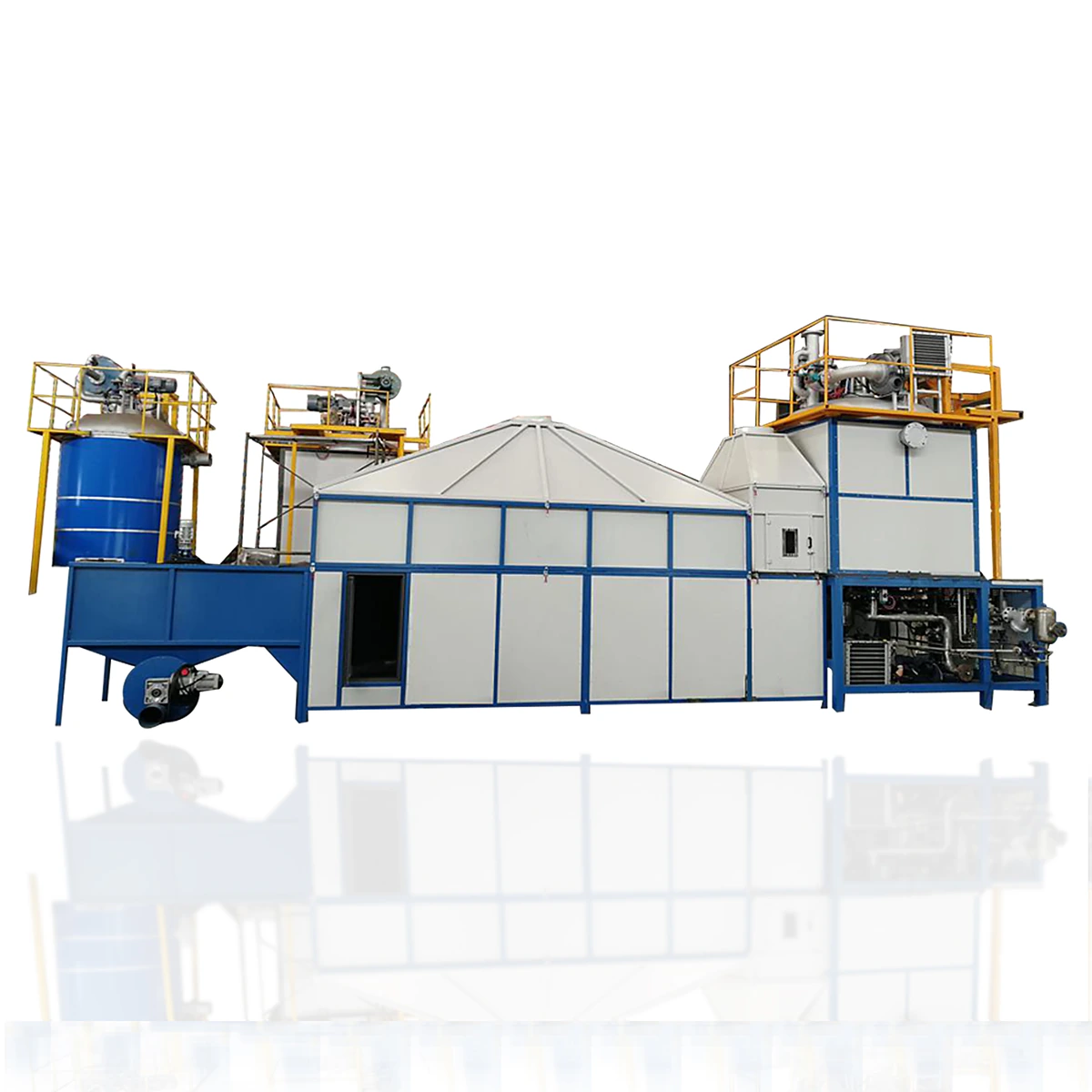
Selecting the right EPS pre-expander is one of the most critical decisions in setting up or upgrading an expanded polystyrene production line. The pre-expander is the first stage of the EPS manufacturing process, where raw polystyrene beads are exposed to steam and a blowing agent (typically pentane at 5-7% concentration) to expand them to

To buy an EPS machine from China, follow a structured 8-step verification process: define your capacity needs, compare full-line configurations, audit energy specs, evaluate automation levels, verify after-sales support, and negotiate warranty terms. China EPS machinery prices range from $15,000 for single machines to $500,000+ for complete automated production lines. ChinaEps simplifies this process with transparent pricing, factory inspections, and 12-month comprehensive warranties.

China manufactures more EPS machinery than any other country in the world. The scale of production means you can find equipment at nearly every price point, from budget machines to fully automated, export-quality production lines. That range is both an opportunity and a risk: buy from the right manufacturer, and you get world-class equipment at 40–60% less than European equivalents. Buy from the wrong one, and you face costly delays, quality issues, and inadequate support.

This guide presents the 8 critical questions every buyer should ask before placing an order for EPS machinery from China. For each question, we explain what to ask, why it matters, and what red flags to watch for. Use this as your pre-purchase checklist to protect your investment and set your production line up for success.

2026 China EPS Machinery Price Overview

Before diving into the eight questions, here is the current pricing landscape for EPS machinery from China as of Q2 2026. These figures represent FOB China prices from established manufacturers with CE certification and documented export history:

Machine Type Model Example Price Range (FOB China) Key Specification
Block Molding Machine BM-1400 (1400×800×400mm) $25,000–$45,000 8–12 blocks/hour, Siemens PLC
Block Molding Machine (Large) BM-1800 (1800×1200×600mm) $40,000–$70,000 5–8 blocks/hour, vacuum cooling
Shape Molding Machine SM-1000 / SM-1400 $30,000–$80,000 Custom mold, 60–120s cycle time
Pre-Expander (Batch) PE-1000 / PE-2000 $15,000–$35,000 1–2 tons/hour capacity
Pre-Expander (Continuous) CPE-3000 $40,000–$65,000 3+ tons/hour, 24/7 operation
EPS Cutting Line CNC hot wire cutter $8,000–$25,000 Horizontal + vertical cutting
Recycling System Crusher + de-duster + compactor $12,000–$30,000 100–300 kg/hour throughput
Complete Production Line (Basic) 50–100 m³/day $80,000–$150,000 1-shift operation, semi-automatic
Complete Production Line (Mid-Range) 100–300 m³/day $150,000–$300,000 2-shift, Siemens PLC, vacuum cooling
Complete Production Line (High-End) 300+ m³/day $300,000–$500,000+ Fully automated, 3-shift, SCADA-ready

Key 2026 market trends:

  • Energy efficiency is now the top buyer priority. Steam consumption per cycle has dropped 15–20% over the past 3 years thanks to improved vacuum cooling and insulation design. Ask every manufacturer for their kg-steam-per-m³ figure.
  • EPP machinery demand is growing fast. EPP (Expanded Polypropylene) requires higher steam pressure (3–6 bar vs. 0.8–1.2 bar for EPS) and specialized molds. If you anticipate EPP production in the future, factor this into your equipment selection now. See our EPS vs EPP comparison for details.
  • Automation ROI breakpoint has shifted. With rising labor costs globally, full automation now pays back in 18–24 months in most markets (down from 30–36 months five years ago).
  • Lead times are normalizing. Post-pandemic supply chain disruptions have largely resolved; expect 45–75 days manufacturing plus 15–45 days shipping to most destinations.

Prices last updated: April 2026. All prices are approximate and vary based on configuration, certifications, and order volume. Contact ChinaEps for a precise quotation based on your requirements.

Question 1: What Is My Actual Production Capacity Requirement?

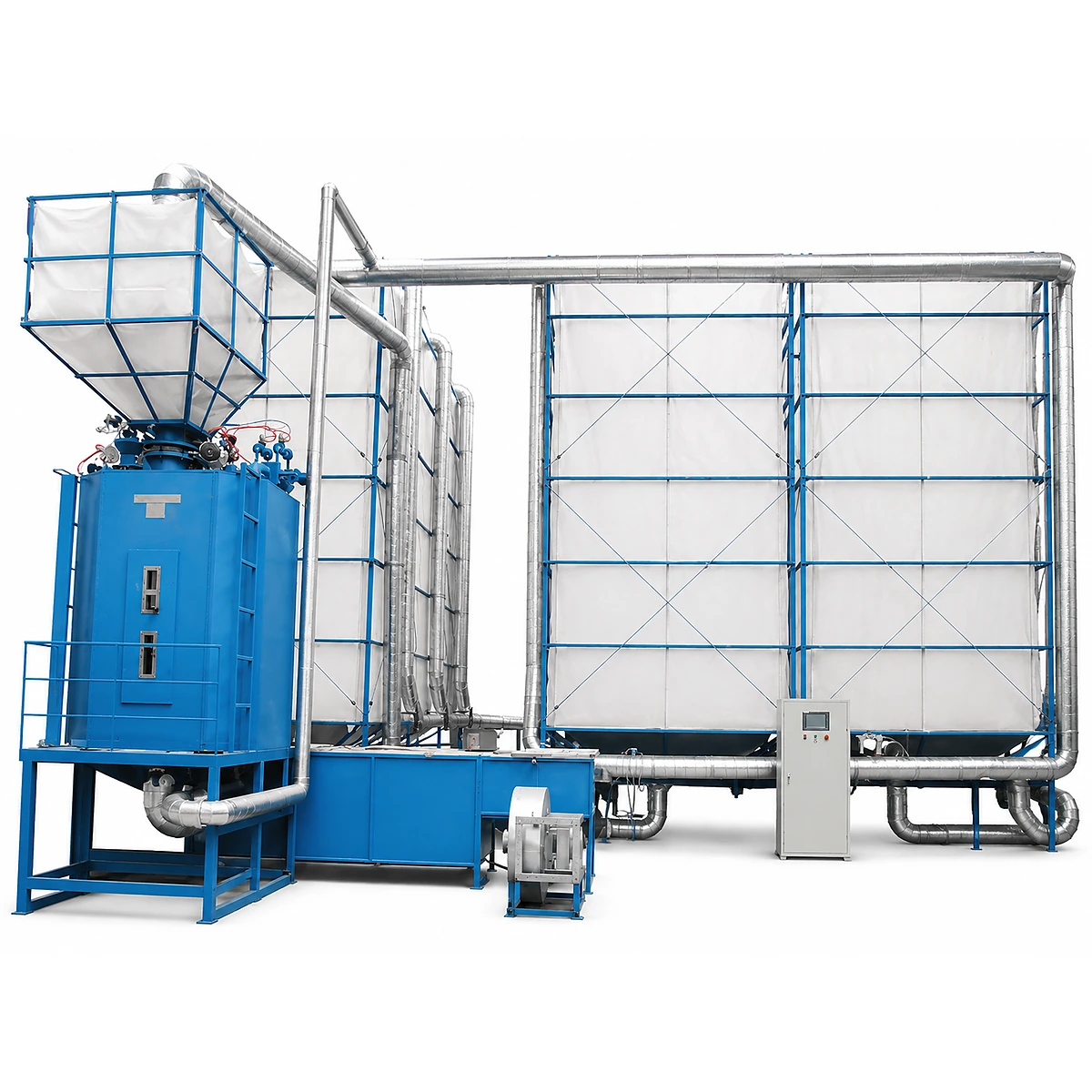
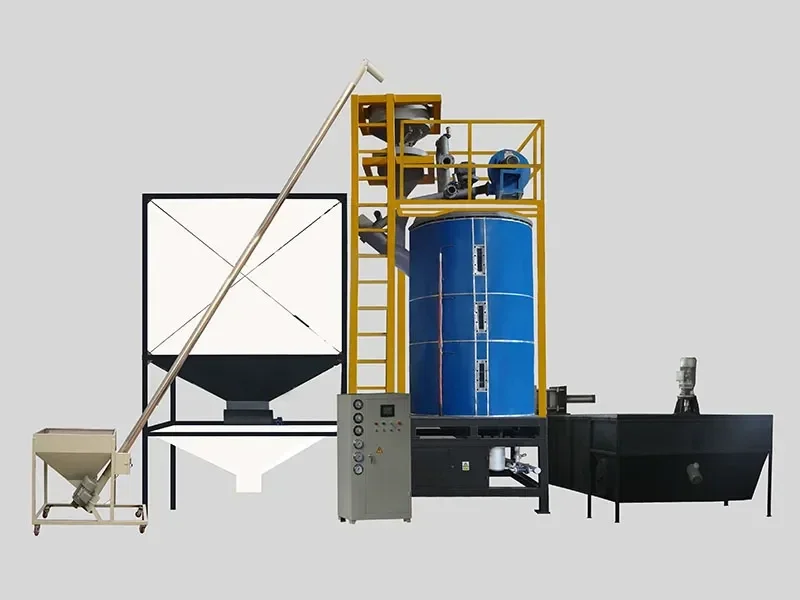
PE-1400 EPS Pre-Expander — 700-900 kg/h throughput with PLC steam control
Capacity-class example: PE-1400 EPS Pre-Expander, 700-900 kg/h continuous output, suitable for medium-scale block + shape molding lines.

What to Ask Yourself

Before you speak to any manufacturer, define your target daily and annual production volumes in cubic meters (m³) of finished foam product. Factor in:

  • Current market demand (confirmed orders or realistic sales projections)
  • Projected demand growth over 3–5 years
  • Product mix (block molding vs. shape molding, density ranges)
  • Planned operating shifts (1-shift, 2-shift, or 3-shift operation)
  • Seasonal demand variations

Why It Matters

Machine capacity directly determines your investment size. An undersized machine limits revenue; an oversized machine increases your capital cost and payback period without proportional benefit. As we discussed in our ROI calculation guide, machine utilization rate is one of the most important factors in investment return.

Red Flags

  • A manufacturer who pushes you toward their largest (most expensive) machine without understanding your market
  • Capacity claims that seem unrealistically high for the machine size (always ask for the cycle time breakdown: fill time + steaming time + cooling time + demolding time)
  • No distinction between theoretical maximum capacity and realistic operating capacity

Good vs. Bad Answers

Good Sign Red Flag
Manufacturer asks about your target market, product types, and growth plans before recommending a machine size Manufacturer immediately quotes their most popular (or most expensive) model without asking about your needs
Capacity is specified with clear assumptions: density, block size, cycle time, utilization rate A single "capacity" number with no context or assumptions

Question 2: What Exactly Is Included in the Machine Configuration?

What to Ask the Manufacturer

Request a complete equipment list with model numbers, specifications, and brand names for every component. Key items to verify:

  • Core machine (block molding machine or shape molding machine)
  • Pre-expander (batch or continuous, what capacity)
  • Aging silos (how many, what volume)
  • Vacuum system (pump type, capacity)
  • Material handling (pneumatic transport, weighing)
  • Control system (PLC brand — Siemens, Mitsubishi, or local Chinese brand)
  • Block cutting system (if applicable)
  • Software and HMI (human-machine interface)

Why It Matters

The quoted price for an "EPS production line" can vary by $50,000 or more depending on what is and is not included. Some manufacturers quote only the core machine, leaving you to source and integrate the pre-expander, vacuum system, and cutting line separately — often at higher total cost and with integration risks.

Red Flags

  • Vague equipment lists ("includes all necessary auxiliary equipment")
  • PLC and electrical components from unknown brands (quality and spare parts availability are concerns)
  • No mention of the vacuum system, which is critical for cycle time and energy efficiency
  • Cutting system not included or quoted as a costly add-on

Good vs. Bad Answers

Good Sign Red Flag
Detailed equipment list with specifications, brand names, and photos of each component One-line item: "Complete EPS line — $X"
Clear statement of what is and is not included (e.g., "boiler not included; we recommend X specification") Discovering after purchase that critical components were not included

Question 3: What Are the Steam and Power Requirements?

What to Ask

  • Steam consumption per cycle and per cubic meter of product (kg steam/m³)
  • Required steam pressure and temperature
  • Recommended boiler capacity (tons/hour)
  • Total electrical power requirement (kW) for the complete line
  • Compressed air requirements (m³/min at what pressure)
  • Cooling water requirements (flow rate and temperature)

Why It Matters

Steam is the single largest energy cost in EPS production, typically accounting for 40–60% of total energy expenditure. If the manufacturer cannot provide precise steam consumption data, they either have not tested the machine properly or are hiding poor efficiency. These utility specifications also determine whether your existing facility can support the equipment or whether you need infrastructure upgrades. For a deeper analysis of steam costs, see our guide on steam energy optimization in EPS production.

Red Flags

  • Inability to provide specific steam consumption figures ("depends on many factors" without providing any baseline data)
  • Steam consumption per m³ that is significantly higher than industry benchmarks (above 50 kg steam per m³ for block molding at 15 kg/m³ density suggests poor efficiency)
  • No mention of vacuum cooling (without vacuum-assisted cooling, cycle times are longer and energy consumption is higher)

Good vs. Bad Answers

Good Sign Red Flag
Specific figures: "28–35 kg steam per m³ at 15 kg/m³ density, 0.8 bar steam pressure" "It varies" or no data available
Complete utility specification sheet provided as part of quotation You have to ask multiple times for utility requirements

Question 4: What Level of Automation Is Available?

ChinaEps assembly workshop — PLC-equipped EPS pre-expanders during automation testing
Automation-ready EPS lines on our assembly floor — PLC + HMI integration tested before shipment to customer site.

What to Ask

  • What operations are automated vs. manual in the base configuration?
  • What optional automation upgrades are available and at what cost?
  • How many operators are required per shift for the proposed configuration?
  • Can automation be upgraded later, or must it be specified at purchase time?
  • What PLC platform is used and can it integrate with plant-level SCADA systems?

Why It Matters

Automation affects labor costs, product consistency, throughput reliability, and safety. In markets with rising labor costs, the ROI of automation upgrades can be substantial — as discussed in our ROI guide. However, automation also increases complexity, and in markets with abundant low-cost labor, a simpler machine may be more appropriate.

Red Flags

  • Automation described only in vague terms ("fully automatic" without specifying which operations)
  • No option for remote monitoring or diagnostics (standard in modern machines)
  • Proprietary control systems that cannot be serviced by third-party PLC technicians

Good vs. Bad Answers

Good Sign Red Flag
Clear automation breakdown: "Automatic bead filling, automatic steam/cooling cycle, manual block extraction; auto extraction available as $X upgrade" "Fully automatic production line" with no detail
Uses industry-standard PLC (Siemens S7-1200/1500, Mitsubishi FX/Q series) Unknown or proprietary PLC brand with no local service availability

Question 5: What After-Sales Support Do You Provide?

What to Ask

  • Do you have service engineers who can travel to my country for installation and troubleshooting?
  • What are your response times for technical support inquiries?
  • Do you offer remote diagnosis via video call or machine data connection?
  • Do you have reference customers in my region I can contact?
  • What languages does your technical support team speak?
  • Is there a local agent or distributor in my country?

Why It Matters

After-sales support is arguably the single most important differentiator between Chinese EPS machinery manufacturers. The machine will eventually need troubleshooting, spare parts, or process optimization assistance. A manufacturer who is unreachable after payment is a manufacturer who will cost you far more in downtime than you saved on the purchase price.

Red Flags

  • No reference customers, or unwillingness to provide references
  • Communication only via email with response times measured in days, not hours
  • No engineers available for international travel
  • Technical support available only in Chinese
  • No remote diagnostic capabilities

Good vs. Bad Answers

Good Sign Red Flag
Provides 3+ reference customers in your region with contact details No references or only domestic Chinese references
English-speaking technical support team with WhatsApp/video call availability Communication delays exceeding 48 hours during the quoting process

Question 6: What Installation and Training Is Included?

What to Ask

  • How many engineer-days of on-site installation supervision are included?
  • What are the customer's responsibilities during installation (civil works, electrical connections, rigging)?
  • Is operator training included? How many days? How many operators can attend?
  • Is a detailed installation manual provided in English (or your local language)?
  • What commissioning tests are performed, and what acceptance criteria apply?
  • What happens if commissioning reveals performance issues?

Why It Matters

Improper installation is one of the most common causes of early machine problems. Inadequate operator training leads to poor product quality, excessive waste, and premature component wear. The cost of a manufacturer's installation engineer traveling to your site is trivial compared to the cost of troubleshooting installation errors remotely over months.

Red Flags

  • Installation supervision not included or offered only as an expensive add-on
  • "We will guide you by video call" as the primary installation support method for complex production lines
  • No formal commissioning test protocol
  • Training described only as "on-site training during commissioning" with no defined scope or duration

Good vs. Bad Answers

Good Sign Red Flag
10–20 days of on-site installation and commissioning included in the price, with travel expenses clearly defined Installation guidance by video call only, or installation supervision quoted as $500/day extra
Written commissioning protocol with specific performance criteria (cycle time, density accuracy, surface quality) No formal acceptance testing

Question 7: How Accessible Are Spare Parts?

ChinaEps spare-parts production line — stocked OEM components for EPS machinery
Spare parts produced and stocked in-house. Most high-wear components ship within 48 hours of order.

What to Ask

  • Can you provide a recommended spare parts list for the first 2 years of operation?
  • What is the lead time for spare parts orders?
  • Are wear parts (gaskets, seals, valve components) standard sizes available from local suppliers, or proprietary?
  • What is your spare parts pricing policy? (Some manufacturers offer spare parts at cost or modest markup; others use them as a profit center.)
  • Can you ship spare parts to my country via express courier? What is the typical delivery time?

Why It Matters

A machine that sits idle for 3 weeks waiting for a $50 spare part from China costs far more in lost production than the part itself. Reputable manufacturers design their machines with commonly available components (standard bearings, seals, pneumatic fittings) so that you can source replacements locally for most routine maintenance. They also maintain spare parts inventory and can ship urgently when needed.

Red Flags

  • All spare parts must be purchased exclusively from the manufacturer (monopoly pricing risk)
  • No recommended spare parts list available
  • Lead times exceeding 2–3 weeks for critical wear parts
  • Proprietary, non-standard components where industry-standard equivalents exist

Good vs. Bad Answers

Good Sign Red Flag
Recommended spare parts kit included with machine purchase; 80%+ of wear parts are standard industrial components No spare parts list; proprietary components for basic items like seals and bearings
Express courier delivery to most countries within 5–7 business days "We will ship parts when available" with no defined timeline

Question 8: What Are the Warranty Terms?

What to Ask

  • What is the warranty period? (Industry standard for Chinese EPS machinery: 12–18 months from commissioning or 18–24 months from shipment.)
  • What does the warranty cover? (Full machine? Electrical components only? Structural defects only?)
  • What does the warranty explicitly exclude? (Wear parts? Damage from improper operation?)
  • How are warranty claims processed? Who pays for shipping of replacement parts?
  • Is there an option for an extended warranty or service contract?
  • What documentation is required to validate a warranty claim?

Why It Matters

A warranty is only as good as the manufacturer's willingness and ability to honor it. A 24-month warranty from a manufacturer who ignores your emails is worthless. A 12-month warranty from a manufacturer who ships replacement parts within 48 hours of a validated claim is highly valuable. ChinaEps stands behind our equipment with clear warranty terms; see our quality assurance page for details.

Red Flags

  • Warranty terms that are vague or not provided in writing until after payment
  • Warranty that excludes electrical and electronic components (these are the most likely to fail early)
  • Customer responsible for all shipping costs on warranty claims (for a 200 kg component shipped internationally, this can exceed the component's value)
  • No warranty on the control system or software

Good vs. Bad Answers

Good Sign Red Flag
Written warranty covering all major components for 12–18 months, with clear claim procedure and manufacturer-paid parts shipping Verbal warranty promise only; warranty document not available until after deposit
Extended warranty or annual service contract available as an option No option to extend warranty beyond standard period

Putting It All Together: Your Pre-Purchase Checklist

Before signing a purchase order for EPS machinery from China, verify that you have satisfactory answers to all eight questions. Use this summary checklist:

  1. Production capacity — Clearly defined, based on realistic assumptions, matched to your market demand
  2. Complete equipment list — Every component specified with model, brand, and specifications
  3. Utility requirements — Steam, electrical, compressed air, and water requirements documented
  4. Automation level — Defined operation by operation, with upgrade path if needed
  5. After-sales support — Verified through reference customers, response time tested during quoting process
  6. Installation and training — On-site engineering days specified and included in price
  7. Spare parts — Recommended list provided, lead times acceptable, components mostly standard
  8. Warranty — Written terms covering all major components, clear claim procedure

If any manufacturer cannot provide clear, documented answers to these eight questions, that is itself a significant red flag. The quoting process is the best preview of what the after-sales relationship will be like. If communication is slow, vague, or evasive before you pay, it will only be worse after.

Why ChinaEps

ChinaEps (chinaeps.net) manufactures complete EPS and EPP production lines with a focus on export-quality engineering and comprehensive after-sales support. We provide detailed technical specifications, reference customers in over 30 countries, on-site installation and commissioning, and responsive technical support in English. Learn more about our company, review our quality certifications, or request a quotation with complete answers to all eight questions above.

Frequently Asked Questions

How long does it take to receive an EPS machine from China after ordering?

Manufacturing lead time is typically 45–90 days depending on machine complexity and current production schedule. Sea freight adds 15–45 days depending on destination. Total delivery time from order to arrival at your facility is usually 60–120 days. Custom configurations or peak season orders may extend this. Always confirm lead time in writing before placing your order.

What payment terms are standard for Chinese EPS machinery manufacturers?

The most common payment structure is: 30% deposit (T/T) upon order confirmation, 60% before shipment (after factory inspection or video inspection), and 10% within 30 days of commissioning. Some manufacturers accept letter of credit (L/C) for larger orders. Be cautious of any manufacturer requiring more than 50% deposit before production begins.

Should I visit the factory before ordering?

Strongly recommended for orders above $100,000. A factory visit allows you to inspect manufacturing quality, see machines in operation, meet the engineering team, and evaluate the manufacturer's true capabilities vs. their marketing materials. If travel is not feasible, request a live video factory tour and ask to see machines currently in production. ChinaEps welcomes factory visits; contact us to arrange one.

Can I get a machine customized to my specific requirements?

Reputable manufacturers routinely customize machines for specific block sizes, product types, automation levels, and local electrical standards (voltage, frequency, certifications). Customization is one of the key advantages of buying from China — many manufacturers offer bespoke configurations at prices comparable to standard models from European brands. Document all customizations in the purchase contract and technical specification sheet.

What certifications should I look for in a Chinese EPS machine manufacturer?

Key certifications include ISO 9001 (quality management system), CE marking (required for European import), and relevant electrical certifications for your market. The machine itself should comply with local safety standards in your country. Ask the manufacturer to provide certification documentation — not just logos on their website. ChinaEps maintains current certifications viewable on our quality page.

What if the machine does not perform as specified after installation?

This is why a formal commissioning protocol with written acceptance criteria is essential. If the machine fails to meet agreed-upon specifications (cycle time, capacity, product quality) during commissioning, the manufacturer is obligated to resolve the issue. This may involve remote troubleshooting, software adjustments, component replacement, or additional on-site engineering support. Having clear acceptance criteria in the purchase contract protects you legally and practically. Withholding the final payment (typically 10%) until successful commissioning is standard practice and provides additional leverage.

Is it safe to buy EPS machines from China?

Yes, buying EPS machines from China is safe when you follow proper due diligence. Over 70% of global EPS machinery is manufactured in China, and thousands of production lines operate successfully worldwide. Key safety steps include: verifying ISO 9001 and CE certifications, requesting references from existing customers in your region, conducting a factory visit or live video inspection, and structuring payments with a 10% holdback until successful commissioning. ChinaEps provides full documentation, factory tours, and traceable component sourcing for every order.

How much does an EPS production line from China cost?

A complete EPS production line from China typically costs between $80,000 and $500,000, depending on capacity, automation level, and configuration. A basic block molding line producing 50–100 m³/day starts around $80,000–$150,000. Mid-range automated lines (100–300 m³/day) range from $150,000–$300,000. High-capacity fully automated lines exceeding 300 m³/day can reach $500,000 or more. These prices are typically 40–60% lower than equivalent European equipment. ChinaEps provides detailed quotations with full component breakdowns.

What warranty do Chinese EPS machine manufacturers offer?

Standard warranty from reputable Chinese EPS machine manufacturers is 12 months from commissioning or 18 months from shipment, whichever comes first. This typically covers manufacturing defects in mechanical components, electrical systems, and control software. Wear parts such as seals and heating elements are usually warranted for 6 months. Top manufacturers like ChinaEps also provide lifetime technical support, remote PLC diagnostics, and guaranteed spare parts availability for a minimum of 10 years after purchase.

What is the BM-1400 block molding machine?

The BM-1400 is a mid-range EPS block molding machine with a block size of 1,400×800×400mm, producing 8–12 blocks per hour depending on density. It features Siemens PLC control, vacuum-assisted water spray cooling, hydraulic clamping, and automatic bead feeding. The BM-1400 is the most popular model for manufacturers entering the EPS block production market, offering a balance of capacity, energy efficiency, and investment cost. ChinaEps manufactures the BM-1400 with CE certification and 5-year warranty. View full BM-1400 specifications.

How do I choose between block molding and shape molding machines?

Block molding machines produce large rectangular blocks that are subsequently cut into sheets, boards, or custom shapes. They are ideal for construction insulation panels, packaging sheets, and any application where standard geometric shapes suffice. Shape molding machines produce custom-shaped parts directly from a mold — for example, protective packaging inserts, helmets, or automotive components. Choose block molding if your primary products are flat panels or boards; choose shape molding if you produce custom-shaped parts in high volume. Many EPS factories operate both types to serve different market segments. See our shape molding buyer’s guide for more details.

using renewable energy. Graphite-enhanced EPS (grey EPS) offers 20-30% better insulation than standard white EPS, allowing thinner panels and less material usage. ChinaEps supplies both standard EPS raw beads and EPP raw beads for manufacturers looking to produce either material.

Cost Analysis

Cost differences between EPS and EPP extend well beyond raw material prices.

Cost Factor EPS EPP
Raw Material $1,200-1,600/ton $2,500-4,000/ton
Mold Cost (Shape Molding) $3,000-15,000 $8,000-30,000
Steam Energy per Cycle 1× (baseline) 2.5-3× (higher temp/pressure)
Cycle Time 60-120 seconds 90-180 seconds
Finished Part Cost (per dm³) $0.02-0.05 $0.08-0.20

While EPP parts cost 3-5× more to produce, the total cost equation changes when product lifespan is considered. For reusable applications, EPP's ability to survive 50-100+ use cycles typically delivers a lower cost-per-use starting at cycle 15-20.

Machinery Considerations

Manufacturers considering adding EPP capability to an existing EPS production line should understand the key equipment differences. EPP requires higher steam pressures (0.3-0.5 MPa vs. 0.08-0.12 MPa for EPS), which means boilers, piping, and molding machines must be rated accordingly. EPP pre-expansion typically uses autoclave systems rather than the steam-chest pre-expanders used for EPS.

Shape molding machines like the SM-1400 can be configured for both EPS and EPP production with appropriate steam system upgrades. ChinaEps provides dual-capability production lines that allow manufacturers to switch between EPS and EPP processing, maximizing equipment utilization and market flexibility.

EPP Foam Properties at a Glance

EPP foam (Expanded Polypropylene) is a semi-crystalline closed-cell foam with a density of 15–120 kg/m³, thermal conductivity of 0.034–0.046 W/(m·K), and continuous service temperature up to 130°C. Its defining property is elastic recovery: EPP regains 95–99% of its original shape after 50%+ compression and survives 50,000+ impact cycles without permanent deformation — a behavior EPS cannot replicate.

EPP Property Typical Value Relevance for Buyers
Density 15–120 kg/m³ Wider range than EPS (15–35); tune weight vs. stiffness
Thermal conductivity 0.034–0.046 W/(m·K) Insulates up to 130°C without R-value loss
Water absorption (7d) 0.5–1.5% by volume Half of EPS (1–3%); better for humid, outdoor, or cold-chain use
Impact recovery 95–99% after 50% compression Reusable over 50–100+ cycles (EPS fails after first major impact)
Tensile strength 0.35–0.95 MPa 2–3× higher than EPS at equal density
Chemical resistance Resists oils, solvents, acids EPS dissolves in solvents; EPP withstands automotive fluids
Recyclability Fully reground and re-molded Closed-loop automotive OEM programs (Toyota, BMW)

These properties explain why EPP commands a 2–3× price premium over EPS: a single EPP automotive bumper core absorbs 5–10 impact events over a vehicle’s life, where the equivalent EPS would be destroyed after the first collision. For reusable logistics trays, medical device cases, and HVAC components, EPP’s combined thermal, mechanical, and chemical resistance profile delivers lifecycle cost savings that justify the higher unit cost.

Choosing the Right Material for Your Application

Use EPS when your application requires the lowest cost per part, maximum thermal insulation per unit thickness, single-use protective packaging, or construction insulation where long-term moisture resistance is needed. EPS is the right choice for 80-85% of general foam applications.

Choose EPP when your application demands multi-impact energy absorption, reusability over many cycles, exposure to temperatures above 80°C, contact with chemicals or solvents, or premium automotive and technical applications. EPP commands higher prices and justifies them through superior performance in these demanding applications.

Frequently Asked Questions

Is EPS or EPP better for protective packaging?

EPS is usually the better choice for low-cost, single-use protective packaging because it offers strong cushioning and insulation at the lowest part cost. EPP is the better fit when the package must be reused many times or must recover after repeated impacts.

Can the same machine produce both EPS and EPP parts?

Some shape molding machines can be configured for both materials, but EPP requires higher steam pressure, higher temperature, and stronger machine construction. An EPS-only machine cannot automatically be assumed to process EPP safely or efficiently.

Why is EPP more expensive than EPS?

EPP typically costs more because the raw beads are more expensive, processing temperatures and pressures are higher, and cycle times are usually longer. The higher initial cost can still be justified when the finished part is reused many times or needs multi-impact performance.

Which material is better for insulation applications?

EPS is generally better for mainstream thermal insulation because it combines low thermal conductivity with low cost. EPP has advantages in durability and heat resistance, but those benefits are usually more important in technical parts than in standard building insulation.

What are the insulative benefits of EPP?

EPP provides thermal conductivity of 0.034–0.046 W/(m·K), making it an effective insulator for applications requiring both thermal protection and mechanical durability. Unlike EPS, EPP maintains full insulation performance up to 130°C and retains structural integrity after repeated thermal cycling. EPP also absorbs only 0.5–1.5% water by volume over 7 days, compared to 1–3% for EPS, which means its R-value degrades less in humid or wet environments over time.

What is the difference between EPP and EPS beads?

EPS beads are polystyrene resin containing 5–7% pentane blowing agent, pre-expanded at 80–110°C using atmospheric steam. EPP beads are polypropylene copolymer expanded in autoclaves at 140–160°C under 2.5–5.0 MPa pressure using CO₂ or butane. EPP beads produce semi-crystalline cell walls that recover after compression, while EPS beads create rigid cells that collapse permanently. Raw EPS beads cost $1,200–1,600/ton versus $2,500–4,000/ton for EPP beads.

Can EPP replace EPS in packaging?

EPP can replace EPS in packaging where reusability justifies the 3–5× higher initial cost. EPP packaging survives 50–100+ shipping cycles with over 95% shape recovery, making it cost-effective after 15–20 uses in closed-loop supply chains. Major automotive OEMs like Toyota and BMW already use EPP returnable containers. However, for single-use consumer packaging, EPS remains more economical at $0.02–0.05 per cubic decimeter versus $0.08–0.20 for EPP.

Is EPP more expensive than EPS?

Yes, EPP costs significantly more at every stage. Raw EPP beads run $2,500–4,000/ton compared to $1,200–1,600/ton for EPS. Mold tooling costs $8,000–30,000 for EPP versus $3,000–15,000 for EPS. EPP also requires 2.5–3× more steam energy per cycle due to higher processing temperatures (140–155°C vs. 110–120°C). Finished EPP parts cost $0.08–0.20/dm³ versus $0.02–0.05/dm³ for EPS, though EPP delivers lower cost-per-use in reusable applications after 15–20 cycles.

Is EPE foam the same as EPS?

No, EPE and EPS are different foams made from different polymers. EPS (Expanded Polystyrene) is a rigid closed-cell foam made from polystyrene beads expanded with pentane, used mainly for insulation and rigid packaging. EPE (Expanded Polyethylene) is a softer, semi-flexible closed-cell foam extruded from polyethylene, commonly used as protective cushioning for electronics, furniture, and shipping inserts. EPE has a smoother surface, higher flexibility, and better abrasion resistance, while EPS offers higher compressive strength and superior thermal insulation at lower cost. In a typical comparison: EPS density runs 15–35 kg/m³ with compressive strength of 0.07–0.21 MPa; EPE runs 20–50 kg/m³ but compresses and recovers like a soft foam. Choose EPS when rigidity, insulation, or cost is critical; choose EPE when surface softness, flexibility, and scratch protection matter more.

What is EPO foam and how does it differ from EPS and EPP?

EPO (Expanded Polyolefin) is a broad material family that includes both EPE and EPP alongside newer polyolefin-blend foams, often engineered to combine properties of polyethylene and polypropylene. Compared to EPS, EPO foams are non-brittle, flexible, and recoverable after impact — similar to EPP but sometimes at lower cost or lower temperature resistance depending on the blend. Compared to EPP specifically, general EPO blends typically have slightly lower maximum service temperature (80–100°C vs 130°C for EPP) and lower chemical resistance, but can be 15–30% cheaper on the raw bead. EPS remains the right choice for rigid thermal insulation and single-use packaging where cost dominates; EPO and EPP win when reusability, flexibility, or multi-impact performance is required.

Looking to expand into EPS or EPP manufacturing, or upgrade your existing production line? ChinaEps supplies complete machinery solutions for both materials, from raw material supply to shape molding equipment. Contact our technical team to discuss your production requirements and receive a customized equipment proposal.

Related Machines

Siap Membangun Lini Produksi EPS/EPP Anda?

Dapatkan solusi turnkey yang disesuaikan — harga kompetitif, teknologi teruji, dan dukungan purnajual penuh dari tim teknik kami.