EPS shape molding cycle time is not a single number on a spec sheet — it moves between roughly 60 seconds for a thin-wall fish box and 150 seconds for a thick-section automotive part on the same machine. The machine's rated cycle time (30–45 seconds empty, no product) tells you almost nothing about your actual output, because the part you mold, not the machine, sets most of the clock. Below are the six variables that actually determine cycle time, in the order they matter most, so you can size output before you sign a purchase order rather than discover it after.
1. Why the spec sheet number and your real cycle time are different numbers
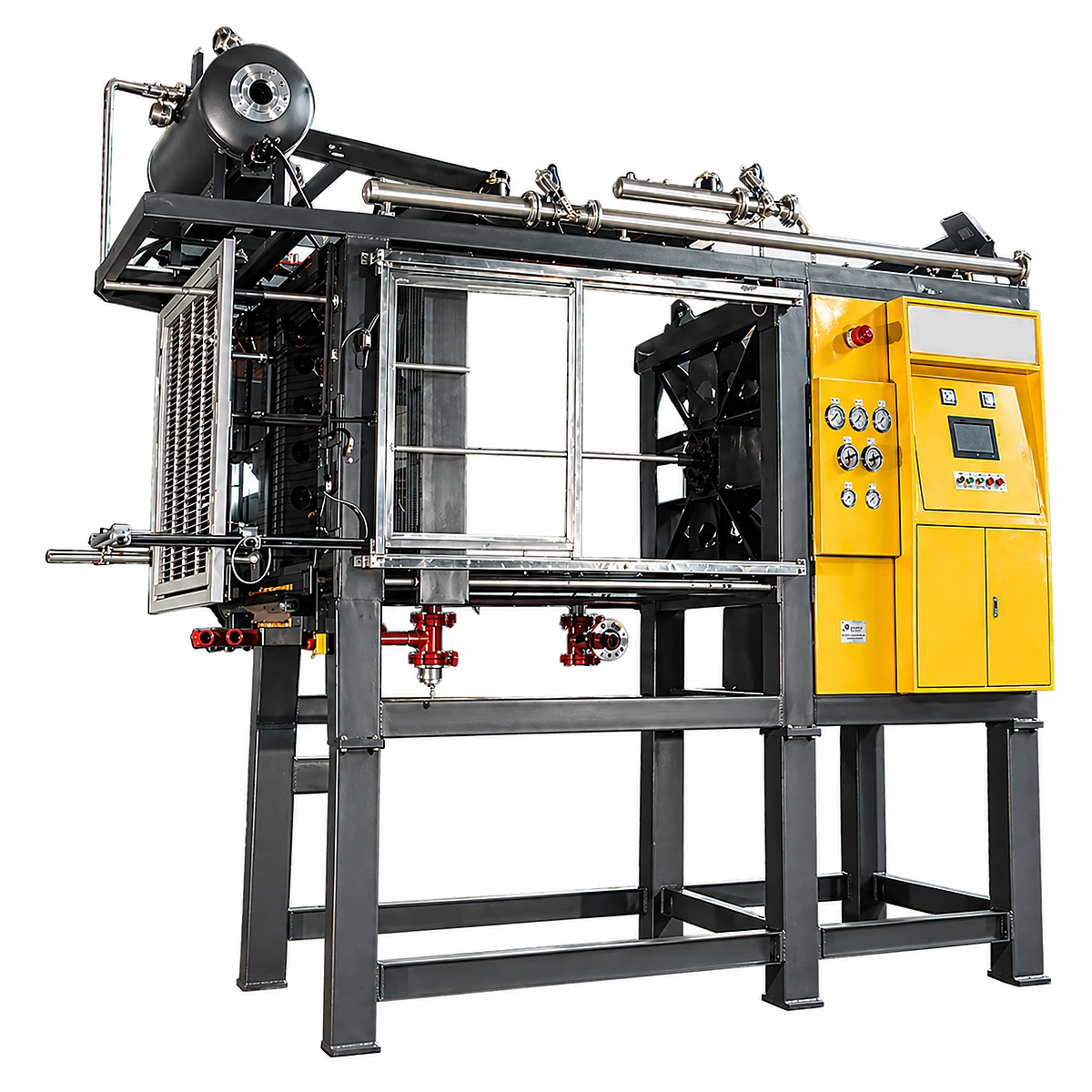
Machine spec sheets list an empty-test cycle time — how fast the platen can close, steam, cool and open with no product inside. On our SM-1200 shape molding machine, that number is 30–45 seconds. But the moment a mold cavity is filled with beads, the cycle time becomes a function of how much mass has to be heated through to full fusion and then cooled back down — and that number ranges from 60–90 seconds for a fish box to 120–150 seconds for a thick-section automotive part on the identical machine.
Buyers who size a production line off the empty-test number consistently overestimate output by 2–3x. The variables below are what actually sets the number you will live with on the shop floor.
2. The output formula: what a cycle-time number actually means for your shift
Cycle time only matters in the context of output per shift. The formula is straightforward:
Parts per shift = (3,600 ÷ cycle time in seconds) × shift hours × OEE
OEE (overall equipment effectiveness) accounts for mold changes, minor stops and startup — a realistic working figure is 75–85% for an experienced crew. Applied to two real product types on the same SM-1200:
| Product type | Cycle time | Parts/hour (80% OEE) | Parts per 8-hr shift |
|---|---|---|---|
| Fish box (14–25 kg/m³) | 60–90 sec | 32–48 | 256–384 |
| Thick-section automotive (30–50 kg/m³) | 120–150 sec | 19–24 | 152–192 |
Notice the fish box line produces roughly double the parts per shift of the automotive line on the exact same machine — the gap is entirely the product, not the equipment.
3. Wall thickness and product mass are the single biggest driver
Steam has to penetrate the full cross-section of the part to fuse the beads, and then that same mass has to shed heat during cooling before it can be ejected without deforming. A thin-wall fish box (10–15mm wall) fuses and cools fast because heat travels a short distance in both directions. A thick-section part like a bumper insert or ICF block (40mm+ in places) has to move heat through several times that distance, and heat transfer through EPS foam does not scale linearly with thickness — it gets disproportionately slower as wall thickness increases. This is why the SM-1200's own spec range spans 60–150 seconds depending on part geometry alone, with no other variable changed.
4. Density: higher density means more mass to heat and cool
Density and wall thickness compound each other. A 15 kg/m³ fish box has less material mass per cubic centimeter than a 45 kg/m³ automotive part of the same wall thickness, so the lighter part both fuses and cools faster. Buyers quoting a target density without also specifying wall thickness will get a cycle-time estimate that is only half-informed — the two variables need to be given together for an accurate quote.
5. Cooling method: vacuum vs. water-only sets 30–50% of the total cycle
Cooling is consistently the longest single stage in a shape molding cycle, the same as it is in block molding. Vacuum cooling pulls a partial vacuum inside the sealed mold chamber after fusion, which flash-evaporates residual moisture in the part and pulls heat from the interior directly rather than working in from the surface — our vacuum vs. water cooling comparison covers the physics of this in block molding, and the same mechanism applies to shape molding. The SM-1200 uses vacuum + water spray as standard specifically because water-only cooling on a shape mold, with its more complex geometry and uneven wall sections, runs 30–40% longer per cycle than vacuum-assisted cooling on the same part.
6. Steam pressure regulation and multi-zone control
An open-loop steam system either over-steams (wasting cycle time and fuel) or under-steams (leaving weak fusion that shows up as rejects later). The SM-1200's closed-loop PLC holds mold chamber pressure at 0.08–0.12 MPa, which lets the controller cut steam the moment fusion is reached rather than running a fixed timer with margin built in. On asymmetric molds — a helmet liner or an automotive part with one thick section and one thin section — independent multi-zone steam control lets each zone reach fusion on its own schedule instead of the whole cycle running as long as the slowest zone needs, which is a meaningful cycle-time difference on geometrically uneven parts.
7. Mold change time: the output cost buyers forget to ask about
Cycle time measures one part; mold change time determines how many different parts you can actually run per week. A quick-insert mold swap, using a standardized clamp interface for the same product format, takes about 45 minutes on the SM-1200. Switching to a genuinely different format — different steam manifold routing, different platen insert — takes 4–6 hours. A factory running 8–10 SKUs needs to size mold-change time into its output plan the same way it sizes cycle time, because a machine that changes molds slowly loses more weekly output to changeovers than it gains from a marginally faster per-part cycle.
| Mold change type | Time | When it applies |
|---|---|---|
| Quick-insert swap | ~45 minutes | Same format, standardized clamp interface |
| Full platen + manifold reconfigure | 4–6 hours | Different format / steam routing changes |
8. What to send us so we can quote a real cycle time, not a spec-sheet number
With these five details we can give you an accurate cycle time and shift-output estimate in one reply, instead of the generic 30–45 second machine spec:
- Product wall thickness (thinnest and thickest sections)
- Target density (kg/m³)
- Product weight and approximate outer dimensions
- Number of different SKUs/molds you plan to run and how often you'll switch between them
- Target output (parts per shift or per day)
If you already own an SM-1200 or similar shape molding machine and want to shorten a cycle time that is running longer than it should, that is a different question — see our cycle time optimization guide for a stage-by-stage bottleneck diagnosis on an existing line.
Frequently Asked Questions
What is a normal EPS shape molding cycle time?
On the SM-1200, cycle time runs 60–90 seconds for lighter products like fish boxes and packaging (14–25 kg/m³), and 120–150 seconds for thick-section, higher-density parts like automotive components (30–50 kg/m³). The empty-machine test cycle of 30–45 seconds is not what you will see in production.
Why does the same machine have such different cycle times for different products?
Wall thickness and density set how much material mass has to be heated to fusion temperature and then cooled back down before ejection. A thin-wall, low-density fish box moves through that heat cycle far faster than a thick-section, high-density automotive part — the machine's control system is the same, but the physics of heat transfer through the part is not.
Does vacuum cooling meaningfully change shape molding cycle time?
Yes — vacuum-assisted cooling typically runs 30–40% faster than water-only cooling on shape-molded parts, because it pulls heat from the part's interior through flash evaporation rather than only cooling from the surface inward. This is why vacuum + water spray is standard on the SM-1200 rather than an upgrade option.
How much does mold change time affect weekly output?
A same-format quick-insert swap takes about 45 minutes; switching to a genuinely different product format with different steam manifold routing takes 4–6 hours. A factory running many SKUs with frequent format changes can lose more weekly output to changeovers than it gains from a faster per-part cycle, so mold change time needs to be sized alongside cycle time, not ignored.
Can I estimate my output before buying a machine?
Yes, using parts per shift = (3,600 ÷ cycle time in seconds) × shift hours × OEE, with OEE realistically set at 75–85% to account for mold changes and minor stops. Send us wall thickness, density, and part dimensions and we will return a specific cycle-time estimate rather than a generic range.
Is a faster-rated machine always better if my parts are thick-section?
Not necessarily. If your product mix is dominated by thick-section, higher-density parts, the empty-machine cycle-time rating has limited bearing on your real output — cooling capacity and steam zone control matter more than the platen's raw speed. Two machines with identical spec-sheet cycle times can produce meaningfully different real-world output on the same thick-section part depending on their cooling system.
My current machine's cycle time is longer than the spec sheet promised — what should I check first?
That is a troubleshooting question rather than a buying one — steam distribution, vacuum system condition, and condensate buildup are the most common causes of cycle time drifting above spec on an existing machine. Our cycle time optimization guide walks through the bottleneck diagnosis stage by stage.
Send us your product specs and we'll return a real cycle-time estimate
Use the contact form to send wall thickness, target density, part dimensions and SKU count. We'll reply with an expected cycle time, shift output estimate, and mold-change-time impact for your specific product mix — not the generic spec-sheet number. The SM-1200 shape molding machine page has full specs, and the European Manufacturers of EPS (EUMEPS) publishes broader production guidance on EPS processing if you want a second source before you specify a line.