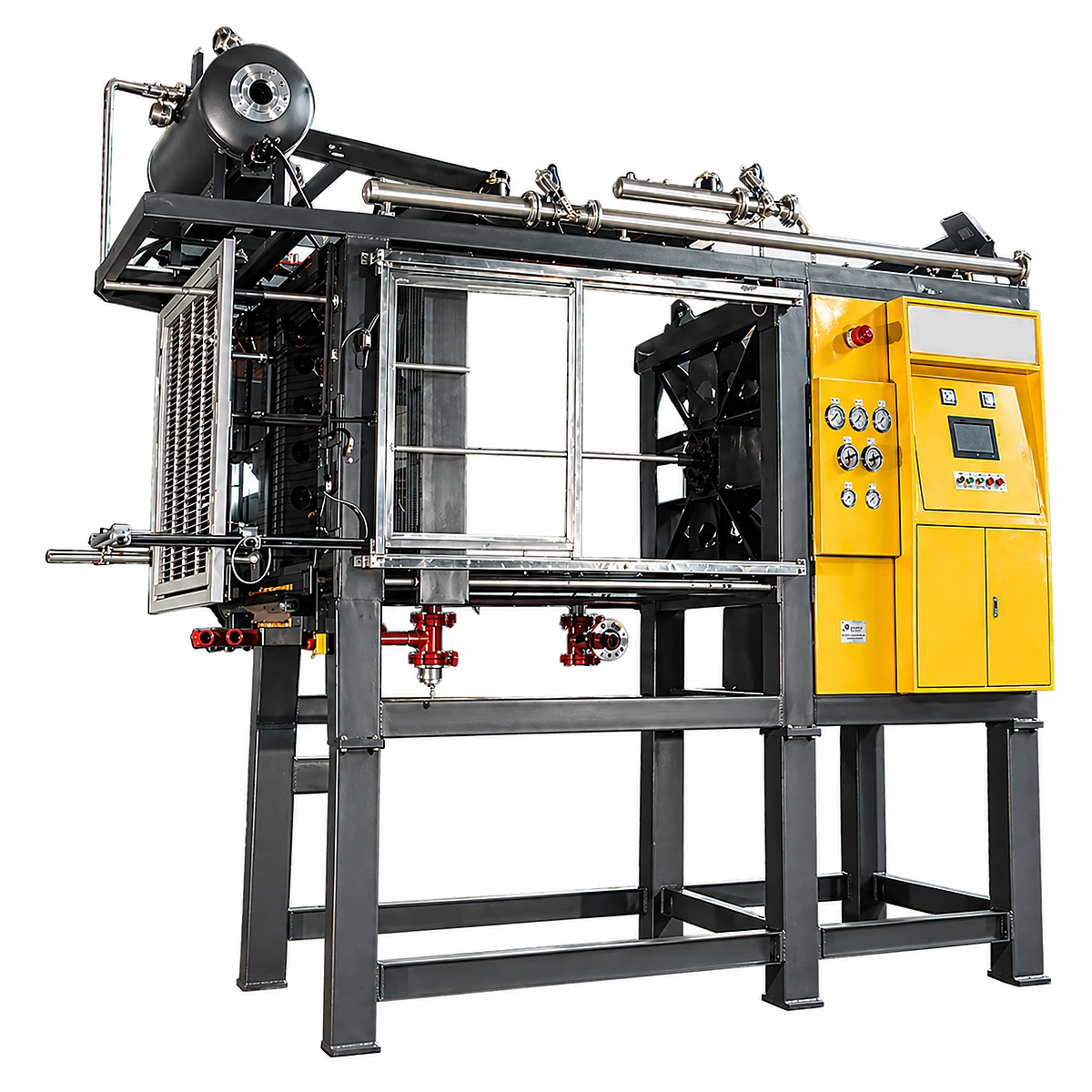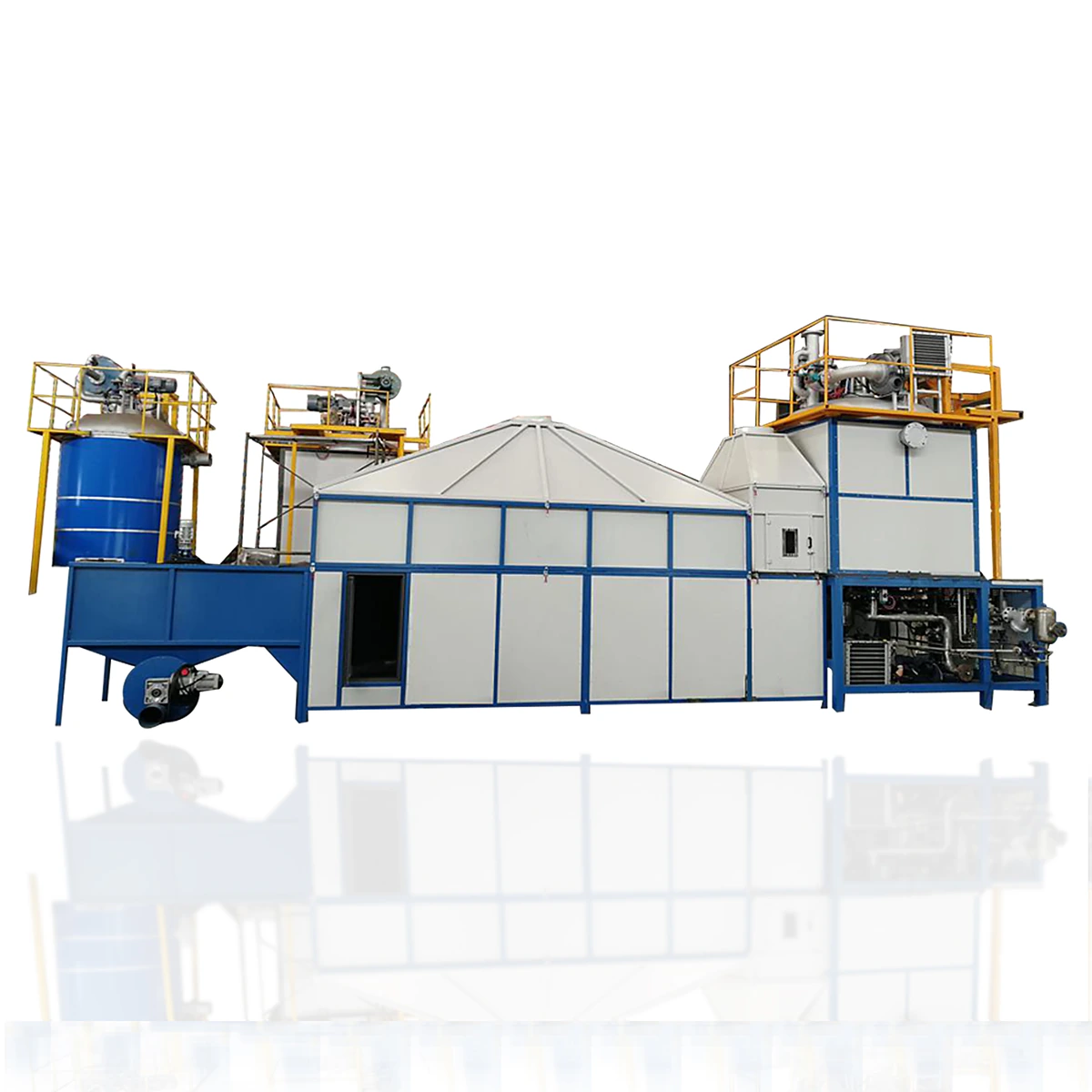

An EPS fish box production line costs $85,000–$220,000 depending on tier and automation level. Output range: 4,000–12,000 boxes per day at typical density 18–22 g/L. The line's core is an EPS shape molding machine (SM-1000 to SM-1400 class) fed by a pre-expander and aging silos. Payback is 12–20 months in India/Indonesia/Vietnam seafood-export markets where box demand tracks fishing-season peaks (April–October and November–February for different species). Box format decides the market before equipment does: India buys 20 and 40 L, Indonesia 40 and 60 L, Vietnam 40 L, Latin America 60 and 100 L. B2B factory buyers only — MOQ 1 line, $85K+ CapEx. For the subsystem breakdown, utility sizing and container loading of a complete EPS fish box production line, use the configuration page; pair it with our EPS shape molding machine buyer's guide for the core equipment specs and how to set up an EPS factory for full factory planning.
1. Why the EPS Fish Box Market Is Growing in 2026
Global seafood exports crossed $180 billion in 2025 and are projected to reach $215 billion by 2028 per FAO Fisheries statistics. That growth translates directly into EPS fish box demand — every kilogram of iced-transport seafood ships in EPS packaging, and the industry has no cost-effective substitute at 22–35 g/L density and 0.036 W/(m·K) thermal conductivity per ASTM C578 specifications.
Three specific market forces are pulling new EPS fish box factory investment in 2026:
- India shrimp export scaling. India shrimp exports grew from $5.3B in 2020 to $8.1B in 2025, with Andhra Pradesh, Kerala, and Tamil Nadu clusters each demanding regional fish-box supply within 200 km truck radius of processing plants.
- Indonesia and Vietnam tuna/skipjack. Both markets have federal-level cold-chain modernization programs (2024–2028) that require standardized 40-liter and 60-liter EPS boxes for export-grade tuna. Local supply is thin — most boxes still imported from Thailand and China.
- Latin America salmon and tilapia. Ecuador, Chile, and Honduras export seafood require EPS boxes with specific density (20 g/L) and geometry (nesting for return shipping). Local EPS production is expanding to meet 15% CAGR demand.
ChinaEps factory note (60+ export markets): Of the EPS shape molding lines we ship annually, fish box lines are the second largest category (after ICF construction blocks). The pattern across India, Indonesia, and Vietnam is consistent — buyers arrive with a specific box specification from their seafood-processor customer, and they need the line up and running before the next fishing season. That gives us a 4–6 month timeline from contract to first commercial box, which is aggressive but achievable if the mold-plate design is locked at contract signing.
2. The 6-Stage Fish Box Production Process
An EPS fish box factory runs six stages, each requiring specific equipment sized for the target output. This is the standard flow regardless of tier:
Stage 1 — Raw Bead Selection
Fish box production uses standard EPS beads (not flame-retardant grade — food-adjacent packaging does not require B1/B2 classification in most markets). Bead grade: MFI 6–14 g/10 min, blowing agent pentane 5.5–6.5%. Typical purchase specifications: E-303 or E-401 grade at $1,500–$1,800/ton FOB Asia. See our EPS raw material grades guide for the full 5-grade selection matrix.
Stage 2 — Pre-Expansion (Batch, 95–105°C)
The pre-expander expands raw beads to the target density. For fish boxes at 18–22 g/L, pre-expansion runs at 100–103°C for 90–120 seconds. Output bead density is what drives box weight and insulation performance — density variance beyond ±0.5 kg/m³ produces boxes that fail regulatory weight limits or thermal-hold tests.
Stage 3 — Aging (8–24 hours in mesh silos)
Pre-expanded beads must age to equilibrate residual pentane with atmospheric air. Fish-box-grade beads age 8–14 hours minimum before molding. Aging silos: 5–15 m³ capacity, mesh fabric or perforated steel walls. Skipping aging causes the single most common fish-box defect — post-molding shrinkage that fails dimensional tolerance for stacking.
Stage 4 — Shape Molding (Steam-Chest, 0.8–1.2 bar)
Aged beads are pneumatically fed into an EPS-specific mold cavity. Steam at 0.8–1.2 bar (110–120°C) fuses the beads into a solid box. Cycle time for a standard 40-liter fish box: 60–90 seconds. Cycle time is the primary throughput driver — shorter cycles produce more boxes per day but risk incomplete fusion at the box corners. See our EPS fish box molding machine guide for platen sizing and cycle-time by machine class.
Stage 5 — Cooling and Ejection (30–60 seconds)
Post-molding cooling via vacuum-assist or water spray. Vacuum cooling is faster (30–40 seconds) and preferred for high-throughput lines. Water-spray cooling is cheaper equipment but 20–30% longer cycle. Ejected boxes are stacked on pallets for downstream processing.
Stage 6 — Post-Processing (Optional: Printing, Assembly, Wrapping)
Many fish box lines add a post-processing station for buyer branding (silk-screen printing of processor logo), assembly (attaching lids), or automatic wrapping for palletized shipping. This adds $8K–$25K to line capex but often justified by 15–25% price premium over unbranded boxes.
Illustrative Calculation — Not a Universal Guarantee
The prices, payback periods, and ROI numbers below use assumed inputs for raw-material cost, electricity, steam, labor, tariffs, sale price, and factory utilization. Actual results vary significantly by country and site. Send your local cost inputs to info@chinaeps.net for a country-specific model.
3. Equipment Cost by Tier
Fish box lines split into three tiers based on daily output capacity:
| Tier | Output (boxes/day) | CapEx (FOB China) | Configuration |
|---|---|---|---|
| Entry | 4,000–6,000 | $85K–$120K | SM-1000 shape molder + PE-900 pre-expander + 2 aging silos + basic cutting |
| Mid | 6,000–9,000 | $120K–$170K | SM-1200 shape molder + PE-1400 pre-expander + 3 silos + vacuum cooling + printing station |
| Industrial | 9,000–12,000+ | $170K–$220K+ | SM-1400 shape molder + PE-1400/1800 pre-expander + 4+ silos + full automation + printing + wrapping |
Add 15–25% for landed cost (shipping + import duty + commissioning) — see our EPS factory line price by country guide for detailed landed cost math per destination market.
4. 5 Box Specifications That Determine Your Target Market
Not all fish boxes are the same. Getting these five specifications right at mold-design stage saves 6–12 months of re-tooling later:
| Spec | Range | Market Preference |
|---|---|---|
| Volume (liters) | 10 / 20 / 40 / 60 / 100 | India: 20 & 40 · Indonesia: 40 & 60 · Vietnam: 40 · Latam: 60 & 100 |
| Density (g/L) | 18–22 (standard), 25–30 (heavy-duty) | Standard 20 for fresh fish · Heavy-duty for frozen tuna long-haul |
| Wall thickness (mm) | 30 / 40 / 50 | 30 mm for short-haul · 40 mm for standard · 50 mm for 5+ day cold chain |
| Nesting geometry | Flat lid vs. locking lid · Stackable vs. non-stackable | Stackable + locking lid for return-shipping economics |
| Ice-drain design | Solid bottom vs. perforated + drain plug | Perforated required by EU import rules · Solid acceptable for Asia |
Sample box test in your target market before finalizing mold design. Buyer specifications are more geographically specific than most new-factory owners expect.
5. Payback Math · India Case
Representative Mid-tier line in Andhra Pradesh, India, producing 40-liter fish boxes at 20 g/L density:
| Line Item | Value |
|---|---|
| CapEx (Mid-tier, landed India) | $195,000 |
| Daily production (Mid-tier @ 80% utilization) | 6,400 boxes/day |
| Working days per year | 310 |
| Annual production | 1,984,000 boxes |
| Cost per box (raw materials + energy + labor) | $0.28 |
| Sell price per box (India seafood processor) | $0.58 |
| Gross margin per box | $0.30 (52%) |
| Annual gross profit | $595,200 |
| Payback period | 4 months on gross profit basis, 12–14 months net after operating overhead |
Payback is unusually fast for fish-box lines because raw material cost is a small fraction of end-user price. Compare this to the ROI calculation for general EPS block molding where payback is typically 14–22 months.
6. 5-Point China Sourcing Checklist for Fish Box Lines
When sourcing a fish-box-specific line from China, verify these five items in addition to standard equipment checks:
- Mold-plate references. Ask for photos/videos of the specific box geometry molds the supplier has produced. Fish box molds are more geometrically complex than standard packaging (nesting features, ice-drain features, stacking lugs) — supplier experience with fish-box-specific molds matters.
- Density-consistency data. Request density-variance reports from previous fish box lines. ±0.5 kg/m³ target. Higher variance means your seafood-processor customer will reject batches for failing regulatory weight limits.
- Cycle-time guarantee at your box spec. Get a written commitment on cycle time (in seconds) for your specific box volume and wall thickness. This determines your daily throughput and directly affects payback math.
- Post-processing integration. If you need printing / wrapping stations, confirm they are integrated with the molder controls (single-PLC operation). Non-integrated stations add 15–25% operating labor.
- After-sales technician dispatch for your region. Insist on 72-hour on-site dispatch commitment in writing. Fish-box customers (seafood processors) have short order windows and cannot accept extended line downtime.
For broader Chinese-supplier verification, see our EPS machine buying guide. The ISO 9001 quality management compliance is table stakes — the fish-box-specific items above sit on top.
7. Regulatory and Certification Requirements by Market
| Market | EPS Fish Box Regulations |
|---|---|
| EU | Direct food-contact restrictions (EPS not directly food-contact for oily fish); box must be washable-recyclable design; perforated drain required |
| USA/Canada | FDA-compliant EPS for indirect food contact (most bead grades qualify); recycling documentation increasingly requested |
| India | BIS quality certification for export-grade packaging; Plastic Waste Management Rules 2016 amendments require producer registration |
| Indonesia | SNI certification for domestic sale; export boxes typically follow buyer-country regulations |
| Nigeria | 2027 EPS ban (single-use packaging) — impacts consumer boxes but industrial fish boxes to processors may qualify for exception; verify with SON |
8. Frequently Asked Questions
What is the minimum investment for an EPS fish box factory?
Entry-tier line at $85K CapEx (FOB China) plus 15–25% for landed cost = $100K–$110K total. Factor another $25K–$40K for working capital, mold-plate design, and first-year operating cushion. Realistic total minimum: $125K–$150K for a functional fish-box factory.
How many fish boxes can I produce per day?
Entry-tier line 4,000–6,000 boxes/day. Mid-tier 6,000–9,000. Industrial 9,000–12,000+. Actual output runs 70–85% of nameplate depending on operational maturity, mold-change frequency, and box specifications (larger boxes = longer cycle = fewer boxes).
What is the price of a fish box mold in China?
Standard 40-liter fish box mold: $8,000–$18,000 depending on complexity (stacking lugs, ice-drain features). Custom-branding mold (processor logo embossed): +$2,000–$5,000. Mold lifespan: 3–8 years or 500,000–1,500,000 cycles depending on wall thickness and cooling design.
What density should EPS fish boxes be?
18–22 g/L for standard fresh-fish boxes (short-haul, 24–48 hour cold chain). 25–30 g/L for heavy-duty frozen tuna or long-haul export (5+ day cold chain). Density directly affects both insulation performance and cost per box.
Can I use one shape molding machine for both fish boxes and other products?
Yes — shape molders are mold-agnostic. A single SM-1200 can produce fish boxes, cooler boxes, helmets, ICF blocks by swapping molds. Mold change takes 2–6 hours. This makes shape molders more versatile investments than block molders for entry-tier factories.
What is the difference between EPS and EPP fish boxes?
EPS fish boxes: $0.28–$0.35 cost, 18–22 g/L, single-use or 3–5 return-shipping cycles. EPP fish boxes: $0.85–$1.20 cost, 25–35 g/L, 50+ return-shipping cycles. EPS wins on single-use economics. EPP wins on multi-use logistics (return shipping loops). See our EPS vs EPP comparison for the full material selection framework.
How do I get seafood processors as customers?
Direct sales to processing plants — visit local seafood clusters (Andhra Pradesh Marine Products, Kerala Seafood Exporters, Jakarta Tuna Processors). Trade shows: Seafood Expo Global (Barcelona), Seafood Expo Asia (Singapore), India International Seafood Show. Build initial 3–5 customer references before scaling capacity.
What is the shelf life of unused EPS fish boxes?
Indefinite in sealed storage. Fish boxes do not degrade with time in dry warehouse conditions. Inventory management focus is space efficiency (nesting design) rather than shelf-life management.
Can I recycle used fish boxes?
Yes — many seafood processors return used boxes to producers for cleaning and reuse (3–5 cycles typical). End-of-life boxes are recyclable via densification (see our EPS recycling cost per ton guide). Recycled content boxes are technically feasible but food-contact regulations restrict use in some markets.
Which countries have the fastest-growing fish box demand?
Top three growth markets 2026–2030: (1) India (shrimp export scaling), (2) Indonesia (tuna cold-chain modernization), (3) Ecuador/Peru (salmon and tilapia). Second tier: Vietnam, Thailand (mature markets but replacement demand), Nigeria (subject to 2027 EPS ban resolution).
Related Reading
- EPS Foam Box Molding Machine: Specs by Box Size — How to spec an EPS fish box molding machine: platen, density and cavity count by box format.
- EPS vs EPP: Key Differences and Applications — Material selection for single-use vs multi-use fish boxes.
- EPS Raw Material Grades Guide — Bead selection for fish box density targets.
- How to Set Up an EPS Factory — Full factory planning framework.
- EPS Machine ROI Calculation Guide — ROI methodology adapting to fish box economics.