TL;DR: An EPS geofoam block production line is not a packaging block line with a different label on it. Geofoam is sold on two numbers a packaging buyer never checks — as-moulded density and dimensional tolerance on a block that can run 2,000–6,000 mm long — and those two numbers decide which pre-expander, which moulder and which cutting line you can actually use. What changes at each of the six production stages, the machine specifications that matter, how to size steam, and the nine questions to put to a supplier before you sign — below, written for factory owners and civil-supply contractors specifying a line, not for the engineer specifying the fill.
1. What an EPS Geofoam Block Production Line Is
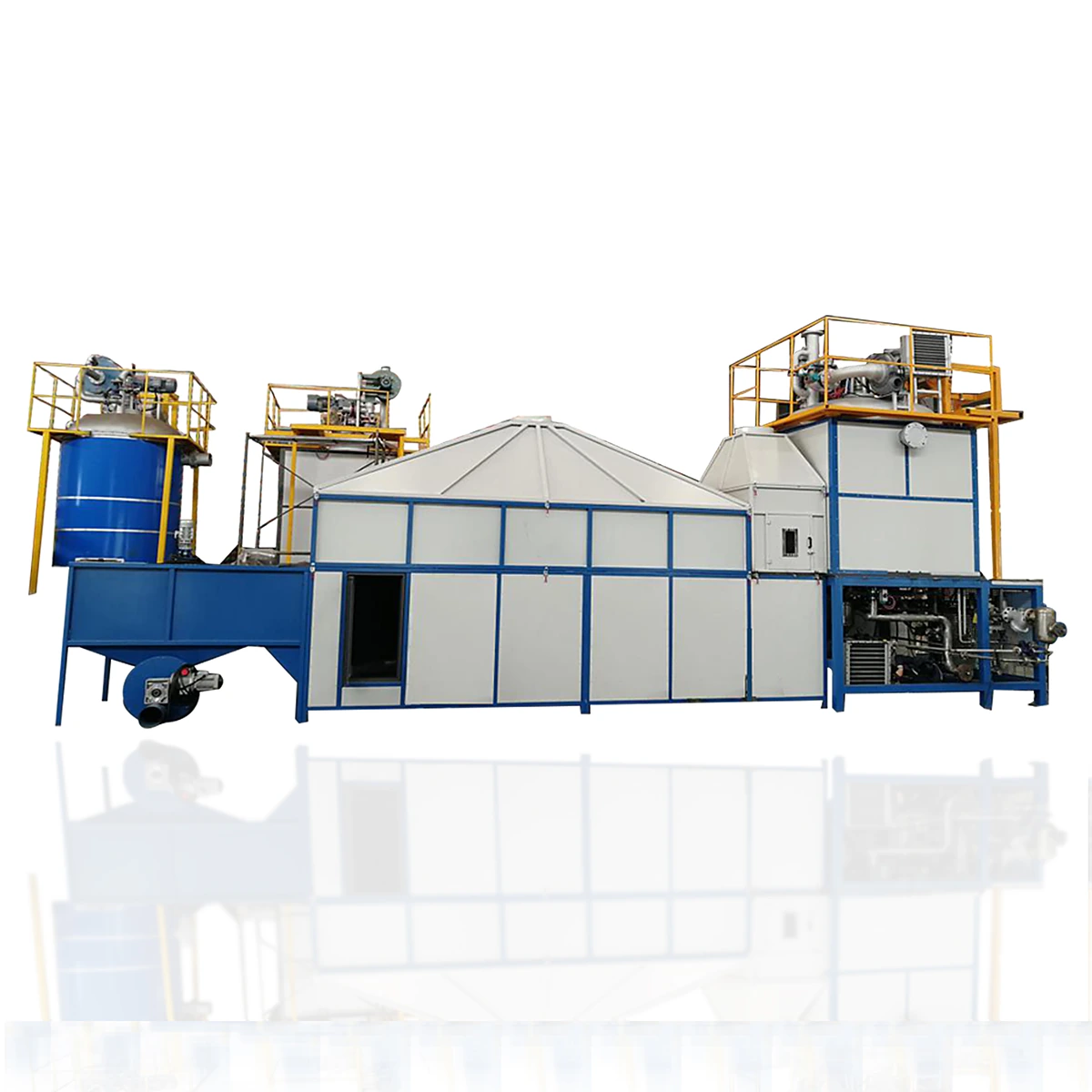
An EPS geofoam block production line is a plant that converts raw expandable polystyrene beads into large, high-density foam blocks used as lightweight structural fill in civil engineering — road embankments over soft ground, bridge approach fills, retaining-wall backfill, slope stabilisation, and void fill under slabs and plazas. Three machines do the work: a pre-expander that sets bead density, a block moulder that fuses the beads into a block, and a hot-wire cutting line that trims the block to the dimensions on the drawing. Aging silos sit between stages one and two.
Physically, that is the same equipment family that produces insulation board or packaging blocks. Commercially, it is a different product, because of who buys it. A packaging buyer inspects the finished box. A geofoam buyer is a contractor working to a geotechnical specification, and what they inspect is a certificate: this block is grade X, at this minimum density, cut to this tolerance. If the paperwork does not hold, the delivery goes back regardless of how good the foam looks.
That single difference — certificate rather than appearance — is what drives every equipment decision below.
2. The Mistake That Kills Most Geofoam Quotes
The commonest failure we see is a buyer who asks for "an EPS block line" and receives a perfectly good quote — for a packaging or insulation-board line. It arrives cheaper than the competition, gets signed, and eighteen months later cannot serve the geofoam contract it was bought for.
You can see why from published machine ranges, including our own. Look at the density ceilings:
| Machine | Published density range | Where it stops being enough for geofoam |
|---|---|---|
| PE-1400 batch pre-expander | 8–30 kg/m³ | Covers the low and mid geofoam grades. The heaviest grades sit above this ceiling and need a pre-expander specified for them. |
| BM-1200 horizontal moulder | 8–30 kg/m³, block 1,200 × 600 × 300 mm | Density is workable, block size is not — see section 4. |
| SPB-LZ vertical moulder | 4–35 kg/m³, block 2,000–6,000 mm long | The geofoam-capable moulder in our range on both counts. |
| SPB-Q multi-wire cutting line | 12–45 kg/m³, block 2,000–6,000 mm | Cuts the full grade range, including flame-retardant modified EPS. |
Read that table as a chain, because that is how it behaves. The line's real density ceiling is the lowest ceiling in the chain, not the highest number on the brochure. A quote that pairs a 45 kg/m³ cutting line with a 30 kg/m³ pre-expander is a 30 kg/m³ line. Suppliers are not usually hiding this — they are quoting each machine honestly against its own datasheet, and nobody in the loop is asked to check the chain end to end. That is your job at quotation stage, and it takes ten minutes.
Factory note. When an enquiry says "geofoam" we ask two questions before quoting anything: which grade designations does your contract name, and what is the longest block on the drawing. Those two answers eliminate most of our catalogue immediately, and the quote that comes back is usually more expensive than what the buyer expected. We would rather have that conversation before the contract than after the first rejected delivery.
3. Density Is the Number Your Line Is Judged On
Geofoam grades are defined by density, and density is what the specifying engineer designs against — the fill's compressive resistance, and therefore how much load the embankment can carry without creeping, follows from it. In North America the governing product specification is ASTM D6817 for rigid cellular polystyrene geofoam, which designates types by nominal density; the underlying test methods are the familiar ones, ISO 845 for apparent density and ASTM D1621 for compressive properties of rigid cellular plastics. European projects generally work from EN 14933 for thermal insulation and lightweight fill products, with ASTM C578 appearing in mixed-code markets. Trade bodies on both sides — the EPS Industry Alliance in the US and EUMEPS in Europe — publish the application guidance your customers' engineers will be reading.
Pull the exact edition of whichever standard your contract names and read the type table yourself before you set a moulding recipe. Grade designations and minimum densities are revised between editions, and a production recipe built on a remembered number is a recipe for a rejected batch. We are deliberately not reprinting the type table here; what we can tell you is what the machine side has to deliver.
What the density requirement means for your equipment
Geofoam is specified on minimum density, which changes how you run the line. In packaging you chase the lowest density that survives shipping, because beads are the dominant cost. In geofoam, running under nominal fails the certificate, so producers deliberately aim above nominal — and every kilogram of overshoot is margin burned on raw material. The tighter your pre-expander holds density, the smaller the safety margin you have to buy.
Our PE-1400 holds ±0.5 kg/m³ batch to batch with a ±50 g electronic weighing system and closed-loop steam regulation at 0.18–0.23 MPa; the block moulder adds its own variance, ±0.8 kg/m³ per block on the BM-1400 class. Those two numbers stack. Budget for the stack, not for one of them, when you decide how far above nominal to aim. Our pre-expander selection guide covers the density-control mechanics in detail, and the raw material grades guide covers which bead grade to buy for the high-density end.
4. Block Geometry: Where the Standard Block Moulder Runs Out
Geofoam is placed like masonry. Blocks are stacked in courses, staggered, and trimmed on site to fit the embankment geometry, so contractors want large blocks — fewer joints, fewer lifts, faster placement. Typical civil-project block lengths run to several metres.
A conventional horizontal packaging moulder does not produce that. Our BM-1200 moulds a 1,200 × 600 × 300 mm block; the BM-1400 class moulds 1,400 × 800 × 400 mm, up to 600 mm high with the deep cavity insert. Good blocks, wrong shape for this trade.
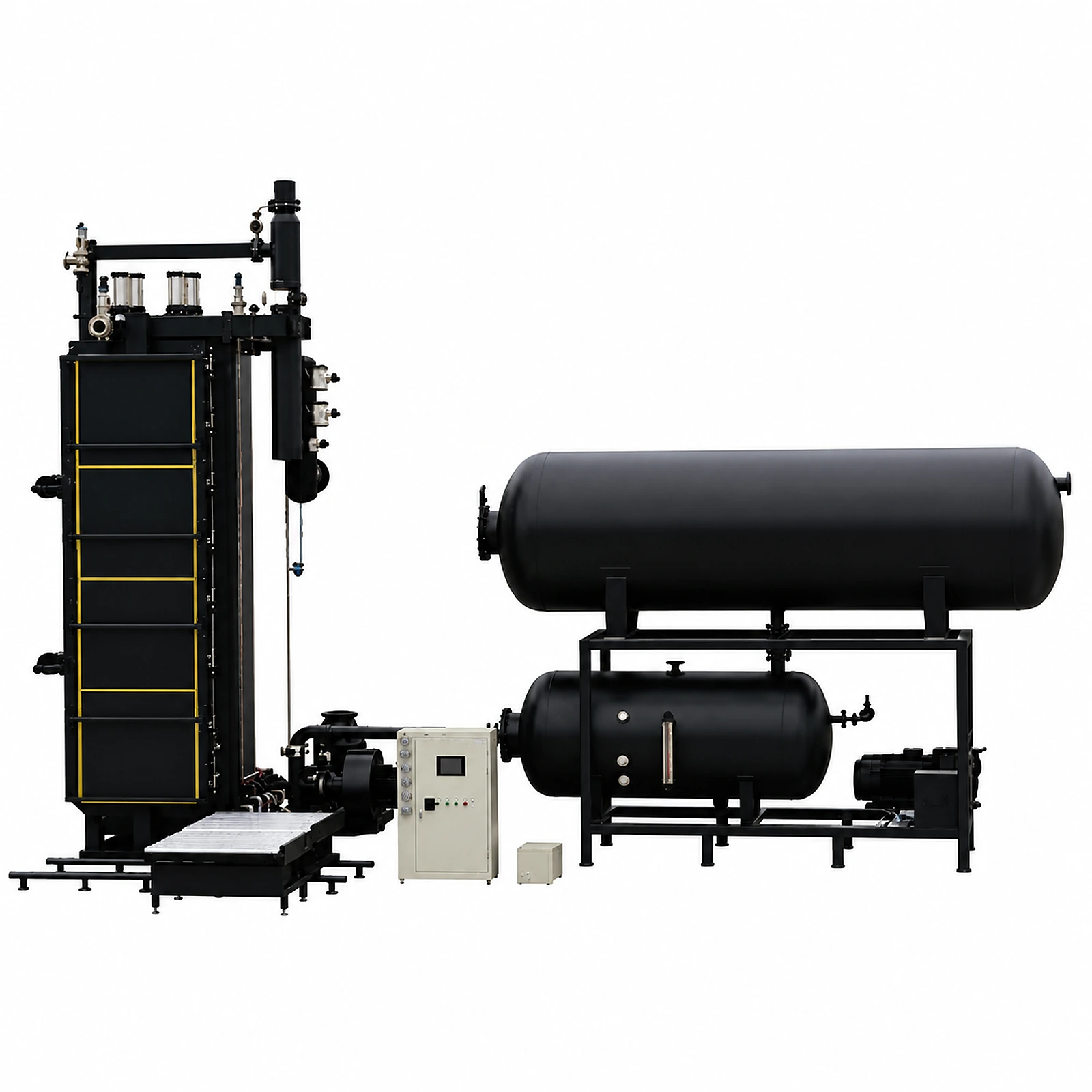
The machine that fits is a large-format moulder. The SPB-LZ vertical block moulder produces blocks 600–1,200 mm wide, 1,200 mm deep, and 2,000–6,000 mm long, at 4–30 blocks per hour depending on density, and takes 30–40% less floor area than the equivalent horizontal machine because the block stands on end. Downstream, the SPB-Q multi-wire cutting line is built for that envelope: block length 2,000–6,000 mm, width 1,000–1,260 mm, height 500–1,260 mm.
Cut tolerance is a contract term, not a nice-to-have
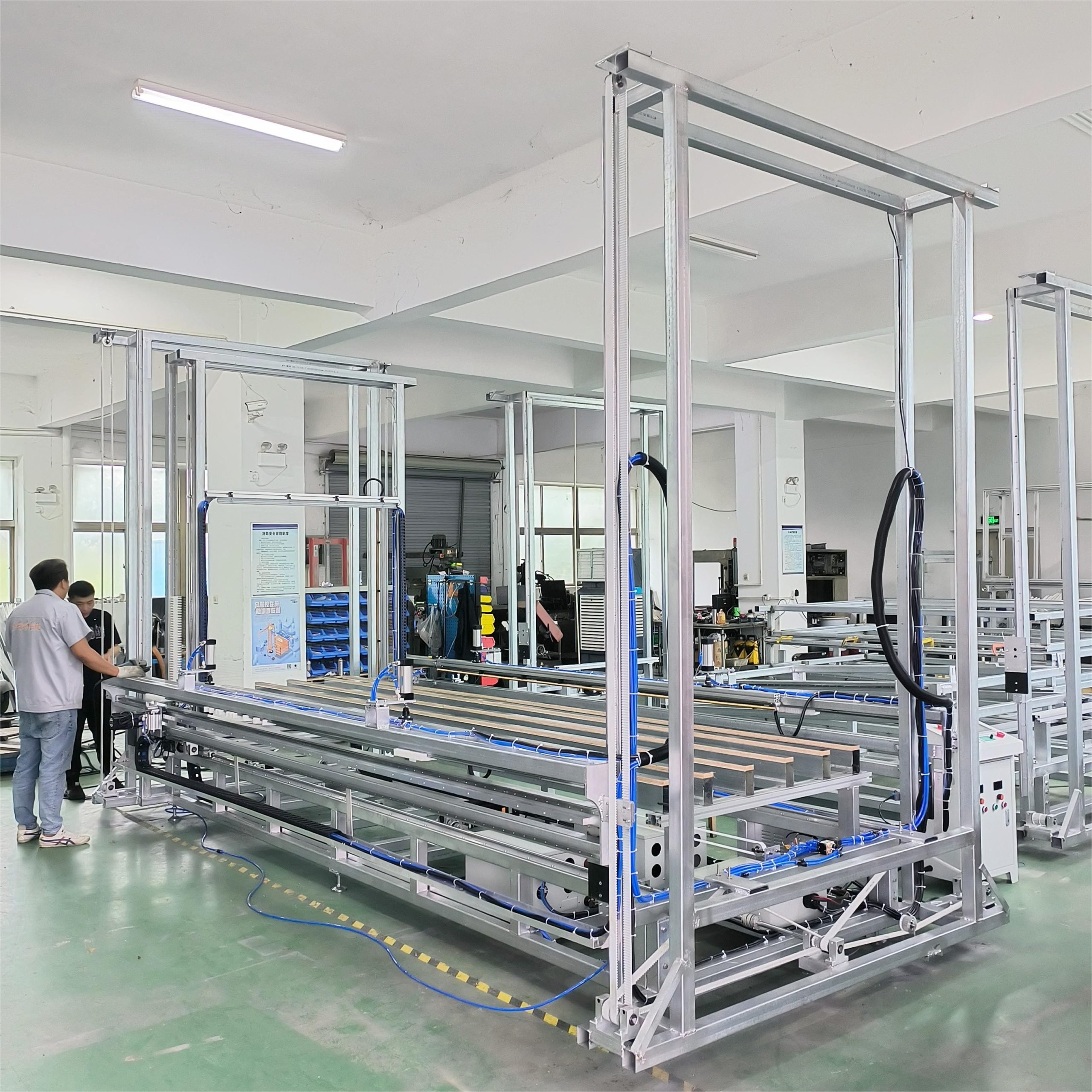
Stacked geofoam only behaves as designed if the courses bear evenly. A block that is out of square loads its neighbours through the high corner, and inspectors reject on it. The SPB-Q holds ±0.3 mm thickness tolerance via an A-type oscillation cutting frame, keeps that tolerance on dense flame-retardant material with 32 kW of wire heating and 0.7 mm nichrome wire, and positions 60 wires automatically in 2–4 minutes. Cutting speed is 1–1.5 m/min on 30 kg/m³ foam — slower than on packaging-density foam, which is a throughput fact worth putting into your capacity model early. Three-direction scrap recovery keeps 95–98% of offcut, which on high-density foam is real money. The EPS cutting machine guide compares the cutting-line families in full.
5. The Six Stages, and What Changes at Each One
| Stage | Standard block line | What geofoam changes |
|---|---|---|
| 1. Bead selection | Standard or fast-cycling grade chosen on cost | High-density-capable grade; flame-retardant grade where the project or national code calls for it |
| 2. Pre-expansion | Density chased downward for material cost | Density held above a specified minimum; variance is the metric that matters, not throughput |
| 3. Aging | 8–24 h in mesh silos | Toward the long end — higher-density beads need longer to equilibrate residual pentane. Short-aged high-density blocks shrink after moulding and go out of tolerance |
| 4. Block moulding | 1,200–1,400 mm packaging block | 2,000–6,000 mm large-format block; longer cycle, higher steam demand per block |
| 5. Cutting | Trim to sheet or board size | Cut to drawing dimensions at contract tolerance, with dimensional QA logged per block |
| 6. QA and documentation | Visual and dimensional spot check | Density and dimension recorded per block or per batch, retained as the delivery certificate |
Stage 6 is the one that surprises people. On a packaging line, QA is something you do. On a geofoam line, QA is part of the product — you are selling a documented block, and the documentation has to be defensible months later when a section is being investigated. Specify the production-logging option on the moulder and cutting line at purchase; retrofitting it costs more and disrupts a running plant. Our EPS quality control and defects guide covers the defect modes to log against.
6. Utilities: Size the Boiler for the Heaviest Grade, Not the Average
Steam is the constraint that most often bites after commissioning, because boilers get sized against the grade the factory expects to run most of the time, and geofoam contracts arrive at the top of the range.
| Machine | Steam | Electrical |
|---|---|---|
| PE-1400 pre-expander | 0.18–0.23 MPa regulated; 80–100 kg per batch; 4–6 min cycle | 30 kW installed |
| SPB-LZ vertical moulder | 0.6–0.8 MPa supply; 6–25 kg steam per m³ of finished block | 23.5–34.5 kW, model-dependent |
| BM-1400 class horizontal moulder | 0.08–0.15 MPa at the chest; 35–55 kg per cycle | 25 kW installed |
| SPB-Q cutting line | — | 32 kW wire heating + 11 kW drive |
Note the spread on the vertical moulder: 6–25 kg of steam per cubic metre of finished block. The top of that range is roughly four times the bottom, and high-density geofoam sits at the top. Size against the top. Undersized boilers do not announce themselves by failing — they announce themselves by quietly stretching cycle times, which shows up as a capacity shortfall you cannot explain. Our steam and energy cost guide covers boiler sizing and recovery in detail.
Pentane handling deserves a line of its own. Pre-expansion and aging release pentane, and high-density production means more bead mass through the plant per block. Ventilation, ignition-source control and gas detection in the silo hall are engineering requirements, not paperwork — see the NIOSH pocket guide entry for pentane and your local industrial code, and read our aging silo system guide before laying out the building.
7. Cost: What We Can State, and What We Will Not
What we can state, because it is already published on this site:
- A BM-1400 class block moulder runs $80,000–$110,000 FOB China in 2026, driven by automation level, PLC brand and vacuum-cooling specification — full breakdown in the BM-1400 specs and price guide.
- Around that machine, sea freight for a 40HQ runs $3,500–$6,500, on-site installation and commissioning $5,000–$9,000, and a steam boiler $15,000–$35,000 where one is not already installed.
- Landed cost typically adds 15–25% over FOB, varying widely by destination duty regime — see the price-by-country guide.
- Our ROI calculation guide puts geofoam block revenue in a $35–$70 per m³ planning band with a 12–30 month payback range across markets.
What we will not state is a single headline price for "a geofoam line". A large-format vertical moulder, a 2–6 m cutting line and a pre-expander specified for the top of the density range are each a different machine from the packaging-line equivalent, and the configuration swing between a 600 mm-wide block at mid grade and a 1,200 mm-wide block at the heaviest grade is wider than any honest single number can carry. Any supplier quoting you a geofoam line price before asking which grade and which block length is quoting a packaging line.
The same applies to the revenue band above. Treat $35–$70/m³ as a planning input for a first-pass model, then replace it with quoted prices from your own market before committing capital. Geofoam pricing is project-tendered, and it moves.
8. Nine Questions Before You Sign
- What is the density ceiling of every machine in the chain? Ask per machine, in writing. The line's ceiling is the lowest one.
- What density variance is guaranteed, at the top of the range? Variance quoted at 18 kg/m³ does not carry over to 35 kg/m³.
- What is the maximum block length, and does the cutting line accept it? Moulder and cutting line envelopes must overlap, not merely both sound large.
- What dimensional tolerance is guaranteed on high-density foam? Wire sag increases with density; a tolerance measured on light foam is not the tolerance you will get.
- Is per-block production logging included? If your customers demand certificates, this is the certificate.
- What is the cycle time at the top grade, not the average grade? Build the capacity model on the slow case.
- What steam supply does the quoted configuration assume? Get the number in kg per m³ of finished block, at your grade.
- Is the cutting line specified for flame-retardant modified EPS? If any target market requires FR grade, this changes wire and heating specification.
- What CE or equivalent certification covers the exact models quoted? Certification is issued per model series. Ask which series, and check the quoted model is inside it.
For general supplier due diligence beyond geofoam specifics, the EPS machine buying guide and factory setup guide cover contract structure, inspection and commissioning.
9. What This Guide Does Not Cover
Three things, deliberately.
Geotechnical design. Fill depth, load cases, buoyancy under flood conditions, differential settlement at the transition to conventional fill — that is the specifying engineer's work, and getting it wrong is a structural problem, not a manufacturing one. We build the machines that make the block to the grade they specify.
Grade tables. As said in section 3: read the current edition of the standard your contract names. We are not going to be the reason someone moulds to a superseded number.
Your local market pricing. The band in section 7 is a planning input drawn from our own ROI guide, not a forecast for your market.
10. Frequently Asked Questions
What is an EPS geofoam block production line?
A plant that turns raw expandable polystyrene beads into large high-density foam blocks for civil engineering fill. Core equipment is a pre-expander, aging silos, a large-format block moulder producing blocks up to 6,000 mm long, and a multi-wire hot-wire cutting line that trims to drawing dimensions. What separates it from a packaging block line is the density range it must hold and the dimensional tolerance it must certify.
Can I make geofoam on an existing EPS block line?
Sometimes, at the lower grades, if your pre-expander and moulder both reach the required density and your customer accepts your block size. Check the density ceiling of every machine in the chain, not just the moulder. The block-size constraint is usually the harder one: a 1,200 or 1,400 mm packaging block is not what civil contractors want to place.
What density does geofoam need?
It depends on the grade the project specifies, and grades are defined by the standard named in the contract — ASTM D6817 in North America, EN 14933 in much of Europe. Read the current edition for the type table. On the machine side, plan for a line that reaches comfortably above the heaviest grade you intend to sell, because you will be aiming above nominal to protect the certificate.
How large are geofoam blocks?
Larger than packaging blocks, and set by the project drawing. Our vertical moulder covers 2,000–6,000 mm long by 600–1,200 mm wide by 1,200 mm deep, and the matching cutting line accepts 2,000–6,000 mm length, 1,000–1,260 mm width and 500–1,260 mm height. Confirm the drawing envelope before selecting either machine.
Why does cutting tolerance matter so much for geofoam?
Because blocks are stacked in courses and carry load through their bearing faces. An out-of-square block concentrates load on a corner instead of spreading it across the face, and inspectors reject on it. Our premium cutting line holds ±0.3 mm thickness tolerance, including on dense flame-retardant material.
Does geofoam need flame-retardant beads?
It depends on the project and the national code. Buried embankment fill and enclosed or near-structure applications are treated differently in different markets. Confirm with the specifying engineer, and if FR grade is in scope, specify a cutting line rated for FR-modified EPS at purchase — the wire and heating specification differs.
How much steam does a geofoam line use?
On our vertical moulder, 6–25 kg of steam per cubic metre of finished block, with high-density production at the top of that range. The pre-expander adds 80–100 kg per batch. Size the boiler against the heaviest grade you plan to run, not the average.
How long should high-density beads age before moulding?
Toward the long end of the normal 8–24 hour window. Higher-density beads hold more residual pentane and need longer to equilibrate; under-aged high-density blocks shrink after moulding and drift out of dimensional tolerance, which is exactly the failure a geofoam customer rejects on.
What does a geofoam production line cost?
We do not publish a single figure, because the configuration range is too wide to be honest about in one number. A BM-1400 class moulder alone is $80,000–$110,000 FOB China; large-format vertical moulding and a 2–6 m cutting line specified for the top of the density range are a different configuration. Send us the grade designations and the longest block on your drawing and we will configure against them.
Can the same line also produce insulation board or ICF blocks?
Yes, and most factories do — the density and block-size requirements for geofoam sit above those for board and ICF, so a line specified for geofoam covers the lighter work with a recipe and cavity change. The reverse is not true. See the insulation board line guide and the ICF block line guide for those configurations.
Related Reading
- EPS ICF Construction Blocks Production Line Guide — the other construction-market block line, with interlocking geometry instead of large format.
- EPS Insulation Board Production Line Guide — lighter grades, sheet output.
- How to Choose an EPS Pre-Expander — density control mechanics in detail.
- EPS Cutting Machine Guide — cutting-line families and tolerance.
- EPS Aging Silo System Guide — aging capacity and pentane handling.
- How to Set Up an EPS Factory — the full plant-planning pillar.